
Introduction
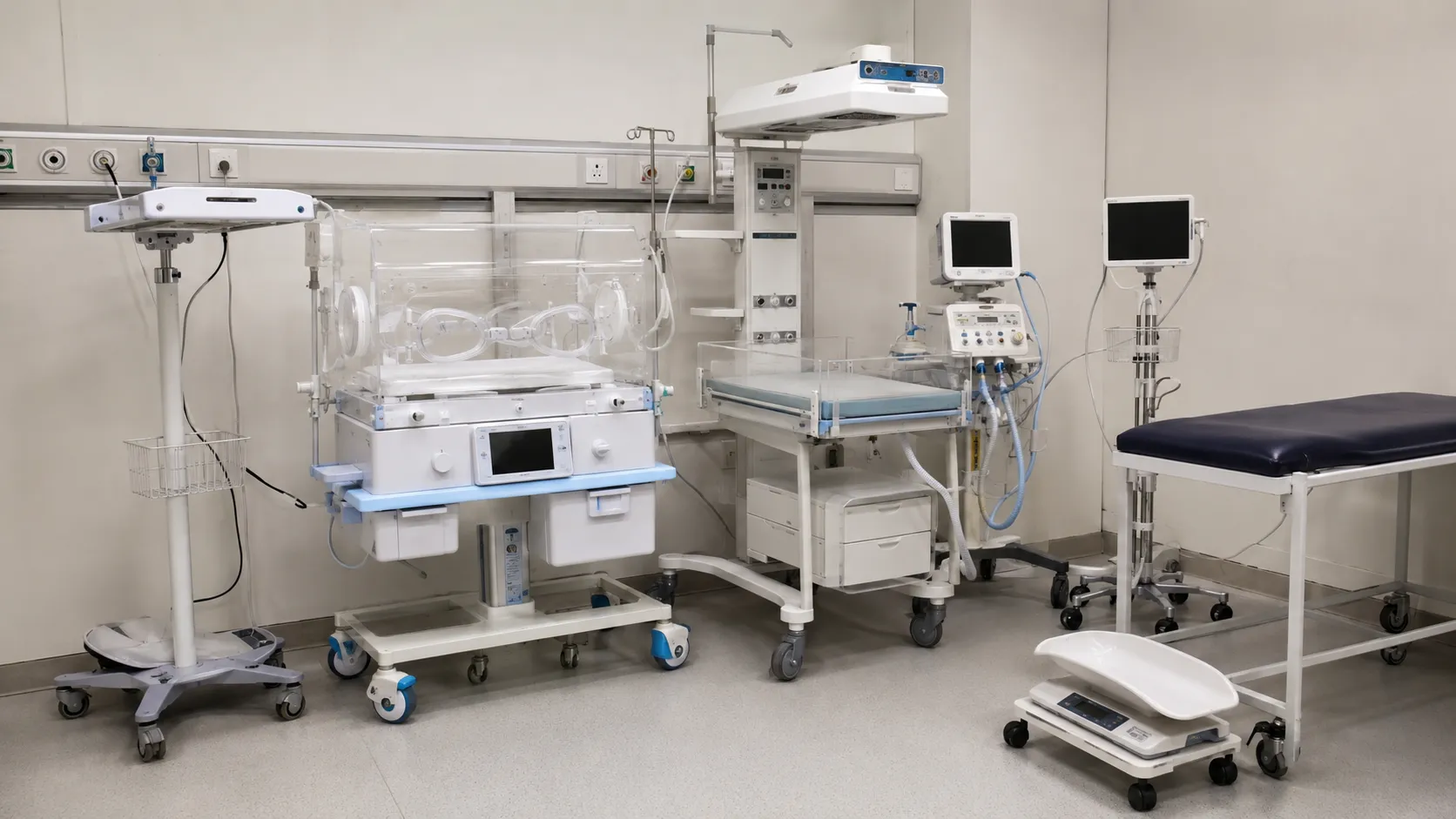
The smallest and youngest patients need equipment designed and sized just for them. Neonatal and paediatric care spans thermal care such as incubators and warmers, respiratory support and monitoring scaled to tiny bodies, and the resuscitation, infusion and feeding equipment that supports babies and children. Understanding those groups helps any unit plan, compare options and budget sensibly.
This guide walks through the main types of neonatal and paediatric equipment used worldwide, what each does, where it fits, and how to choose — with notes on approval across the UK, the EU, the US, the Gulf (GCC) states, and South Africa.
The short version — neonatal and paediatric equipment in three groups
Most neonatal and paediatric equipment falls into one of three groups — thermal and respiratory care, monitoring sized to small patients, and the support and delivery equipment scaled for babies and children.
-
Thermal & respiratory — incubators, warmers, phototherapy and neonatal ventilation.
-
Monitoring — neonatal and paediatric monitors and oximeters sized to small patients.
-
Support & delivery — resuscitation, infusion and feeding equipment scaled for babies and children.
Types of neonatal and paediatric equipment
-
Incubators & radiant warmers. Closed incubators and open radiant warmers with servo control to keep newborns at a stable temperature.
-
Phototherapy units. LED phototherapy units and bilirubinometers to treat and measure newborn jaundice.
-
Neonatal ventilators & CPAP. Ventilators, CPAP and high-flow systems that support fragile newborn lungs.
-
Resuscitaires. Delivery-room resuscitation platforms with warmth, oxygen and suction for newborns.
-
Neonatal & paediatric monitors. Multi-parameter monitors and pulse oximeters sized and calibrated for small patients.
-
Infusion & syringe pumps. Precise low-volume pumps for the tiny, tightly controlled fluid and drug doses babies need.
-
Point-of-care testing. Bilirubinometers and small-sample analysers giving bedside results with minimal blood.
-
Transport & support. Transport incubators, scales and paediatric beds for moving, weighing and caring for children.
What each type does
|
Category |
Examples |
Used for |
|
Thermal care |
Incubators, radiant warmers |
Keeping newborns warm |
|
Phototherapy |
LED phototherapy, bilirubinometers |
Treating jaundice |
|
Respiratory |
Neonatal ventilators, CPAP |
Breathing support |
|
Resuscitation |
Resuscitaires, T-piece, bags |
Newborn resuscitation |
|
Monitoring |
Neonatal/paediatric monitors, oximeters |
Continuous observation |
|
Infusion |
Syringe and infusion pumps |
Precise low-volume fluids |
|
Point of care |
Bilirubinometers, glucometers |
Bedside results |
|
Transport & support |
Transport incubators, scales |
Moving and weighing safely |
Neonatal thermal and respiratory equipment compared
Newborn care balances warmth, breathing and access, and several devices do related jobs in different ways.
|
Equipment |
What it does |
Best for |
Consider |
|
Incubator |
Enclosed, controlled warmth and humidity |
Stable, very preterm babies |
Access for care |
|
Radiant warmer |
Open overhead heat |
Resuscitation and frequent access |
Fluid loss; open environment |
|
CPAP |
Continuous positive airway pressure |
Breathing support without intubation |
Nasal interface care |
|
Neonatal ventilator |
Mechanical ventilation |
Babies who cannot breathe adequately |
Intensive care; monitoring |
Incubators and warmers provide thermal care, while CPAP and ventilators provide graded breathing support — most units use all of them, matched to the baby's needs.
Equipping a neonatal or paediatric unit?
We'll help you choose the right kit. Tell us your level of care, your budget and your market — we'll help you pick neonatal and paediatric equipment that fits your unit and is approved for use where you'll use it.
No pressure, no obligation. → Talk to the team
Neonatal and paediatric equipment by setting
-
Neonatal intensive care - the full range of ventilation, monitoring, incubators and infusion for the sickest babies.
-
Special care baby units - incubators, phototherapy, monitoring and feeding for less intensive care.
-
Delivery suites - resuscitators and warmers for newborn resuscitation at birth.
-
Paediatric wards - paediatric monitors, infusion and beds sized for children.
-
Transport & retrieval - transport incubators with their own ventilation, monitoring and power.
Choosing neonatal and paediatric equipment
-
Define the level of care and age range the equipment must support.
-
Match thermal, respiratory and monitoring equipment to that level.
-
Choose devices designed and sized specifically for neonates and children.
-
Confirm market approval, the device class and higher-risk requirements.
-
Plan consumables, gases, calibration and service support.
Neonatal and paediatric devices are higher-risk and precise, and commissioning, calibration and consumables add to the price — weigh new against certified refurbished, confirm the device's risk class, and plan validation before you buy.
Emerging neonatal and paediatric technology
-
Gentler respiratory support. Non-invasive CPAP and high-flow reduce the need for intubation in newborns.
-
Smarter monitoring. Closer oxygen targeting and integrated monitoring improve safety for fragile babies.
-
Family-centred design. Incubators and units are designed around parental access and developmental care.
-
Connected devices. Neonatal equipment feeds data into the record and central monitoring.
-
Small-sample testing. Point-of-care testing reduces blood loss in tiny patients.
Approval by region
|
Region |
Regulator |
Requirement |
|
United Kingdom |
UKCA mark (CE accepted to 2028–2030) |
|
|
European Union |
CE marking under the EU MDR |
|
|
United States |
510(k) clearance or PMA approval |
|
|
Gulf (GCC) |
SFDA & GCC bodies |
National registration / GCC conformity |
|
South Africa |
Medical device licensing |
Neonatal and paediatric devices sit at the higher-risk end of medical-device regulation, with strict safety and electrical standards. For clinical and quality guidance, the NICE and World Health Organisation resources are useful references. Our buyer hub sets out how to purchase with confidence.
More from Business
-
Buyers — source neonatal and paediatric equipment for your hospital or unit.
-
Suppliers — list your neonatal and paediatric equipment and reach buyers worldwide.
-
Advertise — promote your products and services to a clinical audience.
-
Business overview — explore everything MediGear offers healthcare organisations.
Disclaimer
This article is for general information only and does not constitute clinical, neonatal, paediatric, medical, procurement or regulatory advice. Neonatal and paediatric equipment, requirements and regulations vary by country, setting and need, and change over time. Always confirm that equipment suits the intended clinical use and is approved for your market (for example, UKCA, CE under the EU MDR, FDA, SFDA/GCC or SAHPRA), follow safety and electrical standards, and consult qualified neonatal, paediatric, biomedical engineering and procurement professionals for decisions specific to your organisation. medigear.uk accepts no liability for actions taken based on this content.
The right kit for your neonatal or paediatric unit.
From incubators, radiant warmers and ventilators to phototherapy, monitors and infusion pumps, we supply neonatal and paediatric equipment to hospitals across the UK, Europe, the US, the Gulf and South Africa — compliant, supported and ready to use.
Frequently Asked Questions
The main types are thermal care such as incubators and radiant warmers, phototherapy units and bilirubinometers for jaundice, neonatal ventilators and CPAP for breathing support, resuscitaires for the delivery room, neonatal and paediatric monitors and pulse oximeters, syringe and infusion pumps for precise fluids, point-of-care testing, and transport incubators. Equipment is sized and designed specifically for small patients.
An incubator is an enclosed unit that holds a stable, warm and humid environment, ideal for very preterm and stable babies. A radiant warmer is open, with overhead heat, giving easy access for resuscitation and frequent procedures but more fluid loss. Units use both, choosing by the baby's stability and the care needed.
Newborn breathing support ranges from supplemental oxygen and high-flow, through CPAP, which keeps the airways open without intubation, to full mechanical ventilation with a neonatal ventilator for babies who cannot breathe adequately. Gentler, non-invasive support such as CPAP is used first where possible to protect fragile lungs.
Yes. Monitors, pumps and warmers are available as certified refurbished units and can reduce costs, while ventilators and incubators are often bought new given their critical role. Confirm certified refurbishment, a warranty, calibration and service support, and check the device is approved for your market and validated after installation.
These devices sit at the higher-risk end of regulation and must be approved for the market — UKCA or CE under the EU MDR in the UK and EU, FDA clearance in the US, and SFDA or SAHPRA registration in the Gulf and South Africa. Strict safety and electrical standards apply, so plan for commissioning, calibration and routine servicing.
Children are not small adults — their airways, blood volume and physiology differ — so equipment such as monitors, cuffs, masks, tubes and infusion devices must be correctly sized for safe, accurate care. Using equipment designed and scaled for neonates and children avoids inaccurate readings, ineffective treatment and harm.