
Introduction
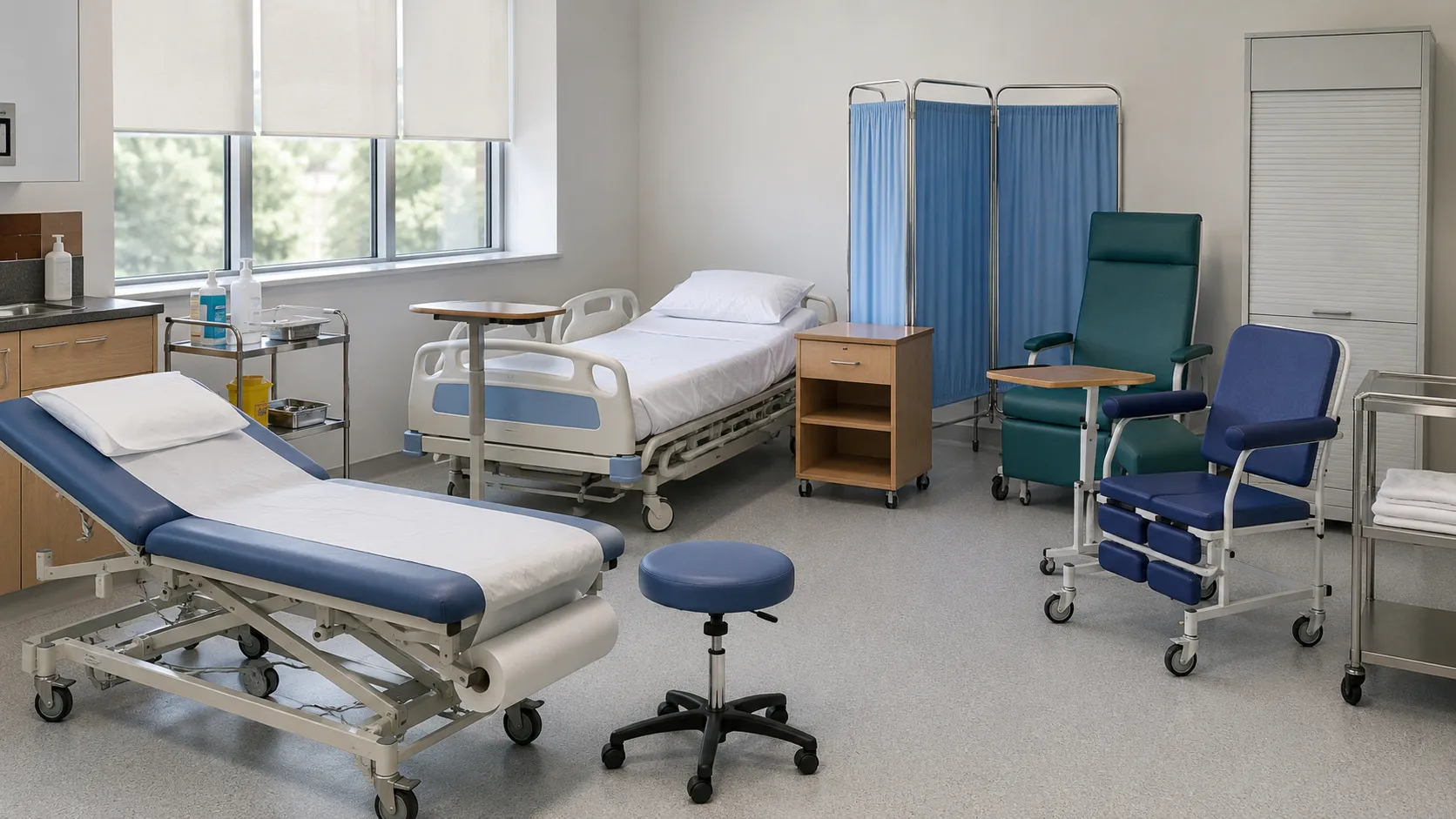
Medical furniture is the often-overlooked infrastructure of clinical care — the examination table on which every assessment begins, the storage that keeps consumables organised and infection-controlled, and the seating and ward furniture that defines the patient experience. Well-chosen furniture supports clinical workflows, meets infection-control requirements and endures the demands of a busy healthcare environment. Understanding those groups helps any facility plan, compare options and budget sensibly.
This guide walks through the main types of medical furniture used in clinical settings worldwide, what each does, where it fits, and how to choose — with notes on approval across the UK, the EU, the US, the Gulf (GCC) states, and South Africa.
The short version — medical furniture in three groups
Most medical furniture falls into one of three groups — clinical workstations and examination, patient furniture and seating, and storage and support furniture.
-
Clinical workstations & examination — examination tables, treatment chairs and procedure couches.
-
Patient furniture & seating — patient chairs, visitor seating, ward recliners and infusion chairs.
-
Storage & support — medical trolleys, clinical storage, IV stands and instrument tables.
Types of medical furniture
-
Examination tables. Fixed, hydraulic and electric examination couches for patient assessment in GP, outpatient and clinic settings.
-
Treatment chairs & couches. Electrically adjustable treatment chairs for infusion, minor procedures and dialysis.
-
IV stands & drip poles. Height-adjustable stainless-steel poles that hold infusion bags, pumps and monitoring accessories at the bedside.
-
Medical trolleys. Dressing trolleys, medicine trolleys, resuscitation trolleys and equipment carts for organising clinical supplies.
-
Clinical storage. Stainless-steel and antimicrobial instrument cabinets, medical-grade shelving and controlled-access medication cupboards.
-
Ward furniture. Over-bed tables, bedside cabinets, locker units and chair-bed combinations for the inpatient ward environment.
-
Clinical seating. Clinician stools, operator chairs and waiting-area seating with easy-clean upholstery for clinical and public areas.
-
Instrument tables & Mayo stands. Stainless-steel trolleys and Mayo stands that hold instruments and consumables during surgical and clinical procedures.
What each type does
|
Category |
Examples |
Used for |
|
Examination tables |
Fixed, hydraulic, electric couches |
Patient examination and assessment |
|
Treatment chairs |
Adjustable infusion and procedure chairs |
Infusion, procedures, dialysis |
|
IV stands |
Height-adjustable poles |
Holding bags, pumps, lines |
|
Medical trolleys |
Dressing, medicine, resus trolleys |
Organising clinical supplies |
|
Clinical storage |
Instrument cabinets, shelving |
Storing and organising |
|
Ward furniture |
Over-bed tables, lockers |
Inpatient environment |
|
Clinical seating |
Stools, operator chairs, waiting |
Staff and patient seating |
|
Instrument tables |
Stainless Mayo stands, trolleys |
Holding instruments during procedures |
Examination table types compared
Examination tables come in several configurations, each suited to different clinical settings and patient needs.
|
Type |
Adjustment |
Best for |
Consider |
|
Fixed height |
None |
Basic clinic assessment |
Not adjustable for access |
|
Hydraulic |
Foot-pump height |
GP and general outpatient |
Slower to adjust |
|
Electric |
Motor-driven, multi-section |
Specialist and procedure |
Cost; power needed |
|
Bariatric |
Wider, high weight rating |
Larger patients |
Space; cost |
Most GP and outpatient clinics use hydraulic tables, with electric multi-section couches in specialist and procedure rooms, and bariatric tables where clinical need requires.
Equipping a clinical space?
We'll help you choose the right furniture. Tell us the setting, your workflow and your market — we'll help you pick medical furniture that fits your clinic and is approved for use where you'll use it.
No pressure, no obligation. → Talk to the team
Medical furniture by setting
-
GP and primary care - examination tables, clinical storage, medical trolleys and waiting-area seating.
-
Outpatient and specialist clinics - electric couches, specialist procedure chairs and infection-controlled clinical storage.
-
Hospital wards - over-bed tables, bedside cabinets, IV stands and clinical trolleys for inpatient care.
-
Operating theatres - Mayo stands, instrument tables and stainless storage designed for sterile environments.
-
Day surgery and infusion units - adjustable treatment chairs, IV stands and clinical trolleys for day-case procedures.
Choosing medical furniture
-
Define the clinical workflows the furniture must support.
-
Match examination tables and chairs to the procedures and patient group.
-
Select materials — stainless steel or polymer — based on infection-control requirements.
-
Confirm market approval and weight ratings for examination and treatment furniture.
-
Plan cleaning, servicing and replacement cycles for upholstered and high-use items.
Medical furniture must withstand intensive cleaning with hospital-grade disinfectants — confirm material compatibility, weight ratings and infection-control credentials before purchasing, especially for examination tables and seating.
Emerging trends in medical furniture
-
Antimicrobial materials. Copper alloy surfaces and antimicrobial polymers are reducing surface pathogen transmission.
-
Height-adjustable workstations. Electric height-adjustable clinical desks support sit-stand working for clinical staff.
-
Integrated power and data. Furniture with built-in USB, power and data sockets reduces cable clutter in clinical areas.
-
Lean design. Smaller footprint, mobile furniture improves flexibility in modern clinical spaces.
-
Sustainable manufacture. Healthcare furniture buyers are increasingly requiring low-VOC materials and recyclable construction.
Approval by region
|
Region |
Regulator |
Requirement |
|
United Kingdom |
UKCA mark (CE accepted to 2028–2030) |
|
|
European Union |
CE marking under the EU MDR |
|
|
United States |
510(k) clearance or PMA approval |
|
|
Gulf (GCC) |
SFDA & GCC bodies |
National registration / GCC conformity |
|
South Africa |
Medical device licensing |
Medical furniture such as examination tables and treatment chairs may be regulated as medical devices depending on their intended use. For clinical and quality guidance, the NICE and World Health Organisation resources are useful references. Our buyer hub sets out how to purchase with confidence.
More from Business
-
Buyers — source examination tables, clinical storage and medical furniture for your clinic or hospital.
-
Suppliers — list your medical furniture and clinical equipment and reach buyers worldwide.
-
Advertise — promote your products and services to a clinical audience.
-
Business overview — explore everything MediGear offers healthcare organisations.
Disclaimer
This article is for general information only and does not constitute clinical, medical, procurement or regulatory advice. Medical furniture requirements and regulations vary by country, setting and need, and change over time. Always confirm that furniture suits the intended use and is approved for your market where required (for example, UKCA, CE under the EU MDR, FDA, SFDA/GCC or SAHPRA), follow infection-control and weight-rating standards, and consult qualified clinical, facilities and procurement professionals for decisions specific to your organisation. medigear.uk accepts no liability for actions taken based on this content.
The right medical furniture for your clinic.
From examination tables, clinical storage and treatment chairs to IV stands, ward furniture and clinical seating, we supply medical furniture to hospitals, clinics and GP practices across the UK, Europe, the US, the Gulf and South Africa.
Frequently Asked Questions
Medical furniture covers examination tables including fixed, hydraulic and electric couches, treatment and infusion chairs, IV stands and drip poles, medical trolleys including dressing, medicine and resuscitation carts, clinical storage including instrument cabinets and medical shelving, ward furniture such as over-bed tables and bedside lockers, clinical seating for staff and patients, and instrument tables and Mayo stands.
An examination table is primarily used for clinical assessment — the patient lies or sits on it while the clinician examines them — and typically has basic or hydraulic height adjustment. A treatment couch or chair has greater articulation, often electrically powered, to position patients for procedures such as infusion, minor surgery or specialist examination. Both must be cleanable with hospital disinfectants.
Medical furniture uses stainless steel for trolleys, instrument tables and storage because it is durable and easy to clean. Examination couches and treatment chairs have powder-coated or polymer frames with vinyl or antimicrobial upholstery that withstands repeated cleaning with hospital-grade disinfectants. Infection control is the primary material criterion, and any item in a clinical space must be compatible with the facility's cleaning products.
Yes. Examination tables, storage units and medical trolleys are available second-hand or refurbished and can reduce costs. Confirm that upholstery is intact with no cracks or tears, that hydraulic or electric mechanisms function correctly, that the item can be thoroughly cleaned to infection-control standard, and that weight ratings are clearly documented. Clinical suitability must be verified before patient use.
Medical furniture such as electrically adjustable treatment tables and chairs is regulated as a medical device in most markets and must be approved — UKCA or CE under the EU MDR in the UK and EU, FDA clearance in the US, and SFDA or SAHPRA registration in the Gulf and South Africa. General clinical furniture must meet building, fire-safety and infection-control standards, and weight ratings for examination tables must be clearly stated.
Choose furniture with smooth, unbroken surfaces without joints or crevices where microorganisms can accumulate. Upholstery should be tear-free vinyl with antimicrobial treatment, compatible with hospital disinfectant wipes and sprays. Stainless steel is preferred for trolleys and instrument tables. Avoid wood and fabric in clinical areas. Confirm chemical compatibility between the furniture material and the facility's cleaning and decontamination products before purchase.