
Introduction
Four minutes into a Premier League match, a midfielder goes down clutching his head after an accidental collision. Before he's finished falling, the club doctor and physio are moving from the dugout with a specific bag between them — the emergency medical bag mandated by the Premier League for every matchday. Inside is a specific list of equipment that would look familiar to anyone who works in prehospital medicine: airway adjuncts, oxygen, a bag-valve-mask, IV cannulation kit, adrenaline, and a portable defibrillator. On the touchline is a spinal board, a scoop stretcher, and a stretcher team briefed before kickoff. The equipment isn't glamorous. It is meticulously specified and audited, because the consequences of getting it wrong at professional level are visible to millions of people within the same hour.
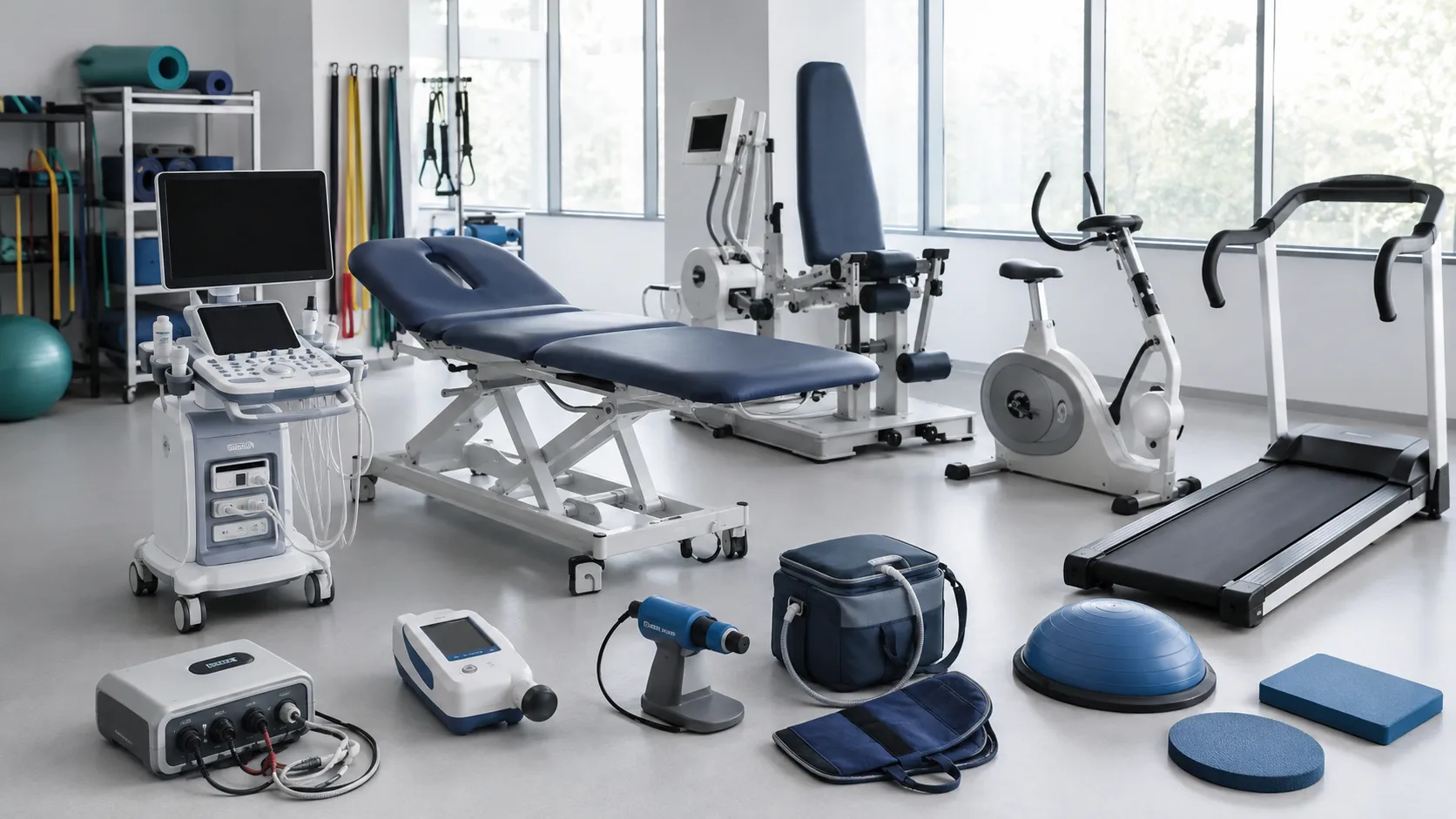
Sports medicine equipment covers a much wider range than this pitchside scene alone, though. It includes diagnostic equipment used in clinic assessment, rehabilitation equipment used in the treatment phase after injury, and performance and recovery equipment used with athletes when they're not injured. What follows walks through the four functional areas that structure how sports medicine equipment is actually specified and used, with UK regulatory and governing-body context throughout.
Emergency and pitchside equipment
The category with the most rigorous specification, because it operates under the highest scrutiny. Different sports have different mandated pitchside equipment requirements: the Premier League and Championship require an emergency medical bag with defined contents, an accessible AED, a spinal board, and a doctor and physio with specific certifications; the RFU has similar but sport-specific requirements including immediate concussion assessment equipment; motorsport has its own specialised medical rescue provision through the FIA and MSA.
The emergency medical bag typically contains oropharyngeal and nasopharyngeal airways in a range of sizes, laryngeal mask airways, a bag-valve-mask with reservoir and portable oxygen, IV cannulation equipment, tranexamic acid, adrenaline, glucose, and immediate life support drugs. AEDs at professional stadia are typically Zoll AED Plus, Philips FRx, or LIFEPAK CR2, spaced through the stadium and mapped for rapid response. Spinal immobilisation equipment includes a rigid spinal board, scoop stretcher, cervical collars in adjustable sizes, and head immobiliser blocks. Sport-specific requirements exist for rugby (in-play concussion assessment cards and video replay integration for HIA), cricket (helmets and immediate impact protocol), and equestrian (dedicated rescue equipment).
Below professional level, the picture is less regulated but no less important. Grassroots football, rugby, and other contact sports increasingly have access to AEDs through initiatives like the FA National Game defibrillator programme and Premier League community grants. The FA Medical & Well-being programme is the anchor guidance for football medical provision at all levels.
Diagnostic equipment in sports medicine clinics
Musculoskeletal ultrasound is the dominant diagnostic modality in outpatient sports medicine, and portable ultrasound has transformed what can be done at pitchside and in clinic. Devices from GE Vscan, Butterfly IQ, Philips Lumify, and specialist musculoskeletal ultrasound systems from GE Logiq, Mindray, and Samsung support tendon, ligament, muscle, and joint assessment in real time. Point-of-care ultrasound is now genuinely routine in higher-level sports medicine clinics rather than being an exotic capability.
MRI remains the gold standard for many sports injuries but happens in referral imaging centres rather than sports medicine clinics themselves. What clinics do increasingly have is direct access to fast-turnaround MRI for professional athletes, with reporting pathways that can turn around a scan and specialist opinion within hours rather than days. Gait analysis systems (Vicon, Qualisys, or portable IMU-based systems like Xsens) support running biomechanics assessment in the clinics that offer it, though these are specialist rather than universal capabilities.
Concussion assessment equipment deserves specific mention. The SCAT6 (Sport Concussion Assessment Tool, 6th edition) is a standardised assessment tool used across most sports; computerised neurocognitive assessment tools (ImPACT, CogState, and similar) are used at higher levels for baseline and post-injury testing. King-Devick and similar rapid-screen tools are used at pitchside in some sports for immediate suspected-concussion assessment. This is an area where the equipment and the protocols are inseparable, and where governance is tightening across most contact sports.
Rehabilitation equipment
The largest equipment category in sports medicine by volume, and the one where clinic environment and equipment choices most shape what treatment can be offered. Isokinetic dynamometers (Biodex, Cybex, HUMAC NORM) support objective strength testing and controlled resistance rehabilitation, particularly for post-surgical knee and shoulder work. Anti-gravity treadmills (AlterG) support graduated return-to-running after lower-limb injury by reducing body weight through the treadmill's air chamber — a genuinely useful capability that a decade ago was exotic and is now increasingly standard in professional sports rehabilitation.
Electrotherapy and manual therapy equipment includes therapeutic ultrasound units (Chattanooga, EMS Physio), TENS units, interferential therapy machines, and various neuromuscular electrical stimulation (NMES) systems. The evidence base for electrotherapy in sports rehabilitation is more variable than the equipment marketing suggests; buyers should read the specific evidence for each modality and application rather than assuming that all electrotherapy is equally effective.
Shockwave therapy (extracorporeal shockwave therapy, ESWT) is used for chronic tendinopathies, with equipment from Storz Medical, EMS, and BTL. Radial shockwave devices are more affordable and widely used; focused shockwave equipment costs more but is preferred for some specific indications. Both categories have supporting evidence for particular tendinopathies and less for others.
Performance, recovery, and athlete monitoring
Equipment used with athletes when they're not injured is a category that has expanded substantially in the past decade, driven by professional sports investment. Cryotherapy chambers (whole-body cryotherapy at -110°C to -140°C, with equipment from CryoScience, CRYO Innovations, and JUKA) are widely used at elite level for recovery, though the evidence base for whole-body cryotherapy versus simpler cold-water immersion is contested. Ice baths and cold-water immersion units remain the workhorse recovery modality with the strongest evidence base.
Compression therapy garments (Normatec, RecoveryPump, Hyperice), percussion massage devices (Theragun, Hyperice Hypervolt), and various vibration platforms round out the recovery equipment picture. Athlete monitoring systems from Catapult, STATSports, Firstbeat, and Polar Team Pro provide continuous physiological and load monitoring during training and competition, feeding into decisions about recovery, injury risk, and training prescription.
Environmental control equipment for training adaptation — altitude simulation tents and rooms, heat chambers, hypoxic training equipment — is used at elite level for competition preparation. This equipment is expensive (elite altitude installations run into six figures), has narrow application, and is genuinely specialist rather than being appropriate to typical sports medicine practice.
The specification picture at different levels
Sports medicine equipment provision differs enormously between professional, elite amateur, and community levels. Professional football, rugby, and equivalent sports have equipment specifications set by their governing bodies with regular audits. Elite amateur sport is served by the English Institute of Sport and equivalent bodies in Scotland, Wales, and Northern Ireland, with equipment access varying by sport and funding. Community sport largely relies on individual clubs and volunteer medical staff, with equipment ranging from well-specified to minimal depending on club resources and awareness.
The regulatory picture for sports medicine equipment sits within the broader medical device framework — devices used in a clinical role are subject to MHRA registration and UKCA or CE marking requirements. Consumer wellness or fitness equipment doesn't automatically become medical equipment when used in a sports medicine context, and buyers should be clear about which they're purchasing and using for what purpose. The line matters both for regulatory compliance and for insurance in professional or elite settings. A consumer heart rate strap used for training is not the same class of device as an ECG monitor used to make a clinical decision about return-to-play after suspected cardiac symptoms, and treating the two as interchangeable because they both measure heart rate misses the regulatory distinction that matters when things go wrong, and someone has to answer for the equipment choice.
Sports medicine equipment provision varies significantly by sport, level, and jurisdiction, and specific equipment requirements are set by governing bodies rather than by any single generic standard. This article is for orientation only; specific procurement should be led by clinical staff with sports medicine speciality knowledge in consultation with the relevant governing body's medical committee. Named products reflect current UK market presence and are not endorsements.
Sports medicine as a specialism, not an add-on
Equipping a professional or elite amateur medical setup, refreshing a sports medicine clinic, or working through medical provision for a grassroots club? Sports medicine equipment sits at the intersection of clinical practice, governing-body regulation, and often significant investment decisions. We can help you frame the requirement properly and connect you with suppliers who work in sports medicine as a specialism, not as an add-on to their general medical device range. Tell us what setup you're building.
Frequently Asked Questions
The Premier League and Championship require an emergency medical bag with defined contents (airway adjuncts, oxygen, bag-valve-mask, IV cannulation kit, adrenaline, tranexamic acid, immediate life support drugs), an accessible AED, spinal board, scoop stretcher, cervical collars, and a doctor and physio with specific pitchside emergency care certifications. AEDs are typically spaced through the stadium and mapped for rapid response. Different sports have their own sport-specific requirements set by their governing bodies.
The Sport Concussion Assessment Tool, 6th edition, is a standardised concussion assessment tool used across most sports. It combines a symptom checklist, cognitive assessment (orientation, immediate memory, concentration), balance assessment, and coordination testing. Higher-level sports also use computerised neurocognitive assessment tools like ImPACT and CogState for baseline and post-injury testing. The SCAT6 replaced the SCAT5 in 2023 and is available free from the Concussion in Sport Group.
An anti-gravity treadmill (AlterG is the dominant brand) uses positive-pressure air in a chamber around the runner to reduce their effective body weight, enabling graduated return to running after lower-limb injury without full weight-bearing impact. It has become genuinely standard in professional sports rehabilitation over the past decade. It was exotic equipment ten years ago; it's now expected in higher-level rehab clinics and increasingly available in NHS elite sport medicine services.
The evidence base for whole-body cryotherapy is contested and weaker than the equipment marketing suggests. Simpler cold-water immersion has stronger evidence for post-exercise recovery in specific contexts. Whole-body cryotherapy (chambers at -110°C to -140°C) is popular at elite level and may have modest benefits for some athletes, but the case for the substantial capital investment over ice baths or cold-water immersion tanks is not clear-cut. Buyers should engage with the specific evidence for their application.
Musculoskeletal ultrasound is now the dominant diagnostic modality in outpatient sports medicine. Portable devices like GE Vscan, Butterfly IQ, and Philips Lumify support pitchside and clinic assessment; specialist musculoskeletal systems from GE Logiq, Mindray, and Samsung provide higher-end diagnostic imaging. Point-of-care ultrasound is routine in higher-level sports medicine clinics rather than being an exotic capability. Users need appropriate training as much as they need appropriate equipment.
Athlete monitoring systems from Catapult, STATSports, Firstbeat, and Polar Team Pro provide continuous physiological and load monitoring during training and competition. GPS-tracked distance and speed metrics, heart rate variability, sleep monitoring, and jump and neuromuscular fatigue markers feed into decisions about recovery, injury risk, and training prescription. Used well in elite programmes with sports science support they add real value; used without the analytical infrastructure to interpret them they produce data that gets ignored.
Less rigorously than professional sport, but there are governing-body expectations. The FA National Game defibrillator programme and Premier League community grants have improved AED access at grassroots football. RFU concussion protocols apply across all levels of rugby including community. Individual clubs and volunteer medical staff still carry most of the responsibility below elite level, so equipment provision varies widely by club resources and awareness rather than being set to a single standard.