
Introduction
Mrs Aitken is 87, admitted from home after a fall. On the ward, she doesn't recognise the nurse who introduces herself and asks when her husband is coming to fetch her, though her husband has been dead for eleven years. She can't reach the call bell (it's on the wrong side), can't read the menu (the print is too small and the light is wrong), can't sleep because someone else's monitor keeps alarming, and by day three she can no longer walk to the toilet unaided, though she managed both stairs at home the week before. None of this is unusual. Some of it is unavoidable, but a substantial portion is directly related to equipment and environment that weren't designed with elderly patients in mind.
Care of older patients is now the largest single category of hospital activity in the UK, with people over 65 accounting for around two-thirds of hospital bed days. Yet hospital equipment has historically been specified with a younger, cognitively intact, functionally independent notional patient in mind. Getting equipment right for older people means thinking about equipment and environment together, and about the common geriatric syndromes rather than about isolated diseases. What follows walks through the equipment picture organised around the syndromes that most often affect older patients in hospital.
Falls: prevention, detection, and management
Around one in three people over 65 falls each year; a substantial proportion are older hospital inpatients, where the disorientation of admission combines with the equipment and layout of the ward. Equipment for falls prevention starts with beds that are height-adjustable to below 40 cm (low beds reduce injury when patients get out unassisted), appropriate bed rail policies (rails prevent some falls and cause others; not every patient benefits), sensor pads and floor mats that alert staff when a patient at high risk stands up, and good lighting including low-level lighting for night-time toileting.
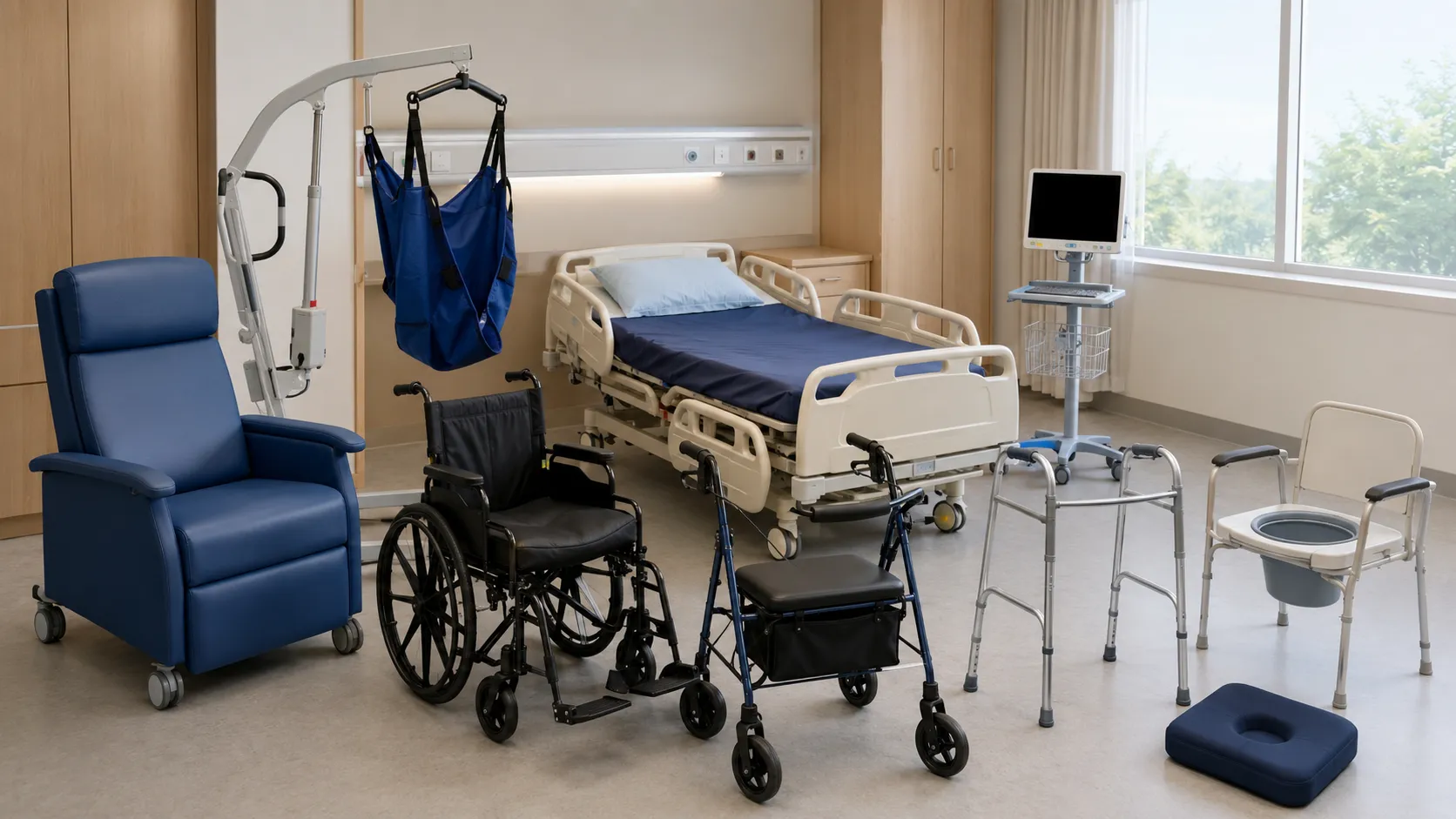
Mobility aids adapted to individual patients rather than issued generically make a real difference. Frames sized to the patient, walking sticks at the correct height, appropriate footwear (not just the standard hospital slipper socks, which are actively slippery in some circumstances). Bathroom aids — grab rails at the right heights, raised toilet seats where indicated, non-slip mats, appropriate shower chairs — all support safer transfers and reduce the falls that happen at that highest-risk moment. NICE guidance on falls in older people (CG161 and related quality standards) sets out the evidence-based approach.
Delirium: environment as equipment
Delirium affects up to a third of hospitalised older patients and is under-recognised in many settings. It's a genuine equipment topic because much of what triggers or worsens delirium is environmental — noise, unfamiliar spaces, disrupted sleep, sensory deprivation, catheter and line tethering. The equipment implications include hospital beds that reduce noise on adjustment, alarm systems that can be centrally silenced without missing genuine alerts, night-time lighting that supports orientation without disrupting sleep, clocks and calendars visible from the bed, and single rooms where clinically appropriate.
Removing unnecessary medical devices matters as much as adding good ones. Every catheter, IV line, and monitor lead tethers the patient and increases risk. Where continuous monitoring is genuinely needed, wireless monitoring can preserve mobility that wired systems eliminate. Sedation is a driver of delirium, so appropriate pain equipment (patient-controlled analgesia, regional anaesthesia infusion pumps that reduce opioid requirements) has an indirect but real role in delirium prevention.
Functional decline and hospital-associated deconditioning
Older patients lose significant muscle mass and function during even short hospital stays — the phrase "post-hospital syndrome" captures the phenomenon. Equipment that supports mobilisation counteracts this: appropriate walking frames, mobility aids at the bedside, chairs that patients can actually get out of unassisted (many hospital chairs cannot be), and the physical space to walk when medically stable.
Bed and chair rest are sometimes clinically necessary but often over-prescribed by ward equipment defaults that make anything else difficult. A patient in an overly-reclined bed with a bedside table across it and their belongings out of reach is being nudged toward immobility by the equipment. Simple things — getting the bed to a proper sitting position, moving the table, putting the call bell and drink within reach, providing appropriate seating — all support the mobilisation that maintains function. NHS End PJ Paralysis and Deconditioning Games campaigns have highlighted this at practice level.
Sensory impairment: vision, hearing, communication
Age-related sensory impairment is nearly universal in older populations and often unrecognised on admission. Equipment implications include ensuring patients have their glasses (many hospital admissions arrive without them, and lost glasses are a chronic problem), hearing aids with working batteries, and communication aids appropriate to the individual. Written information should be printed in large, clear typefaces suitable for age-related visual impairment, not the small print used in generic hospital documents.
Amplified telephones, personal amplifiers, and communication boards support conversations that would otherwise be lost. Signage in ward areas should meet dementia-friendly design principles: high contrast, clear symbols, low reading age, consistent through the environment. Dementia-friendly design considerations extend to floor patterns (busy carpets can look like water and cause falls), doors (glass panels help with orientation), and colour schemes that support wayfinding.
Frailty and multi-morbidity
Frailty is not a diagnosis but a clinical syndrome of increased vulnerability that shapes what equipment is appropriate. Blood pressure monitoring in frail patients should use appropriate cuffs and understand that standing measurements are important (orthostatic hypotension is common); weighing scales that support unstable patients matter; hoists and transfer equipment sized for frail rather than incapacitated patients preserve dignity. The British Geriatrics Society's guidance on frailty in the acute setting is worth engaging with.
Pressure care equipment matters specifically for frail older patients, who lose protective subcutaneous fat and are at high risk of pressure ulcers. Alternating-pressure mattress systems, appropriate heel protection, and cushions for chair use all support skin integrity in ways that generic hospital bedding does not. Continence equipment, appropriately fitted, supports dignity and reduces the skin damage that comes from prolonged contact with urine or faeces.
End-of-life equipment considerations
A substantial proportion of hospital admissions in the oldest age group are in the last year of life, and equipment considerations shift with that clinical trajectory. Comfort equipment — specialist mattresses, positioning aids, mouth care equipment, subcutaneous fluid infusion where oral intake fails — support the shift from cure-oriented to comfort-oriented care. Portable oxygen for symptomatic breathlessness even without severe hypoxia, appropriate analgesia delivery equipment, and quiet, private environments where possible all matter more than the intensive-care-adjacent equipment of earlier admission.
See British Geriatrics Society guidance for the specialist framework across older people's medicine, and NICE quality standard on delirium prevention as one example of specific evidence-based guidance that has direct equipment implications.
The whole environment is equipment.
Perhaps more than in any other patient group, the environment for older patients is functionally equipment. Ward layouts, lighting schemes, noise levels, visual clarity, wayfinding, seating in day rooms, and dining arrangements all shape whether an older patient maintains function or loses it during admission. The best older people's wards have thought about all of this alongside the specific medical equipment; the least good have specified individual devices without considering how the ward as a whole supports or undermines the care of frail older people. The distinction is often visible at a glance: a well-designed older people's ward feels calm, well-lit, easy to navigate, and quiet enough for rest; a poorly-designed one has the same equipment but placed and integrated in ways that undermine rather than support the patient population it exists to serve, and the difference in patient experience and clinical outcomes over time is very real for every patient concerned.
Equipment provision for older patients is an area where individual devices matter less than the whole environment they sit in, and where good practice requires collaboration between clinical teams, occupational therapy, environmental design, and patient and family input. This article is for orientation and does not substitute for specific ward assessment, older people's medicine specialist input, or the local audit against evidence-based guidance that any hospital should undertake for its older-patient population. Named guidance reflects current UK sources and may be updated.
Think about the whole environment, not just the devices
Reviewing an older people's ward, planning a dementia-friendly refurbishment, or trying to work out why hospital-acquired deconditioning rates aren't improving? Equipment for older patients is one area where the whole environment matters as much as individual devices, and where good practice needs collaboration between clinical teams, occupational therapy, environmental design, and patient and family input. We can point you toward suppliers and consultants who understand the older-people-specific requirements from ward-level up, not just device-by-device. Get in touch.
Frequently Asked Questions
Falls prevention equipment includes hospital beds that are height-adjustable to below 40 cm (low beds reduce injury when patients get out unassisted), appropriate bed rail policies, sensor pads and floor mats that alert staff when high-risk patients stand up, good lighting including low-level night lighting for toileting, individually-sized mobility aids and walking frames, appropriate footwear, and bathroom aids such as grab rails, raised toilet seats and non-slip mats. NICE guidance CG161 covers the evidence-based approach.
Delirium is an acute confusional state that affects up to a third of hospitalised older patients. It's an equipment topic because much of what triggers or worsens delirium is environmental: noise, unfamiliar spaces, disrupted sleep, sensory deprivation, catheter and line tethering, and inappropriate sedation. Equipment implications include quieter alarms, night-time lighting that supports orientation without disrupting sleep, wireless monitoring that preserves mobility, and removing unnecessary devices that tether the patient.
Older patients lose significant muscle mass and function during even short hospital stays — the phrase 'post-hospital syndrome' captures the phenomenon. Ward equipment defaults often nudge patients toward immobility: overly-reclined beds, bedside tables placed inconveniently, belongings out of reach. Equipment that supports mobilisation counteracts this: appropriate walking frames at the bedside, chairs patients can actually get out of unassisted, and the physical space to walk when medically stable.
Dementia-friendly design encompasses signage with high contrast, clear symbols, low reading age, and consistency through the environment; floor patterns that avoid dark or busy areas that can look like water or holes; doors with glass panels that help with orientation; consistent colour schemes that support wayfinding; and clocks and calendars visible from patient beds. It also includes environmental factors like lighting that supports diurnal rhythm, and reduced noise from equipment and alarms.
Frail older patients lose protective subcutaneous fat and are at higher risk of pressure ulcers. Equipment includes alternating-pressure mattress systems (with weight ratings appropriate to the patient), heel protection devices, cushions for chair use, and appropriately-fitted continence products to reduce skin damage from prolonged moisture contact. Pressure area care equipment is often specified generically rather than for the actual patient population, which is a common gap in older people's ward equipment.
Because call bell placement, design, and function all affect whether older patients can summon help when they need it. Call bells on the wrong side of the bed, out of reach after position changes, with buttons too small for arthritic hands, or with mechanisms too complex for cognitively impaired patients to use, all fail their purpose. Regular call bell placement checks as part of nursing routine, along with call bell designs suitable for the patient population, are simple but often-overlooked interventions.
Frailty is a clinical syndrome of increased vulnerability to adverse outcomes, common in older patients but not simply a function of age. It changes equipment needs by prioritising equipment that preserves function and dignity: appropriately-sized mobility aids (not just any aid), transfer equipment sized for frail rather than incapacitated patients, and pressure care equipment matched to the specific patient. The British Geriatrics Society's guidance on frailty in acute settings is worth engaging with for specialist context.