
Introduction
The call comes from the ambulance crew twenty minutes out: 46-year-old man, chest pain, weight around 240 kilos. The ED matron gets on the phone straight away. Which bay has bariatric equipment? Is the bariatric trolley free? Which CT scanner takes the higher weight? Is the imaging table the right one? Is a hoist available on the ward we'll be transferring to? Between the ambulance's ETA and the patient's arrival, the ED has to work out whether the hospital is equipped to look after him safely. Not every hospital would be. The equipment picture for bariatric care is not the standard picture, and where it isn't in place, real patients experience real harm.
Adult obesity rates in the UK have risen substantially over the past two decades — NHS data puts adult obesity prevalence at around 26% as of the mid-2020s, with a further 38% classified as overweight. The clinical implications for hospitals are practical: standard equipment weight limits are exceeded more often than they used to be, and services that don't plan for it get caught out. What follows walks through the equipment categories where bariatric-rated versions matter, structured by the care pathway.
Standard versus bariatric: the weight capacity picture
Most standard hospital equipment is rated for patients up to roughly 150–160 kg (24–25 stone). Bariatric-rated equipment typically starts at 200 kg and goes up to 300 kg or more depending on the specific product. This is not a minor rating difference. Exceeding the working load of hospital equipment is a safety incident category in its own right — beds have failed, hoists have collapsed, imaging tables have moved unpredictably, and staff have been injured attempting manual handling of patients too heavy for the equipment provided.
The economic picture is also different. Bariatric-rated equipment typically costs two to three times standard equipment, sometimes more. A standard hospital bed at £3,000–£5,000 becomes a bariatric bed at £10,000–£15,000. A standard patient hoist at £3,000 becomes a bariatric ceiling-track hoist installation at £15,000–£25,000. These are substantial procurement decisions and the specification is not something to compromise on, because the alternative is either turning patients away, transferring them to another hospital, or providing care with equipment beyond its rated capacity.
Pre-hospital and ambulance transfer
Bariatric-capable ambulances exist in most UK ambulance services, though they are usually a small proportion of the fleet and have to be dispatched specifically. They carry higher-capacity stretchers (typically rated to 320 kg or more), reinforced flooring, extended door and ramp systems, and bariatric-specific patient transfer equipment. Non-bariatric ambulances have loading systems (Stryker Power-LOAD equivalents) that are safety-rated for lower loads, and using them beyond that rating is not an option.
For pre-notified transfers, coordination between the ambulance service, the sending unit, if any, and the receiving hospital ED matters more than in standard transfers. The receiving hospital needs to know what equipment to have ready. The ambulance service needs to know which door to bring the patient in through — bariatric patient transfer through standard hospital corridors, lifts, and doorways is often not physically possible.
Emergency department and acute admission
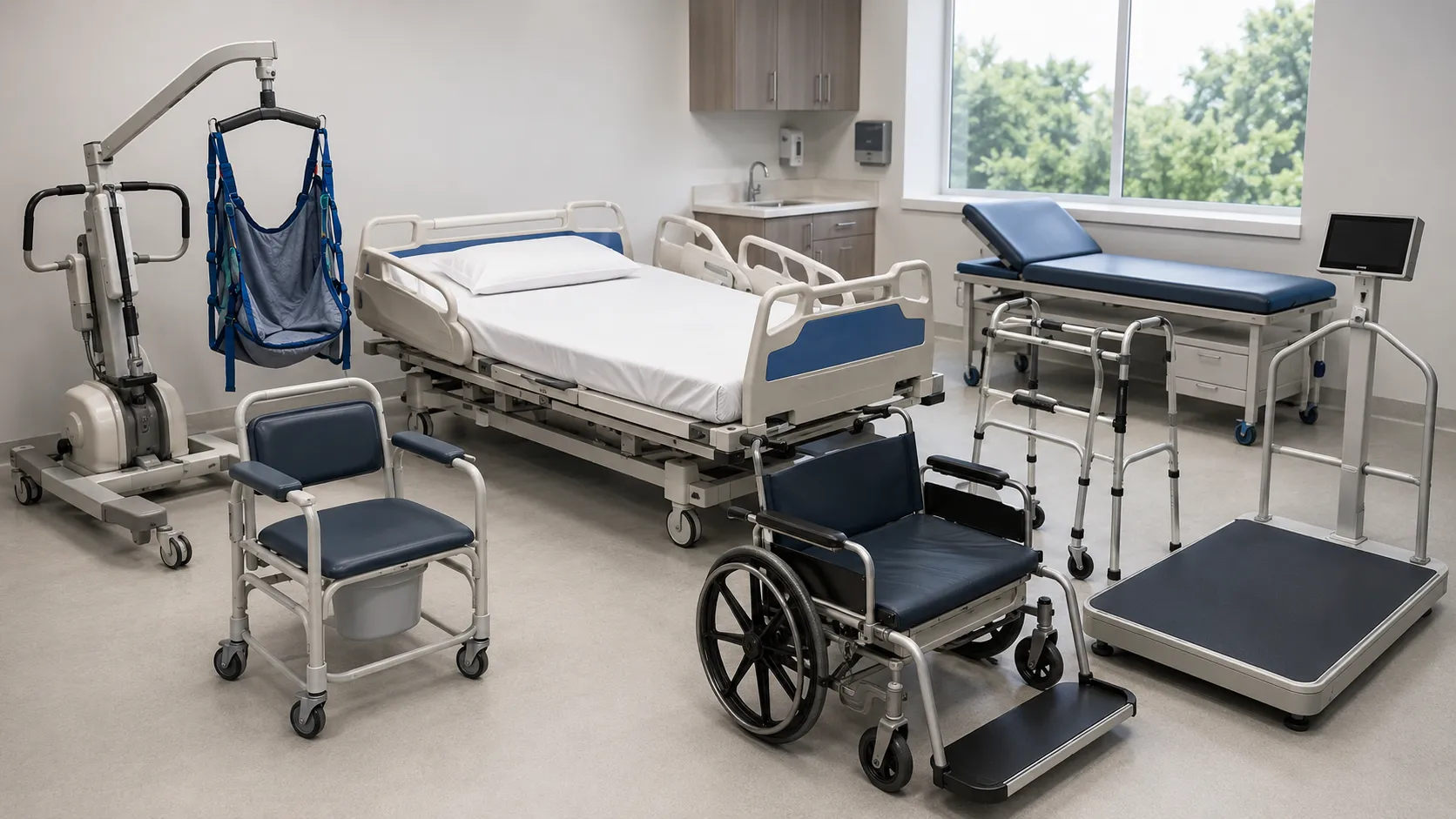
ED bariatric equipment typically includes at least one bay with reinforced flooring, a bariatric-rated trolley, appropriate size gowns and blood pressure cuffs, extended electrode leads for ECG, and clear access for hoists. Bariatric-rated trolleys start around £5,000–£8,000 and are rated to 250–320 kg depending on model. Bariatric commodes and shower chairs are separate categories, usually with 250–300 kg ratings.
Blood pressure measurement is a specific concern. Standard adult BP cuffs are appropriate for arm circumferences of around 27–34 cm; larger arms need adult large cuffs (34–43 cm) or thigh cuffs (over 43 cm). Using an undersized cuff systematically overestimates blood pressure, which can lead to inappropriate treatment decisions. Every ED should have the full range of cuff sizes readily available — this is a low-cost issue with a real clinical impact.
Ward-level equipment
Bariatric wards or bariatric-designated bays typically have wider spaces, reinforced floors, ceiling-track hoists (rather than mobile hoists, which have lower capacity and are harder to position), bariatric beds with extended width and appropriate weight capacity, and access to bariatric commodes, shower chairs, and mobility equipment. Bariatric beds are typically 120–140 cm wide (versus 90 cm for standard), rated to 250–450 kg depending on model, and include lateral tilt for pressure care management and prone positioning where required.
Pressure area care equipment matters specifically for bariatric patients. Standard pressure-relieving mattresses have weight limits; bariatric versions (typically alternating-pressure or hybrid systems rated to 350–500 kg) are essential. Skin fold care equipment, appropriate sizes of anti-embolism stockings, and dignified toileting arrangements are all part of the ward equipment picture. Hoists in particular need to be right — a hoist with insufficient capacity is worse than useless because it creates a false expectation of safe transfer.
Imaging equipment
Diagnostic imaging is one of the most difficult equipment areas for bariatric patients. Standard CT scanners have table weight limits around 200–220 kg and bore diameters around 70–80 cm; bariatric-rated CT scanners exist with weight limits up to 300 kg and larger bores. Standard MRI scanners typically have similar constraints; bariatric MRI is available, but not universally, and open MRI systems have their own limitations. Interventional radiology equipment often has additional constraints.
The practical implication is that hospitals need to know which of their scanners can safely accommodate which patients, and referral pathways to specialist bariatric imaging where their own equipment cannot cope. Ultrasound is generally more accommodating than cross-sectional imaging, though image quality can be affected by tissue depth. Radiographers with bariatric imaging experience make a substantial difference to what studies are achievable.
Theatre and procedural equipment
Bariatric surgery services in the UK are commissioned as specialist services rather than being available at every trust, and centres delivering them have specific equipment. Bariatric operating tables (Maquet Meera, STERIS 5085 SRT bariatric, Getinge Volista) are rated to 450 kg or more, with wider surfaces and extended positioning capability. Bariatric-rated retractors, longer surgical instruments, extended-length trocars for laparoscopy, and appropriate imaging arms are all part of the theatre equipment picture for bariatric surgery.
Beyond specifically bariatric surgery, any theatre that handles emergency work needs to be prepared to operate on bariatric patients. This means the operating table has to have adequate capacity, positioning equipment has to be available, and the transfer equipment has to work. Emergency laparotomies, orthopaedic emergencies, and obstetric emergencies all include bariatric patients, and the equipment has to be ready.
Discharge and community
Discharge planning for bariatric patients often includes provision of home equipment: bariatric beds, hoists, mobility aids, seating, and toileting equipment. In the UK, this is typically arranged through community equipment services with input from occupational therapy. Where the home environment cannot accommodate bariatric equipment safely — narrow doorways, floors that cannot bear the load, stairs without lifts — discharge to appropriate care settings may be necessary, and the assessment can add days to the length of stay.
The service infrastructure around bariatric community equipment matters as much as the equipment itself. Prompt delivery, correct installation, family training, and reliable service response all determine whether the equipment supports safe home care or becomes a source of new problems. Waiting weeks for a bariatric hoist installation while a patient occupies an acute bed is a common failure mode that has direct downstream costs beyond the initial equipment provision decision, and it pays to be planned around at the point of admission rather than dealt with reactively later on the ward or in the community equipment service. NHS-funded provision via community equipment services and private provision through specialist suppliers both exist, with different service models. See UK government guidance on adult obesity in healthcare settings for the wider context.
Bariatric equipment specification is an area where safety compromises have direct consequences for both patients and staff. This article provides orientation; specific procurement decisions should be made with input from moving-and-handling specialists, tissue viability nurses, occupational therapists, and clinical engineering. Named products reflect UK market presence and are not endorsements. Patients requiring bariatric-specific care should be assessed by services with the appropriate equipment rather than managed with equipment beyond its rated capacity.
Get the specification right — safety margins matter directly
Reviewing bariatric equipment provision across a hospital estate, upgrading an emergency department or specific ward to bariatric capability, or working through the specification for a new bariatric surgery service? This is procurement where safety margins matter directly and where the specification decisions have real consequences for both patients and staff. We can help you frame the requirement and connect you with suppliers who work seriously in this specialist area. Get in touch.
Frequently Asked Questions
Bariatric medical equipment is equipment specifically designed and rated for patients above the weight capacity of standard hospital equipment. Most standard hospital equipment is rated for patients up to roughly 150 to 160 kg; bariatric-rated equipment typically starts at 200 kg and goes up to 300 kg or more. Categories include bariatric beds, hoists, wheelchairs, trolleys, imaging tables, operating tables, commodes, shower chairs, and pressure-relieving mattresses. The specification difference isn't minor — exceeding standard equipment ratings is a real safety concern.
Bariatric hospital beds typically range from 250 kg to 450 kg working load, depending on the specific model and application. Most bariatric ward beds are rated to 300 to 350 kg; specialist bariatric ICU and post-operative beds go higher. Width is also different — bariatric beds are typically 120 to 140 cm wide versus 90 cm for standard beds. Prices run £10,000 to £15,000 for bariatric ward beds versus £3,000 to £5,000 for standard equivalents, but the alternative is unsafe care or turning patients away.
Yes. Most UK ambulance services have bariatric-capable ambulances in their fleet, though usually only a small proportion of the total and requiring specific dispatch. They carry higher-capacity stretchers (typically rated to 320 kg or more), reinforced flooring, extended door and ramp systems, and bariatric-specific patient transfer equipment. For pre-notified transfers, coordination between ambulance service, sending unit, and receiving hospital ED matters significantly more than for standard transfers.
Not always. Standard CT scanners typically have table weight limits around 200 to 220 kg and bore diameters around 70 to 80 cm. Standard MRI has similar constraints. Bariatric-rated CT scanners exist with weight limits up to 300 kg and larger bores, but these aren't universally available. Hospitals need to know which of their scanners can safely accommodate which patients, and have referral pathways to specialist bariatric imaging where their own equipment cannot cope. Ultrasound is more accommodating but image quality can be affected.
Using an undersized blood pressure cuff systematically overestimates blood pressure, which can lead to inappropriate treatment decisions. Standard adult cuffs are appropriate for arm circumferences of around 27 to 34 cm; larger arms need adult large cuffs (34 to 43 cm) or thigh cuffs (over 43 cm). Every ED and every ward that admits bariatric patients should have the full range of cuff sizes readily available. This is a low-cost issue with real clinical impact and is often not adequately provided for.
Mobile hoists (also called floor hoists) have lower weight capacities, are harder to position around a patient in bed, and can tip or become unstable under bariatric loads. Ceiling-track hoists are permanently installed, offer higher rated capacities, cover the whole room including bed, chair and en-suite, and are safer for bariatric transfers. Ceiling-track hoist installation for bariatric use typically costs £15,000 to £25,000. Bariatric-designated bays and wards should have ceiling-track hoists rather than relying on mobile equipment.
They are much heavier and stronger but they also have wider surfaces, extended positioning capability, and are designed to allow safe patient transfer, positioning, and access for both bariatric general procedures and bariatric surgery specifically. Products include Maquet Meera, STERIS 5085 SRT bariatric, and Getinge Volista, rated to 450 kg or more. Any theatre handling emergency work needs adequate bariatric capability regardless of whether it's a bariatric surgery centre, because emergency laparotomies and other emergencies include bariatric patients.