
Introduction
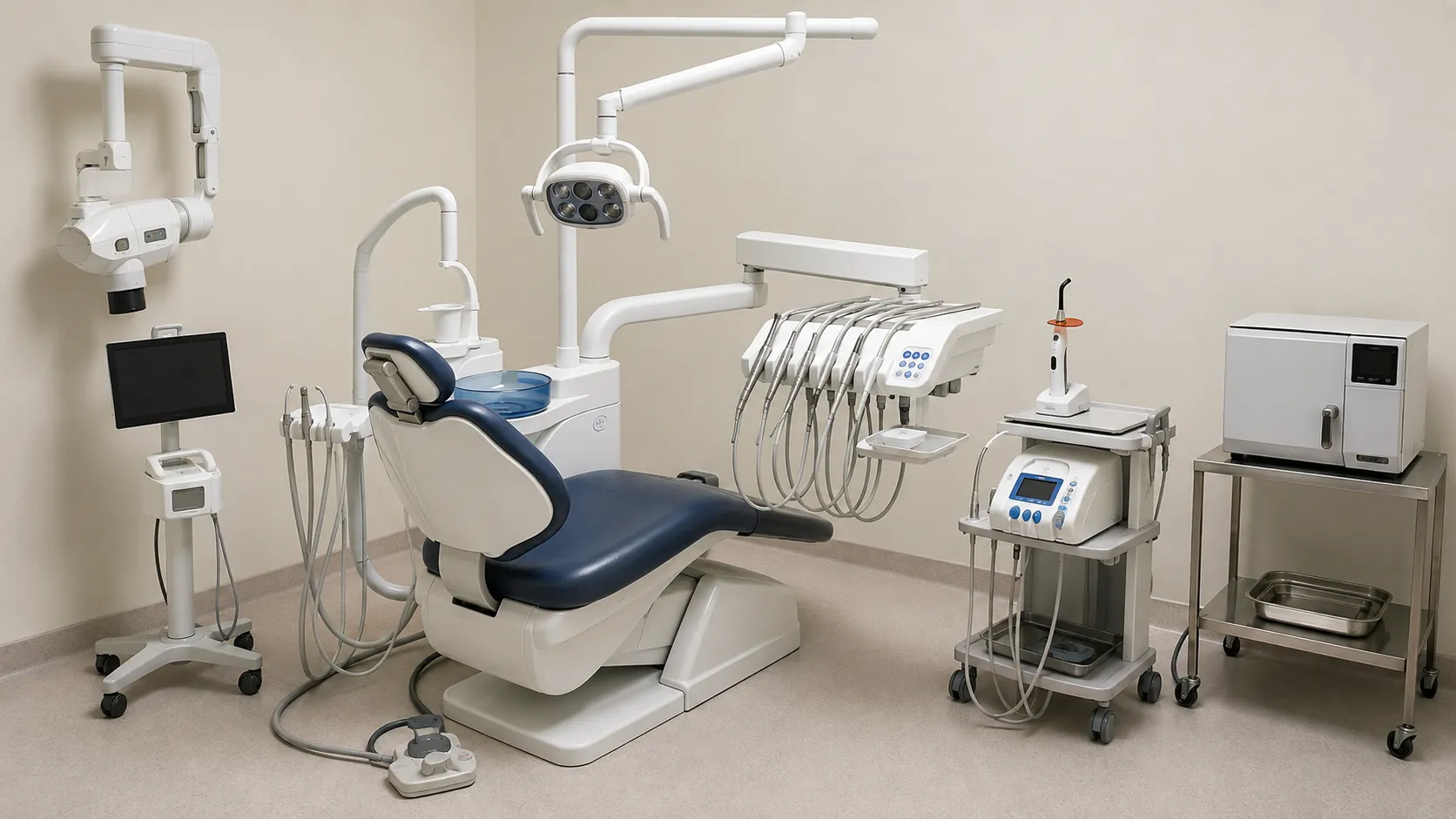
Modern dentistry relies on a wide range of equipment, from the chair at the centre of the surgery to the imaging that plans treatment and the autoclaves that keep instruments safe. Dental equipment spans the patient chair and unit, diagnostic imaging, the handpieces and instruments that do the work, and the decontamination and air systems that keep the clinic running. Understanding those groups helps any practice plan, compare options and budget sensibly.
This guide walks through the main types of dental equipment used in modern clinics worldwide, what each does, where it fits, and how to choose — with notes on approval across the UK, the EU, the US, the Gulf (GCC) states, and South Africa.
The short version — dental equipment in three groups
Most dental equipment falls into one of three groups — the chair and clinical unit, imaging and diagnosis, and the instruments, decontamination and support systems that keep the practice working.
-
Chair & unit — the dental chair, unit and delivery system at the centre of every surgery.
-
Imaging & diagnosis — intraoral and panoramic X-ray, CBCT and intraoral cameras for diagnosis and planning.
-
Instruments & support — handpieces, instruments, autoclaves, air and suction systems.
Types of dental equipment
-
Dental chairs & units. Patient chairs with integrated delivery systems for air, water and suction — the core of every surgery.
-
Dental imaging. Intraoral sensors, panoramic X-ray (OPG), CBCT scanners and cephalometric units for imaging and planning.
-
Intraoral cameras. Small cameras giving chairside images of teeth and soft tissue for diagnosis and patient communication.
-
Dental handpieces. High-speed and slow-speed air turbine and electric handpieces for cutting, polishing and endodontics.
-
Dental lasers. Diode and Er: YAG lasers for soft-tissue procedures, caries removal and teeth whitening.
-
Dental autoclaves. Class B vacuum autoclaves and washer-disinfectors for sterilising dental instruments.
-
Dental air & suction. Oil-free compressors and high-volume suction systems that power the handpieces and keep the field clear.
-
CAD/CAM & digital. Chair-side scanning, milling and 3D printing for crowns, bridges and clear aligners in a single visit.
What each type does
|
Category |
Examples |
Used for |
|
Dental chair & unit |
Integrated chairs, delivery systems |
Treating and positioning the patient |
|
Dental imaging |
Intraoral sensors, OPG, CBCT |
Diagnosis and treatment planning |
|
Intraoral cameras |
Digital intraoral cameras |
Chairside images |
|
Handpieces |
High-speed, slow-speed, electric |
Cutting, polishing, endo |
|
Dental lasers |
Diode, Er: YAG lasers |
Soft tissue, caries, whitening |
|
Dental autoclaves |
Class B autoclaves, washer-disinfectors |
Sterilising instruments |
|
Air & suction |
Compressors, high-volume suction |
Powering handpieces, clearing field |
|
CAD/CAM |
Scanners, mills, 3D printers |
Same-day restorations |
Dental imaging types compared
Dental imaging ranges from simple intraoral sensors to 3D CBCT scanners, each suited to different diagnostic needs.
|
Modality |
What it shows |
Best for |
Consider |
|
Intraoral sensor |
Individual tooth detail |
Caries, periapical and bitewing |
Limited to single tooth/area |
|
Panoramic (OPG) |
Full arch and jaw overview |
Orthodontics, wisdom teeth, overview |
Less detail than intraoral |
|
CBCT |
3D cone-beam volume |
Implants, endo, complex planning |
Higher dose; cost |
|
Intraoral camera |
Colour image of tooth surface |
Patient communication |
Not a diagnostic radiograph |
Most modern practices use intraoral sensors for everyday diagnosis and an OPG for overviews, adding CBCT for implant planning and complex cases.
Equipping a dental clinic?
We'll help you choose the right kit. Tell us your practice type, your budget and your market — we'll help you pick dental equipment that fits your clinic and is approved for use where you'll use it.
No pressure, no obligation. → Talk to the team
Dental equipment by setting
-
General dental practices - chairs, intraoral sensors, OPG, handpieces and autoclaves for everyday dentistry.
-
Specialist and hospital dentistry - advanced imaging such as CBCT, surgical handpieces and theatre-compatible equipment.
-
Orthodontic clinics - cephalometric imaging, intraoral scanners and clear-aligner systems.
-
Dental implant practices - CBCT, surgical units and CAD/CAM for planning and fabricating restorations.
-
Mobile and outreach dentistry - portable chairs, battery-operated units and compact imaging for dentistry away from the surgery.
Choosing dental equipment
-
Define the treatments and patient volumes the clinic must support.
-
Start with the chair and unit, then plan imaging around the case mix.
-
Match handpieces, laser and CAD/CAM to planned treatments.
-
Confirm market approval, radiation-safety requirements and autoclave class.
-
Plan consumables, maintenance, water quality and air-system servicing.
Dental chairs, compressors and imaging are capital-heavy, and ongoing consumables, service contracts and water management add to the running cost — confirm each device's approval class and plan installation before you buy.
Emerging dental technology
-
Digital and same-day restorations. Intraoral scanning, milling and 3D printing enable same-day crowns and aligners.
-
Cone-beam CT. CBCT is now routine for implants, endodontics and complex planning.
-
AI-assisted diagnosis. Software assists caries and bone-level detection on dental images.
-
Digital records and patient comms. Paperless clinics link imaging, records and patient communication.
-
Laser dentistry. Diode and hard-tissue lasers reduce discomfort and expand soft-tissue procedures.
Approval by region
|
Region |
Regulator |
Requirement |
|
United Kingdom |
UKCA mark (CE accepted to 2028–2030) |
|
|
European Union |
CE marking under the EU MDR |
|
|
United States |
510(k) clearance or PMA approval |
|
|
Gulf (GCC) |
SFDA & GCC bodies |
National registration / GCC conformity |
|
South Africa |
Medical device licensing |
Dental X-ray equipment also follows radiation-safety regulations for ionising modalities. For clinical and quality guidance, the NICE and World Health Organisation resources are useful references. Our buyer hub sets out how to purchase with confidence.
More from Business
-
Buyers — source dental chairs, imaging and clinical equipment for your practice.
-
Suppliers — list your dental equipment and supplies and reach buyers worldwide.
-
Advertise — promote your products and services to a clinical audience.
-
Business overview — explore everything MediGear offers healthcare organisations.
Disclaimer
This article is for general information only and does not constitute clinical, dental, medical, procurement or regulatory advice. Dental equipment, requirements and regulations vary by country, setting and need, and change over time. Always confirm that equipment suits the intended clinical use and is approved for your market (for example, UKCA, CE under the EU MDR, FDA, SFDA/GCC or SAHPRA), observe radiation-safety rules for dental imaging, and consult qualified dental, biomedical engineering and procurement professionals for decisions specific to your organisation. medigear.uk accepts no liability for actions taken based on this content.
The right equipment for your dental clinic.
From dental chairs, units and imaging to handpieces, autoclaves and dental air systems, we supply dental equipment to clinics and hospitals across the UK, Europe, the US, the Gulf and South Africa — compliant, supported and ready to use.
Frequently Asked Questions
Dental equipment covers the patient chair with integrated delivery system, diagnostic imaging such as intraoral sensors, panoramic OPG and CBCT scanners, intraoral cameras, high-speed and slow-speed handpieces, dental lasers, Class B autoclaves for sterilisation, oil-free compressors and high-volume suction, and digital systems such as intraoral scanners and CAD/CAM milling units.
Most general practices need intraoral digital sensors for individual tooth imaging and a panoramic OPG for a full-arch overview. Specialist and implant practices add CBCT for three-dimensional planning. Intraoral cameras complement radiography by giving chairside colour images useful for patient communication. The right combination depends on the case mix and budget.
A Class B vacuum autoclave is the standard for sterilising dental instruments, including those with narrow lumens, hinges and complex shapes. It uses a pre-vacuum cycle to remove air before steam is introduced, ensuring penetration to all surfaces. Class B is required in many markets for dental sterilisation — simpler N-class autoclaves are not adequate for hollow or porous loads.
Yes. Dental chairs, compressors, autoclaves and some imaging equipment are available as certified refurbished units and can reduce costs. Confirm certified refurbishment, a warranty, calibration and service support, check the device is approved for your market, and have imaging equipment acceptance-tested and radiation-checked before clinical use.
Dental devices must be approved for the market — UKCA or CE under the EU MDR in the UK and EU, FDA clearance in the US, and SFDA or SAHPRA registration in the Gulf and South Africa. Dental X-ray and CBCT also follow radiation-safety regulations, requiring acceptance testing, dosimetry records and quality assurance. Autoclaves must meet decontamination standards for their device class.
CAD/CAM dentistry uses a digital workflow to design and fabricate restorations in-house, typically in a single appointment. It needs an intraoral scanner to take a digital impression, design software, and a milling machine or 3D printer to make the restoration. It reduces waiting time for crowns, bridges and veneers and eliminates traditional impressions for many cases.