
Introduction
A hospital buys a modern point-of-care blood gas analyser for the emergency department. It works beautifully at the bedside — sample in, results in two minutes on a bright screen. But the results only display on that screen. They can be printed. They can be manually transcribed into the electronic patient record. They don't automatically flow into the EPR, don't populate the observations chart, don't trigger the sepsis pathway when they should, and don't reach the intensive care team looking at the same patient two hours later. The clinical capability of the device is high. The systems integration is minimal. In real-world use, the device produces less clinical value than the salesperson demonstrated, because the demo didn't include the last mile that matters.
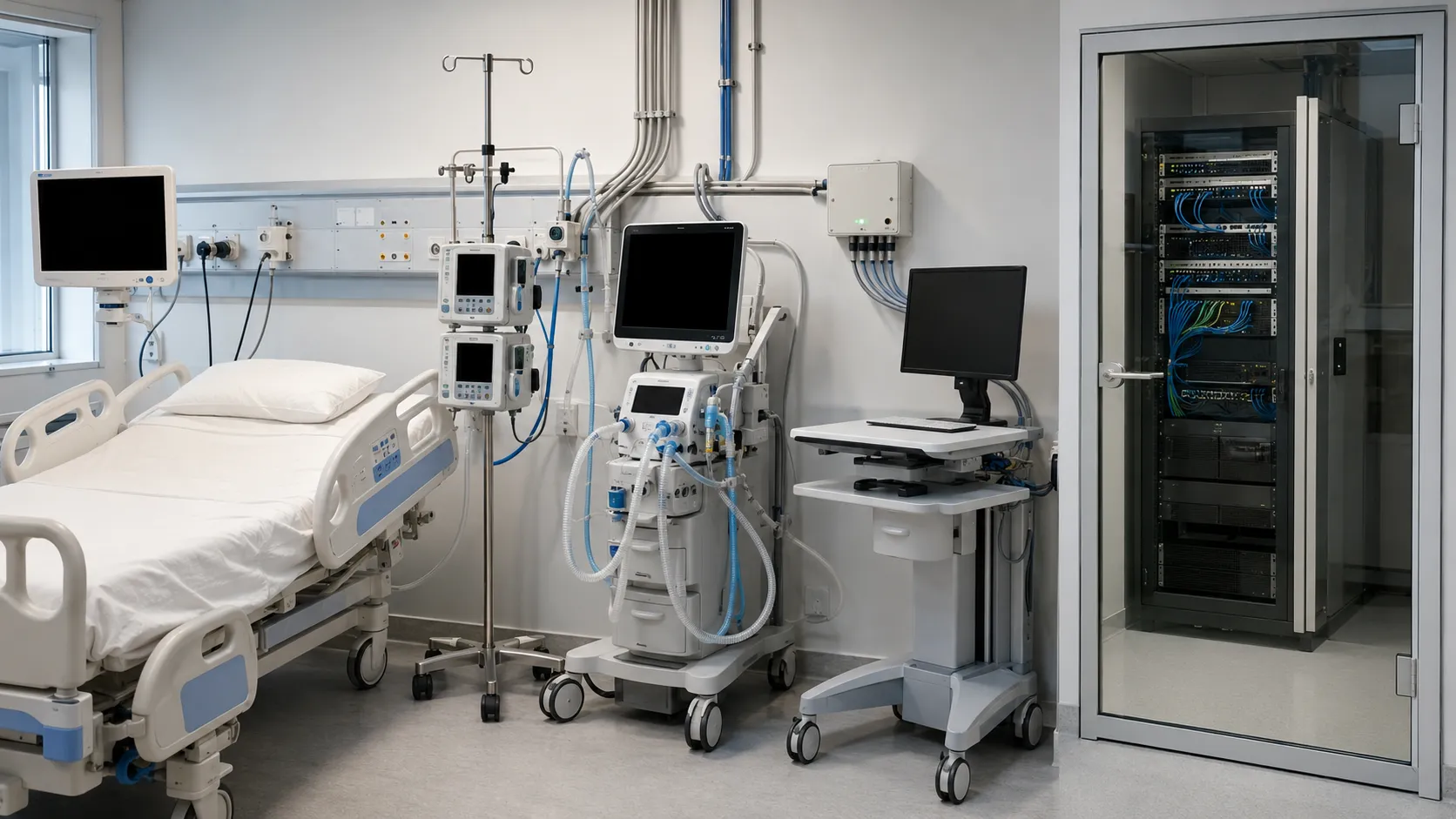
Medical equipment integration with hospital IT systems is a distinct topic from either equipment procurement or IT deployment, and it's the topic where a lot of otherwise-good decisions produce disappointing results. What follows walks through the integration picture organised by layer, because that's how integration is actually specified, built, tested, and (often) fails. The layers are physical device, integration gateway, electronic patient record, and downstream analytics and reporting. Each has its own standards, its own vendor landscape, and its own failure modes.
The device layer: what leaves the equipment
Medical devices vary enormously in what they can output and in what standards they use to output it. Some devices have full network capability with modern APIs; some have serial output only; some have proprietary output that requires vendor-specific software to interpret. The device layer standards that matter include IEEE 11073 (point-of-care medical device communication, particularly the PHDC/PHD family used for consumer and home devices), DICOM (for imaging modalities, universally used but with variation in specific profile implementation), and HL7 v2 messaging as the lowest-common-denominator data output for many hospital devices.
The specific challenges at this layer are that older devices often have limited or no network capability, that vendor implementations of nominally standard protocols vary in ways that create integration friction, and that some devices output data in formats that require substantial pre-processing before they can be used downstream. Procurement decisions that specify integration capability from the outset are much easier to integrate than those that treat integration as a later problem. This is one of the most under-emphasised aspects of specification and one where the integration cost of buying the wrong device can exceed the device price several times over.
The gateway layer: making devices talk to systems
Integration gateways sit between individual medical devices and the hospital's central information systems. They translate device output into standardised messages, add patient identity (typically from admission/discharge/transfer messages the gateway subscribes to), and route messages to the appropriate downstream consumers. Products in this space include Capsule Technologies (formerly Bernoulli, now Philips), Cerner CareAware, Epic Bridges, Nuvon, Iatric Systems, and various vendor-specific gateways from the major device manufacturers.
The gateway layer is where integration architecture is actually implemented. Well-designed gateway architectures let hospitals add new devices without rebuilding integrations for each one, isolate device changes from EPR changes, and provide the message-transformation capability that reconciles the various device output formats with the EPR's ingestion formats. Poorly-designed gateway architectures create tightly-coupled integrations that break when either the device or the EPR changes, and that require expensive vendor engagement for every modification.
IHE (Integrating the Healthcare Enterprise) profiles are the specification framework that guides gateway integration. IHE PCD (Patient Care Device) profiles cover the specific patterns for medical device data flow into hospital systems. IHE profile compliance is a genuinely useful specification criterion for both devices and gateways, though vendor claims of IHE compliance should be verified against specific profile implementation rather than accepted as a general statement.
The EPR layer: where data becomes clinically usable
Electronic patient records ingest data from integration gateways, from user entry, from external systems (laboratory, radiology, primary care), and increasingly from patient-generated sources. Modern UK NHS EPR deployments (Epic at multiple large trusts, Cerner across several, System C Careflow, Nervecentre, and others) all have substantial capabilities for medical device integration, though the actual implementation varies significantly by trust and by specific device.
The specific challenges at the EPR layer are workflow design (device data has to appear in clinicians' workflows in ways that support rather than distract from clinical decision-making), user interface design (a monitor value in the wrong place on the screen is worse than no value at all), and data governance (device-generated data has to be attributable, editable, and reviewable in defined ways). Well-implemented EPR device integration produces value that a poorly-implemented one doesn't, even with identical underlying devices and gateways.
HL7 FHIR (Fast Healthcare Interoperability Resources) is the current standard driving EPR-adjacent integration, particularly for cross-system and cross-organisation data flow. FHIR's REST API approach is more modern and more accessible than earlier HL7 versions, and its adoption in the NHS is being driven by NHS Digital and NHS England Interoperability standards. Devices and gateways that support FHIR output alongside older HL7 v2 messaging have longer functional life ahead of them than those that don't. See NHS Digital's interoperability programme for the current direction.
The analytics and downstream layer
Device data integrated into the EPR feeds downstream systems: clinical dashboards, quality and performance reporting, research databases, artificial intelligence and machine learning applications, and increasingly patient-facing portals showing patients their own data. Each of these has its own integration requirements and its own value propositions.
Clinical dashboards and command-centre systems have expanded in UK NHS trusts over recent years, aggregating operational and clinical data to support real-time decision-making about bed capacity, patient flow, and specific patient conditions. These are heavy consumers of integrated medical device data; without good integration at the underlying layers, dashboards display incomplete or misleading information.
Research and audit consumption of medical device data supports both national clinical audits and local quality improvement. UK NHS trusts submit substantial data to national audits (MINAP, SSNAP, TARN, NNAP, and dozens of others), and where device data is well-integrated the submission is largely automated; where it isn't, it requires substantial manual work that consumes clinical time and introduces error.
Cybersecurity as an integration concern
A dimension of integration that has moved from background consideration to primary specification concern. Medical devices connected to hospital networks are targets for cyberattack. The 2017 WannaCry attack on NHS systems, which affected multiple imaging modalities among many other systems, made this a board-level issue in UK trusts. More recent incidents in other health systems have kept the pressure on. Any device connected to a hospital network must now satisfy specific cybersecurity requirements as part of its procurement and integration.
The UK regulatory picture includes MHRA cybersecurity guidance for medical devices, the NHS Data Security and Protection Toolkit (DSPT), and Cyber Essentials Plus certification for organisations. Devices without demonstrable cybersecurity posture — unpatched operating systems, hard-coded credentials, no vulnerability management process from the vendor — are increasingly rejected in procurement even when they meet other specifications. This is the direction of travel and it is not reversing.
What good integration looks like
Integration that works well has a few consistent features. It is specified from the outset rather than bolted on afterwards. It uses standard protocols (IHE, HL7 FHIR, DICOM) rather than proprietary vendor lock-in where possible. It preserves the ability to swap devices without rebuilding integrations. It respects clinical workflow rather than imposing IT-convenient patterns on it. It has documented data governance and clear ownership. And it is maintained as an ongoing programme rather than treated as a one-off deployment.
Hospitals that succeed at integration invest in the integration architecture as a serious enterprise capability, with dedicated clinical informatics teams, robust gateway infrastructure, and long-term integration strategy. Hospitals that treat integration as a device-by-device problem tend to accumulate a fragmented estate of tightly-coupled integrations that become progressively harder to maintain and modify. The direction of NHS Digital and NHS England policy is toward the former; the practical reality in many trusts is closer to the latter, though this is changing steadily.
Medical device IT integration is a specialist domain requiring clinical informatics, IT infrastructure, cybersecurity, and clinical workflow expertise working together. This article is orientation for those approaching integration without specialist experience; specific integration projects should be led by clinical informatics teams with proper enterprise architecture support rather than being treated as individual device deployments. Named products reflect current UK NHS market presence and are not endorsements.
Integration as an enterprise capability, not a device-level bolt-on
Planning a substantial medical device integration project, evaluating the integration case for a proposed procurement, or trying to fix a fragmented integration estate that has grown organically over years? This is a specialist domain where the equipment cost is often the smaller part of the total picture, and where clinical informatics expertise matters as much as the specific technology choices. We can put you in touch with integration specialists and vendors who understand hospital IT from architecture up. Tell us what you're working on.
Frequently Asked Questions
HL7 FHIR (Fast Healthcare Interoperability Resources) is the current standard driving healthcare IT interoperability, particularly for cross-system and cross-organisation data flow. FHIR's REST API approach is more modern and more accessible than earlier HL7 versions, and its adoption in the NHS is being driven by NHS Digital and NHS England interoperability standards. Devices and gateways that support FHIR output alongside older HL7 v2 messaging have longer functional life ahead of them than those that don't.
Integrating the Healthcare Enterprise (IHE) profiles are specification frameworks that guide healthcare IT integration by defining the specific patterns for how systems should exchange data using underlying standards like HL7, DICOM, and FHIR. IHE PCD (Patient Care Device) profiles cover medical device data flow into hospital systems specifically. IHE profile compliance is a genuinely useful specification criterion for both devices and gateways, though vendor claims of compliance should be verified against specific profile implementation.
An integration gateway sits between individual medical devices and the hospital's central information systems, translating device output into standardised messages, adding patient identity from admission/discharge/transfer messages, and routing messages to appropriate downstream consumers. Products in this space include Capsule Technologies (Philips), Cerner CareAware, Epic Bridges, Nuvon, Iatric Systems, and various vendor-specific gateways from device manufacturers. The gateway layer is where integration architecture is actually implemented.
The most common causes are integration being treated as an afterthought to procurement rather than a specification requirement, tightly-coupled point-to-point integrations that break when either device or EPR changes, poor workflow design that puts data in the wrong place on the screen, and lack of ongoing maintenance for what needs to be an enterprise capability. Hospitals that succeed at integration invest in it as a serious capability with clinical informatics teams and long-term architecture strategy.
Medical devices connected to hospital networks are cyberattack targets, and cybersecurity has moved from background consideration to primary specification concern. Devices without demonstrable cybersecurity posture — unpatched operating systems, hard-coded credentials, no vulnerability management — are increasingly rejected in procurement even when they meet other specifications. UK regulatory framework includes MHRA cybersecurity guidance, NHS Data Security and Protection Toolkit (DSPT), and Cyber Essentials Plus. The 2017 WannaCry attack on NHS made this a board-level concern.
DICOM (Digital Imaging and Communications in Medicine) is the international standard for medical imaging communication, universally used across CT, MRI, ultrasound, and other imaging modalities. It covers image storage, transfer between systems, and communication with modality worklists that push patient identity from admission systems to imaging modalities. DICOM implementation varies in specific profile details between vendors, though the core standard is essentially universal in radiology.
Modern UK NHS EPR deployments include Epic (at multiple large trusts including UCLH, Cambridge University Hospitals, Great Ormond Street), Cerner (across several trusts including Royal Free and Chelsea and Westminster), System C Careflow, Nervecentre, and various regional or specialist systems. All have substantial capabilities for medical device integration, though actual implementation varies significantly by trust and by specific device. The direction of NHS policy is toward interoperability between EPR systems and with other health and care systems.