
Introduction
An 82-year-old woman fell in her bathroom at 6 am and lay on the floor for four hours before her carer arrived. In A&E, an X-ray showed an intracapsular neck of femur fracture on the right. She was on the trauma list for the following morning. Under spinal anaesthetic with sedation, the surgeon fixed the fracture with a cemented hemiarthroplasty using a modular implant from a specialist orthopaedic vendor. She was standing on the ward round the next day, mobilising with a Zimmer frame by day three, and discharged to a community rehabilitation bed on day five with follow-up arranged. Her outcome will depend heavily on the physiotherapy, nutrition, and social support of the next six months, but the acute equipment and surgical intervention have done their job: fracture stable, standing again, home in sight. This is one specific case from the roughly 70,000 UK hip fractures each year that are managed through pathways heavily shaped by equipment developments over the past three decades.
Musculoskeletal (MSK) care equipment covers an enormous span from acute trauma through elective surgery through rehabilitation and long-term function support. What follows walks through the picture organised by kind of intervention, because MSK equipment is most often specified around what the intervention is trying to do rather than which specific condition it is treating. The same fracture fixation equipment might be used in trauma from a fall, from a road traffic collision, or from a sporting injury; the same joint replacement equipment supports patients with osteoarthritis, inflammatory arthritis, or post-traumatic joint damage. The intervention shapes the equipment; the condition shapes the pathway.
Immobilisation
The oldest category of MSK intervention equipment and one that remains essential across all trauma and elective care. Plaster of Paris casting has been substantially replaced by synthetic fibreglass casting materials (3M Scotchcast, BSN Delta-Cast) that are lighter, water-resistant in some formulations, and quicker to apply. Splinting materials for wrist, ankle, and other injuries (SAM splints, various off-the-shelf and custom-moulded thermoplastic splints from BSN Ortho, Ossur, and other suppliers) support conservative management of specific injuries and post-operative immobilisation.
External fixation for complex fractures uses circular fixators (Ilizarov and Taylor Spatial Frame from Smith & Nephew), unilateral frames (Stryker Hoffmann 3, DePuy Synthes External Fixator), and increasingly hybrid designs. External fixation supports management of open fractures where soft tissue coverage is compromised, complex intra-articular fractures where internal fixation is difficult, and limb lengthening for congenital or post-traumatic deformity. The equipment cost is high, and the surgical technique is specialist.
Cervical collar and spinal immobilisation equipment for suspected spinal injury has evolved substantially, with current UK ATLS practice moving away from routine hard collar use in low-risk patients and toward more selective immobilisation. This is one example where the equipment specification followed evidence about when immobilisation actually helps rather than habitually applying it.
Internal fixation
The category that transformed fracture management from the mid-20th century onwards. Plate and screw fixation for long bone and specific fracture patterns uses locking compression plates from DePuy Synthes (LCP system), Stryker, Zimmer Biomet, Acumed, and various regional suppliers. Modern locking plate designs allow fixation in poor-quality bone (elderly osteoporotic fractures, periprosthetic fractures around existing implants) that non-locking plates struggled with.
Intramedullary (IM) nail fixation for long bone shaft fractures uses IM nails from Stryker (Gamma3 for hip, T2 for femur/tibia/humerus), DePuy Synthes (Trigen INTERTAN, Expert Tibial Nail), and Zimmer Biomet. Hip IM nails (short and long variants) have specific applications in extracapsular hip fractures, with the choice between an IM nail and sliding hip screw guided by fracture pattern and surgeon preference. Modern IM nails often include multiple distal locking options and specific proximal designs for particular fracture patterns.
Spinal instrumentation covers a large range of applications from single-level fusion to complex deformity correction. Pedicle screw systems from Medtronic (CD Horizon Solera), DePuy Synthes (EXPEDIUM), NuVasive, and Stryker support posterior spinal fixation. Interbody cages from various vendors support anterior column reconstruction and interbody fusion. Deformity correction rods, sublaminar wires, and specific paediatric growth-friendly spinal systems support the wider spinal surgical practice. Robotic-assisted pedicle screw placement (Medtronic Mazor, Zimmer Biomet ROSA, Globus ExcelsiusGPS) has entered UK spinal surgery in specific centres.
Joint replacement (arthroplasty)
The category with the largest UK volume outside trauma. Total hip replacement and total knee replacement together account for well over 200,000 UK NHS procedures per year, tracked through the National Joint Registry that records every UK arthroplasty procedure with implant details, patient factors, and revision outcomes. This is one of the strongest UK data infrastructures for equipment-outcome analysis.
Hip replacement implants come in cemented, uncemented, and hybrid configurations, with major vendors including Stryker, DePuy Synthes, Zimmer Biomet, Smith & Nephew, and Corin. Bearing surface options include ceramic-on-polyethene, metal-on-polyethene, ceramic-on-ceramic, and (historically, now largely abandoned after metal-on-metal failures) metal-on-metal. NJR data track long-term revision rates by implant, informing both surgical choice and procurement decisions.
Knee replacement implants similarly span major vendors, with cruciate-retaining, posterior-stabilised, and constrained designs available for different clinical situations. Partial (unicompartmental) knee replacement using Oxford Knee (Zimmer Biomet) and equivalent designs supports specific patients with disease limited to one knee compartment. Revision knee equipment for failed primary knee replacement is a specialist subcategory with substantially higher complexity and cost. Robotic-assisted total knee arthroplasty (Stryker Mako, Smith & Nephew CORI, Zimmer Biomet ROSA Knee) has expanded across the UK NHS in specific centres, with evidence continuing to develop on comparative outcomes vs conventional instrumentation.
Shoulder arthroplasty (anatomic and reverse designs), elbow arthroplasty, and ankle arthroplasty are lower-volume specialist areas with their own implant systems and specific patient selection.
Reconstruction and arthroscopy
Arthroscopic surgery using minimally invasive equipment has transformed knee and shoulder surgery over the past 30 years. Arthroscopy towers include high-definition camera systems, xenon or LED light sources, arthroscopic pumps, and specialist instrumentation from Arthrex, Smith & Nephew (Karl Storz, Stryker), and vendor-specific implant systems for procedures like ACL reconstruction, meniscal repair, rotator cuff repair, and labral repair.
Anterior cruciate ligament (ACL) reconstruction uses hamstring or patellar tendon autograft (occasionally allograft) fixed with vendor-specific fixation devices (interference screws, cortical buttons like Arthrex TightRope, Endobutton systems). Meniscal repair uses vendor-specific all-inside repair devices. Rotator cuff repair uses anchor-based suture fixation with vendor-specific anchor designs. Cartilage repair procedures use autologous chondrocyte implantation (ACI/MACI) and various regenerative approaches with specific equipment and cell processing infrastructure.
Rehabilitation and orthotic equipment
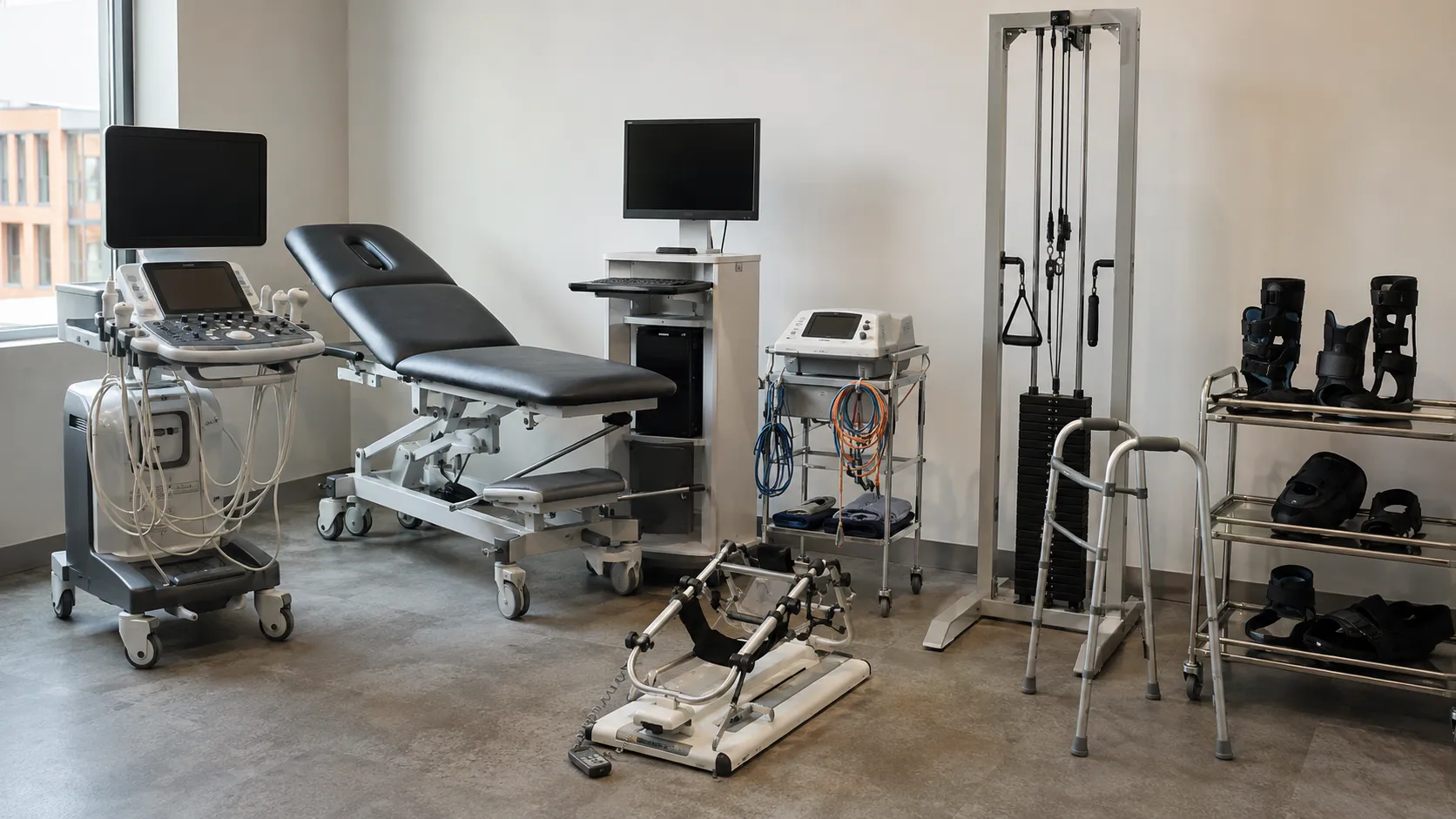
Post-surgical and post-trauma rehabilitation uses equipment ranging from simple to sophisticated. Basic rehabilitation equipment (parallel bars, treatment plinths, therapeutic exercise equipment) forms the backbone of physiotherapy departments. Continuous passive motion (CPM) machines are less used than they once were as evidence has questioned the specific claims made for them. Body-weight-supported training and functional electrical stimulation have been discussed in the neurological rehabilitation context; they also apply to selected orthopaedic and spinal cord injury rehabilitation.
Assistive devices for mobility and function span walking aids (Zimmer frames, elbow crutches, various rollator designs from Drive DeVilbiss, TGA, NRS Healthcare), wheelchairs (from basic transport chairs through active-user wheelchairs from Ottobock, Sunrise Medical Quickie, Invacare), and specialist seating for postural support. Assistive equipment for daily living includes reaching aids, dressing aids, kitchen adaptations, and bathroom equipment, with specialist provision through occupational therapy services.
Prosthetics and orthotics form a specialist provision area. Prosthetic limbs range from basic body-powered upper limb prostheses through sophisticated myoelectric arms (Ottobock bebionic, Össur i-Limb) and advanced lower limb prostheses (Ottobock C-Leg, Össur Power Knee, Endolite Örion). NHS prosthetic services provide amputees with appropriate prostheses based on their specific mobility level and functional goals. Orthotics for foot, ankle, knee, and spinal support are provided through specialist orthotic services with custom and off-the-shelf options.
The wider MSK equipment context
UK MSK equipment procurement is shaped by national frameworks in specific areas (the NHS Supply Chain framework for many implant categories), by National Joint Registry data on implant outcomes, and by professional society guidance from the British Orthopaedic Association and subspecialty groups (BASK for knee, BASS for shoulder, BOFAS for foot and ankle, BSS for spine). The speciality is heavier on capital equipment and consumable implants than most surgical specialities, and procurement decisions have substantial financial implications across the speciality's high case volumes.
The National Hip Fracture Database tracks acute hip fracture care across UK trusts, providing outcome benchmarking that influences equipment procurement and pathway design. Similar audit infrastructure exists for other MSK conditions to varying degrees. See the British Orthopaedic Association for the wider professional context around MSK care and equipment.
Musculoskeletal care equipment procurement is a specialist domain with substantial financial implications given the high case volumes and expensive consumable implants involved. This article is an orientation for those approaching the field from a general healthcare equipment background; specific procurement should be led by orthopaedic clinical, theatre, and procurement leads with appropriate subspecialty expertise. Named products reflect current UK practice and are not endorsements. National Joint Registry data should inform arthroplasty implant selection alongside surgeon preference and patient factors.
MSK equipment as high-volume, high-value specialist procurement
Working through arthroplasty implant contracts, planning a spinal surgery service expansion, refreshing arthroscopy tower provision across theatres, or building the equipment case for a robotic-assisted arthroplasty programme? MSK equipment procurement is high-volume, high-value, and requires close specialist orthopaedic input alongside procurement expertise. We can point you toward specialists who work in the specific MSK subspecialisms. Get in touch about what you're building.
Frequently Asked Questions
The National Joint Registry records every UK arthroplasty procedure with implant details, patient factors, and revision outcomes, tracking well over 200,000 hip and knee replacement procedures per year across the UK NHS and independent sector. It is one of the strongest UK data infrastructures for equipment-outcome analysis and informs both surgical choice and procurement decisions through published implant-specific revision rate data. Similar registry infrastructure supports other arthroplasty categories including shoulder, elbow, and ankle.
The UK manages roughly 70,000 hip fractures per year through pathways shaped by the National Hip Fracture Database. Standard pathway involves rapid assessment in A&E, orthogeriatric medical review, surgery within 36 hours where medically appropriate, cemented hemiarthroplasty or IM nail fixation depending on fracture pattern, early mobilisation with physiotherapy, and structured discharge planning to appropriate rehabilitation environment. Modular hip fracture implants from specialist orthopaedic vendors have made the surgical component more standardised than it was 20 years ago.
Robotic-assisted total knee arthroplasty platforms (Stryker Mako, Smith & Nephew CORI, Zimmer Biomet ROSA Knee) have expanded across UK NHS in specific centres, using preoperative planning and intraoperative robotic guidance for implant positioning. Evidence continues to develop on comparative outcomes vs conventional instrumentation. Uptake varies significantly between trusts, and the equipment represents a substantial capital investment. Robotic-assisted spinal surgery (Medtronic Mazor, Zimmer Biomet ROSA, Globus ExcelsiusGPS) similarly has expanded in specific UK spinal centres.
External fixation using circular fixators (Ilizarov and Taylor Spatial Frame from Smith & Nephew), unilateral frames (Stryker Hoffmann 3, DePuy Synthes External Fixator), and hybrid designs supports management of open fractures where soft tissue coverage is compromised, complex intra-articular fractures where internal fixation is difficult, and limb lengthening for congenital or post-traumatic deformity. Equipment cost is significant and surgical technique is specialist. Modern external fixation is delivered by specific limb reconstruction teams in most UK centres.
Arthroscopy towers include high-definition camera systems, xenon or LED light sources, arthroscopic pumps, and specialist instrumentation from Arthrex, Smith & Nephew, Karl Storz, and Stryker. Vendor-specific implant systems support procedures like ACL reconstruction (interference screws, cortical buttons like Arthrex TightRope, Endobutton), meniscal repair (all-inside repair devices), and rotator cuff repair (anchor-based suture fixation). Arthroscopic surgery has transformed knee and shoulder surgery over the past 30 years.
Spinal instrumentation covers pedicle screw systems from Medtronic (CD Horizon Solera), DePuy Synthes (EXPEDIUM), NuVasive, and Stryker for posterior fixation; interbody cages for anterior column reconstruction; deformity correction rods for scoliosis and other deformity surgery; and specific paediatric growth-friendly spinal systems. Robotic-assisted pedicle screw placement has entered UK spinal surgery in specific centres. The equipment span is substantial and procurement decisions require specialist spinal surgical input.
NHS prosthetic services provide amputees with prostheses based on their mobility level and functional goals. Prosthetic limbs range from basic body-powered upper limb prostheses through sophisticated myoelectric arms (Ottobock bebionic, Össur i-Limb) and advanced lower limb prostheses (Ottobock C-Leg, Össur Power Knee, Endolite Örion). Provision has expanded significantly in recent decades, particularly following the establishment of specialist military amputee rehabilitation services that raised standards across NHS prosthetic provision more broadly.