
Introduction
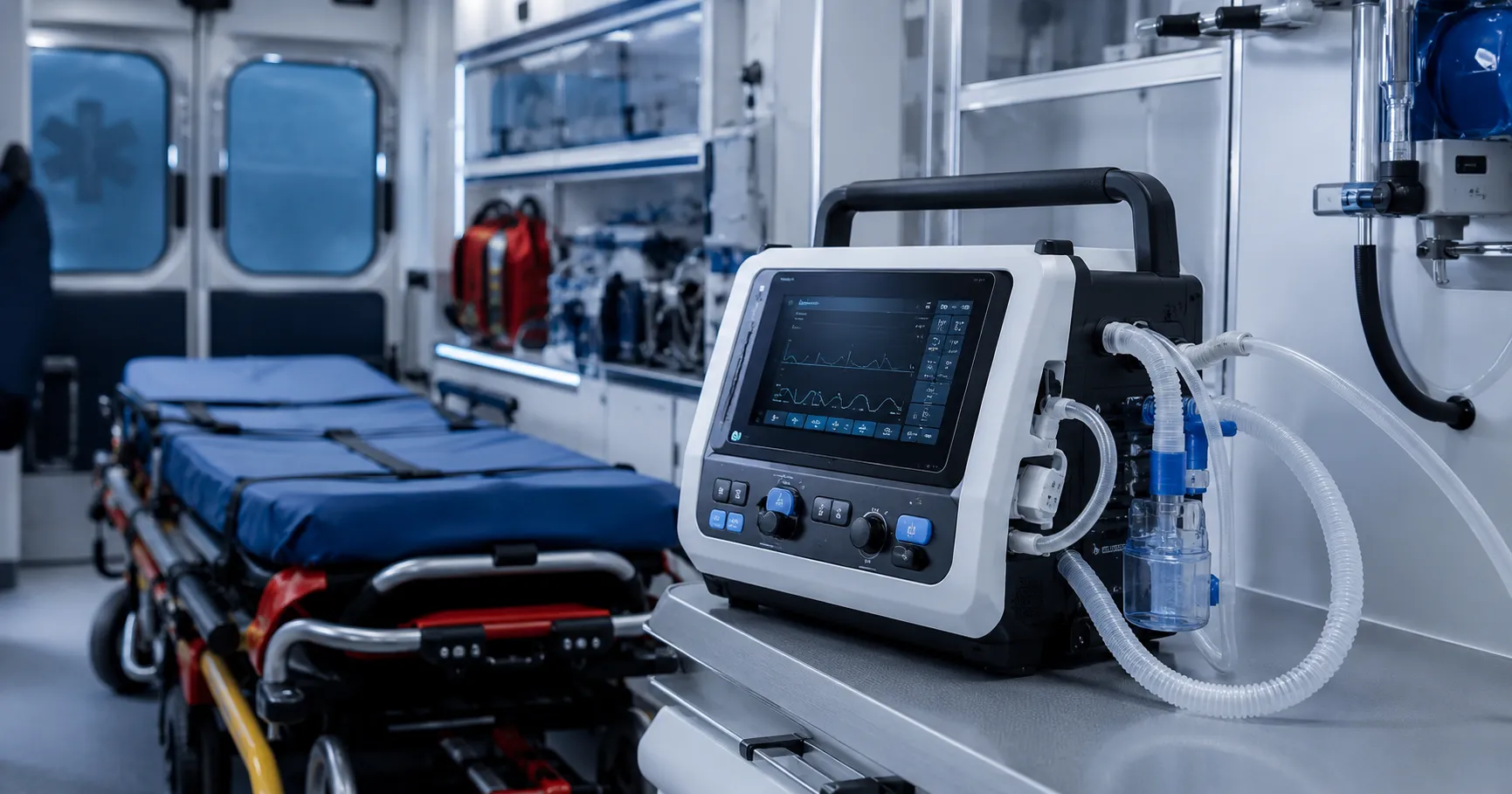
In emergency and transfer care, the transport ventilator sustains patients on the move — so choosing the right one matters. The honest answer to "which is the best transport ventilator?" is that it depends on your transfers, your patients and your environment. A ventilator suited to in-hospital transfer may differ from one for road or air retrieval. What does not change is the set of features and qualities that define a dependable transport-grade ventilator.
This buyer's guide sets out exactly what to look for, the criteria that matter most, how to choose, and what to check before you commit — so you can identify the best transport ventilator for your service with confidence, wherever you operate.
The short version — what a transport ventilator must do
Strip it back, and the best transport ventilator does three things well — moves easily, ventilates reliably, and runs independently of fixed supplies.
-
Portable and robust — compact, rugged design built for transfer and retrieval.
-
Reliable modes — the ventilation modes your transfers need, with monitoring.
-
Independent operation — dependable battery and efficient oxygen use away from fixed supplies.
What makes a transport ventilator transport-grade
-
Portability and durability. A compact, rugged, lightweight design built to withstand transfer, retrieval and rough handling.
-
Appropriate ventilation modes. The volume, pressure and support modes your transfers need, including non-invasive options where required.
-
Battery independence. Dependable internal battery life and hot-swap or external power options for long transfers.
-
Oxygen efficiency. Efficient oxygen use and clear oxygen management to conserve cylinder supplies on the move.
-
Monitoring and alarms. Essential monitoring with clear, prioritised alarms suited to noisy transfer environments.
-
Environmental tolerance. Tolerance of temperature, vibration and altitude where road or air transfer requires it.
-
Simple, fast set-up. Quick, clear set-up and operation for time-critical emergency use.
-
Service and consumables. Available circuits, batteries, filters, calibration and dependable service support.
The buyer's criteria
|
Criterion |
Why it matters in transfer |
|
Portability |
Compact, rugged design suits transfer |
|
Modes |
Must cover the ventilation transfers need |
|
Battery |
Independent power is essential on the move |
|
Oxygen |
Efficient use conserves cylinder supply |
|
Alarms |
Clear alarms suit noisy environments |
|
Environment |
Must tolerate vibration & altitude |
|
Support |
Circuits, batteries, filters & service |
|
Approval |
UKCA/CE/FDA/SFDA/SAHPRA for your market |
Choosing transport ventilators?
We'll match transport ventilators to your service. Tell us your transfers, patients and environment — we'll help you shortlist ventilators that fit, integrate cleanly and are approved for your market.
No pressure, no obligation. → Talk to the team
Choosing the best transport ventilator for your service
-
Define your transfers in-hospital, road or air, and the patients and modes each needs.
-
Match portability and battery, rugged design, and battery independence for your transfer durations.
-
Plan oxygen and environment oxygen efficiency and tolerance of vibration and altitude where needed.
-
Decide new or refurbished by weighing feature currency, warranty and support life.
-
Confirm market approval then plan circuits, batteries, filters and service support.
For the wider picture, see our guide to emergency and critical-care equipment and how transport ventilators fit into a full retrieval setup.
New or refurbished for the service?
Transport ventilators are sometimes available certified refurbished, and certified units are supplied for some settings. For transfer use, set a high bar: insist on certified refurbishment, a warranty, current software, calibration, dependable service and consumable support, and make sure the ventilator suits your transfer environment, has dependable batteries and is approved for your market. New ventilators bring the latest modes and battery performance and the longest support life with full warranties — often the right call for retrieval and air transfer. Many services mix the two: new for retrieval, certified refurbished for in-hospital transfer. Whatever you choose, confirm the device class and certification for your market.
The leading transport ventilator manufacturers
The transport ventilation market is served by several established manufacturers — names you'll commonly evaluate include Hamilton Medical, Dräger, ZOLL, Weinmann, Medtronic and ResMed, among others. Each has strengths across portability, modes, battery and oxygen efficiency, and each offers ranges spanning in-hospital transfer ventilators to ruggedised retrieval systems. Rather than chasing a single "best brand," the practical approach is to match a manufacturer's portability, modes and support to your transfers and environment. A good supplier helps you compare like-for-like across manufacturers and source the right fit.
Approval by region
|
Region |
Regulator |
Requirement |
|
United Kingdom |
UKCA mark (CE accepted to 2028–2030) |
|
|
European Union |
CE marking under EU MDR 2017/745 |
|
|
United States |
510(k) clearance or PMA approval |
|
|
Gulf (GCC) |
SFDA & GCC bodies |
National registration / GCC conformity |
|
South Africa |
Medical device licensing |
For clinical guidance, the NICE and World Health Organisation resources are useful references. If you're equipping a transfer service, our buyer hub sets out how to purchase with confidence.
More from Business
-
Buyers — source the right transport ventilators for your service.
-
Suppliers — list your emergency and critical-care equipment and reach buyers worldwide.
-
Advertise — promote your products and services to a clinical audience.
-
Business overview — explore everything MediGear offers healthcare organisations.
Disclaimer
This article is for general information only and does not constitute clinical, medical, procurement or regulatory advice, nor an endorsement of any particular manufacturer or product. Requirements and device capabilities vary by setting, patient need and country, and change over time. Manufacturer names are mentioned for general orientation only. Always confirm a device suits the intended clinical use, integrates with your systems, and is approved for your market (for example, UKCA, CE under EU MDR, FDA, SFDA/GCC or SAHPRA), and consult qualified clinical, biomedical engineering and procurement professionals for decisions specific to your organisation. medigear.uk accepts no liability for actions taken based on this content.
The right transport ventilators for your service.
We supply transport ventilators to emergency and transfer teams across the UK, Europe, the US, the Gulf and South Africa — helping you compare options, integrate cleanly and obtain compliant, supported equipment, new or refurbished.
Frequently Asked Questions
A transport-grade ventilator should be compact, rugged and lightweight, provide the ventilation modes your transfers need with essential monitoring, offer dependable battery independence and oxygen efficiency, have clear alarms suited to noisy environments, tolerate vibration, temperature and altitude where required, set up quickly for time-critical use, and come with dependable circuit, battery and service support.
A transport ventilator is compact, rugged and battery-driven for moving patients, with a focused set of modes and monitoring and efficient oxygen use. An ICU ventilator provides the full range of modes, detailed monitoring and weaning tools for sustained high-acuity ventilation at the bedside. Use the device matched to the setting; transfers need a purpose-built transport ventilator.
Transfers rely on finite oxygen cylinder supplies, so efficient oxygen use extends how long a cylinder lasts and reduces the risk of running short on a long transfer. Transport ventilators with efficient oxygen management and clear oxygen monitoring help teams plan and conserve supplies. Assess oxygen efficiency and cylinder planning for your typical transfer durations.
Yes, certified refurbished transport ventilators are used in some settings. Choose carefully: insist on certified refurbishment, a warranty, current software, calibration, dependable service and consumable support, and confirm the ventilator suits your transfer environment, has dependable batteries and is approved for your market. Retrieval and air transfer often prefer new ventilators for the latest modes and battery performance.
Road and air transfers expose ventilators to vibration, temperature extremes and, for air transfer, altitude changes that can affect performance. Transport ventilators intended for these environments are built to tolerate them. Confirm the environmental tolerances and any air-transfer certification needed for your service, and match the ventilator to your transfer types.
Transport ventilators must be approved for the market where they're used — UKCA or CE in the UK and EU, FDA clearance in the US, and SFDA or SAHPRA registration in the Gulf and South Africa — with any additional requirements for air transfer where relevant. They're higher-risk devices, so expect thorough documentation and plan for circuits, batteries, filters, calibration and ongoing service.