
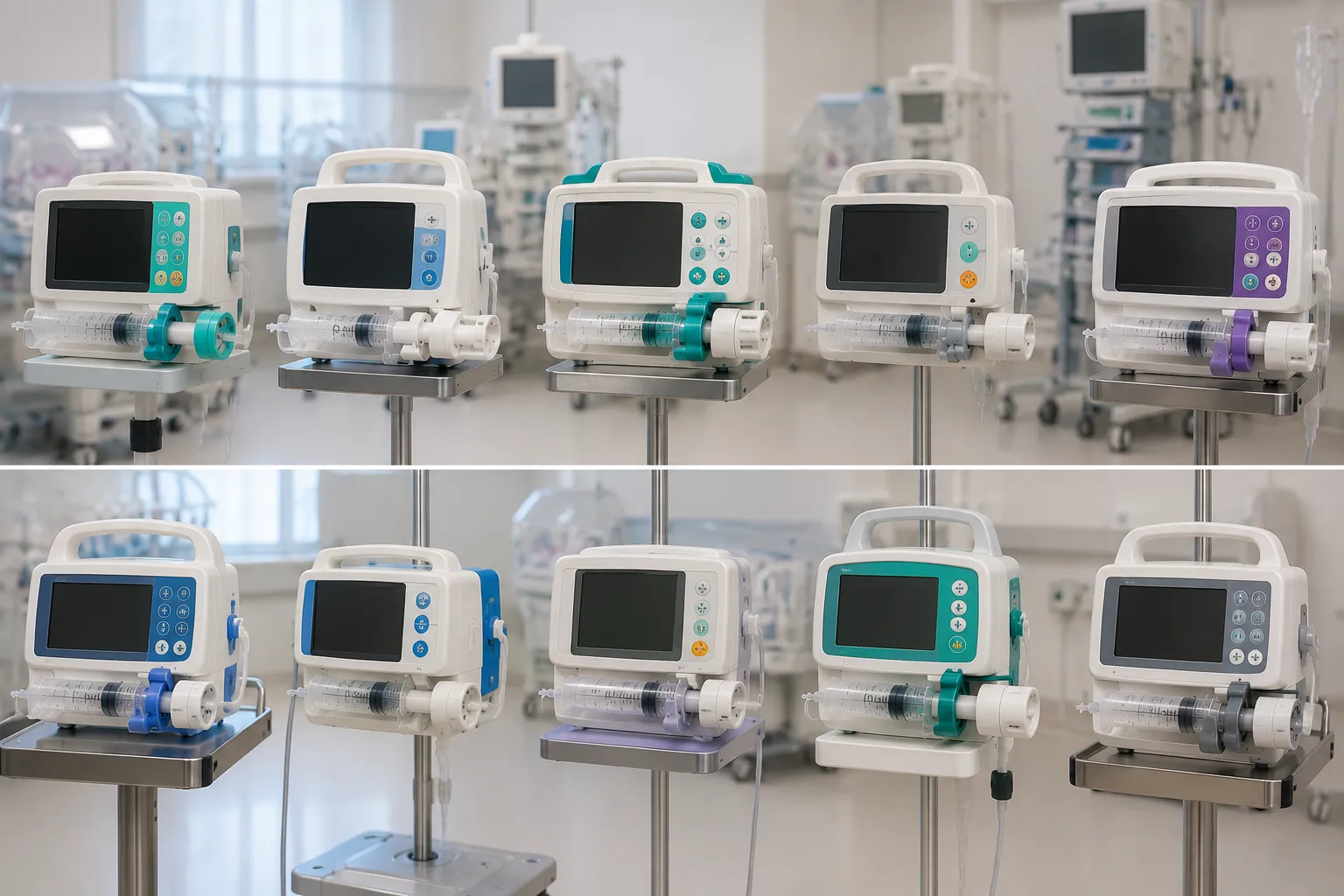
Neonatal infusions expose every weakness in a syringe pump. At very low rates, small mechanical imprecision becomes meaningful, start-up delays lengthen, and the volume held in an extension line can represent a significant part of an hourly dose. Choosing well means looking past the feature list at how the pump behaves at the rates your unit actually uses.
The ten pump types below cover neonatal and paediatric infusion needs. Each entry explains the design and what to confirm before purchase.
Why low-rate performance is the deciding factor
Three behaviours matter most. Flow continuity describes how smoothly the drive advances rather than how it steps up; characteristics describe how quickly flow becomes steady after an infusion begins or a syringe is changed. Occlusion response describes how much pressure builds before an alarm sounds, and what happens to the stored volume when the occlusion clears.
Smaller syringes generally improve low-rate performance, but they require frequent changes-off. That frequent changes-off should be discussed with the clinical team rather than settled on specification alone.
The ten syringe pump types
1. Standard single-channel syringe pumps
The general-purpose device, delivering from one syringe with programmable rate and volume limits. Suitable across many neonatal infusions where low-rate performance is confirmed.
2. Neonatal-configured syringe pumps
Set up with rate resolution, alarm settings and syringe support suited to very small volumes, often with a neonatal drug library profile.
3. Pumps with anti-siphon protection
Designed to reduce the risk of uncontrolled flow if the syringe is positioned above the patient or a plunger is dislodged. Confirm whether protection is in the pump, the line, or both.
4. Pumps with adjustable occlusion pressure
Allow the alarm threshold to be set lower for neonatal infusions, so occlusions are detected sooner, and less volume is stored in the line.
5. Pumps with bolus reduction on occlusion release
Automatically relieve stored pressure when an occlusion clears, reducing the unintended bolus that would otherwise reach the patient.
6. Dual-channel and stackable syringe pumps
Two channels in one device or docking systems linking several pumps. These reduce cabling and bedside clutter where multiple infusions run together.
7. Pumps with automatic syringe recognition
Detect the syringe brand and size fitted, to reduce programming errors. Confirm which syringe types are recognised and what the unit stocks.
8. Pumps with drug libraries and dose limits
Apply preset concentration and dose limits by clinical area. Establish who maintains the library and how updates are delivered to the device.
9. Ambulatory and transport syringe pumps
Compact, battery-powered devices for movement between units or to imaging. Battery endurance and secure mounting are the practical measures.
10. Pumps with infusion data logging
Record events and settings for review and audit. Confirm how data is retrieved and whether software or network access is required.
Lines, syringes and practical setup
-
Extension line volume. Use low-volume lines where appropriate, since priming volume affects how quickly a change takes effect in the patient.
-
Syringe size. Smaller syringes usually improve low-rate accuracy but require more frequent changes.
-
Pump height. Keep the pump at the level agreed in local policy, as height differences affect flow at very low rates.
-
Line selection. Confirm compatibility of filters, valves and light-protected lines with the medicines in use.
-
Mounting. Check pole clamps and docking arrangements against incubator and cot layouts.
Training, servicing and fleet consistency
Training should cover syringe loading technique, purging practice, line change routine and what staff do when an occlusion alarm sounds. These practical steps affect delivered dose more than any programming detail.
Fleet consistency matters especially in neonatal units, where staff move between cot spaces constantly. Fewer models means fewer opportunities for a setting to be misread under pressure.
For servicing, agree planned maintenance intervals, flow accuracy verification at low rates, electrical safety testing, battery replacement and response times. Confirm spare-part availability and expected life, and ensure the unit receives published device safety alerts for field staff and clinical engineering.
Final thoughts
Judge neonatal syringe pumps on their behaviour at low rates, not their feature count. Confirm flow continuity, start-up characteristics, occlusion handling and syringe recognition, then keep the fleet as consistent as clinical need allows. Settle line selection, library governance and servicing before delivery.
This article provides general procurement guidance for healthcare organisations. It is not clinical advice, does not cover dosing decisions, and does not replace manufacturer instructions or local neonatal policy.