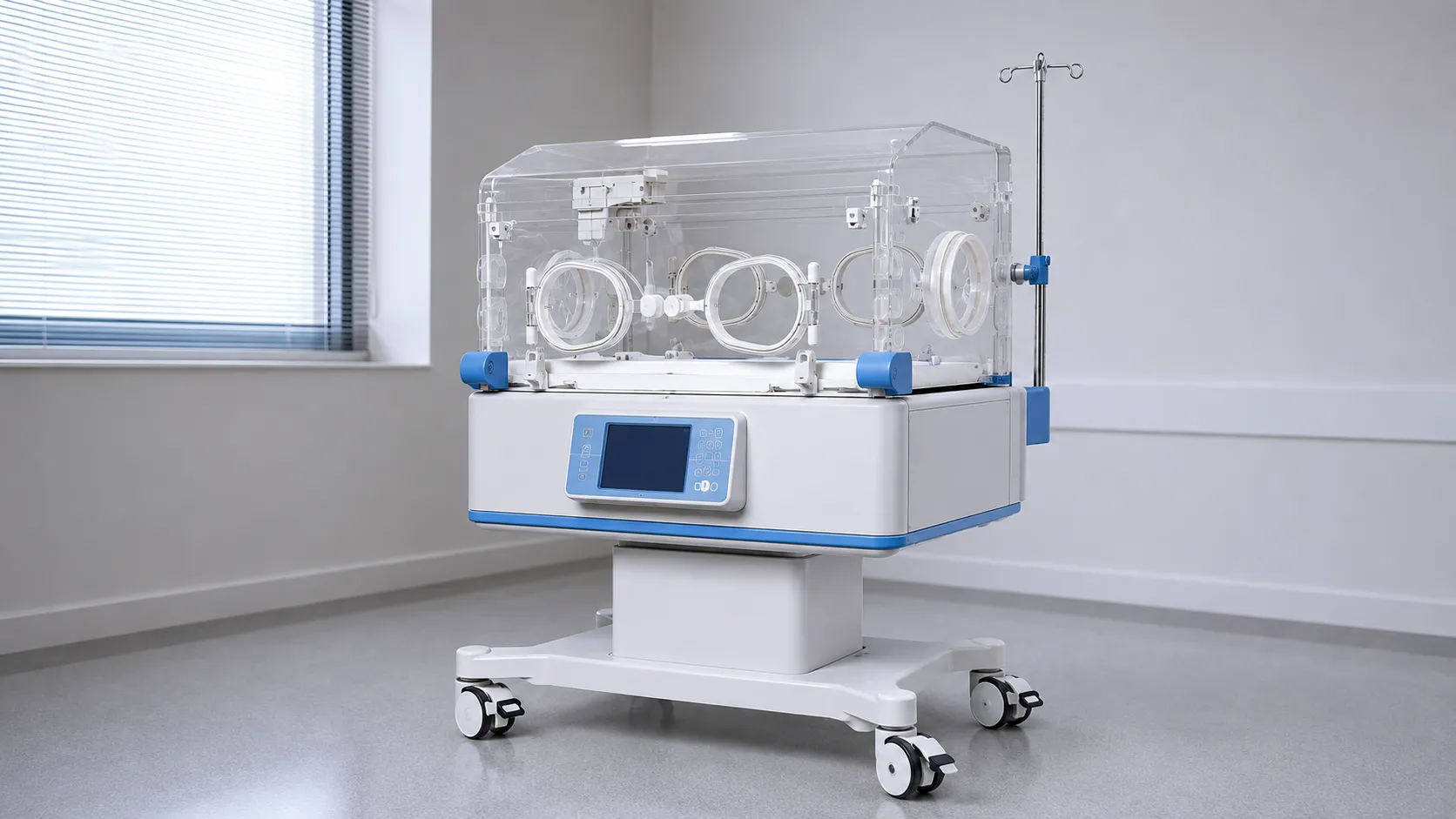
An incubator is a controlled environment that staff must reach into many times a day. Every design balances two competing demands: keeping temperature and humidity stable, and allowing access for care without disturbing either. How a particular model resolves that tension is what separates one from another in daily use.
The ten incubator types below cover intensive care, special care and transport. Each entry explains its role and what to confirm before purchase.
Environment control, access and noise
Temperature control may be air-regulated or skin-regulated through a probe, and most units offer both. Humidity control matters particularly for preterm infants and comprises water supply, reservoir filling, and a cleaning routine that prevents contamination of the humidification system.
Noise is the factor most often overlooked at purchase time. Motor and airflow noise inside the canopy and the sound of port doors closing are part of the infant's environment throughout the day. Ask for measured sound levels inside the canopy rather than accepting a general claim.
The ten incubator types
1. Closed intensive care incubators
Fully enclosed canopies with servo temperature and humidity control, designed for the most preterm and unstable infants.
2. Hybrid incubator and open warmer units
Convert between a closed incubator and an open radiant warmer without moving the infant, which supports procedures and changing clinical needs.
3. Special care incubators
Simpler closed units for infants who need a controlled environment but less intensive support, often without full humidity control.Control incubators
Battery-powered enclosed units on a trolley base for movement between wards, hospitals and imaging. Mounting, battery endurance and gas provision are decisive.
5. Incubators with integrated weighing scales
Weigh the infant in place to avoid handling and heat loss. Confirm calibration arrangements for the scale function.
6. Incubators with height-adjustable stands
Allow staff to set a comfortable working height and support parent access at the bedside.
7. Incubators with integrated phototherapy
Provide phototherapy within the unit under clinical direction. Confirm how the light source is serviced and how output is verified.
8. Incubators with imaging trays
Include a cassette or detector tray beneath the mattress so imaging can be performed without transferring the infant.
9. Incubators with data output
Record environmental parameters and export them to monitoring or record systems. Confirm the interface and who configures it.
10. Incubators designed for family-centred access
Larger doors, wider canopy openings and layouts intended to make parent contact easier while maintaining the controlled environment.
Cleaning, consumables and unit workflow
Decontamination between infants is a substantial task, so the design should support it. Ask how far the unit dismantles, which can be disassembled, and how the humidification system is cleaned and dried. A unit that takes a long time to turn around effectively reduces cot capacity on a busy unit. Consumables deserve the same attention: mattresses, humidity reservoirs, filters and probes all need a defined supply route, and filters in particular are easy to overlook until performance drifts.
What to confirm before ordering
-
Control modes. Confirm air and skin servo control and how they are selected.
-
Humidity performance. Establish range, water supply arrangements and cleaning requirements.
-
Noise levels. Ask for measured sound inside the canopy.
-
Access design. Check port doors, canopy opening and line management with equipment attached.
-
Cleaning. Confirm dismantling, approved agents and turnaround time.
-
Consumables. Verify supply for the mattresses, filters, probes and reservoirs.
Training, checks and servicing
Training should cover control modes, probe placement, humidity management, alarm response, safe opening technique and the full cleaning procedure. Nursing staff carry most of this, so build sessions around their workflow rather than a technical demonstration.
Routine checks should confirm alarm function, probe availability, filter condition and water re,servoir status, following locin accordance with.
For servicing: temperature and humidity calibration, filter replacement, alarm testing, electrical safety testing, etc. E and spare parts, ensure the test is completed. Hence, field safety notices are sent to neonatal and engineering teams.
Consumables: the consumables, filters and probes should be confirmed. Availability across intensive care and transport models can be checked with verified supplier listings.
Final thoughts
Judge incubators on daily use: access with lines attached, noise inside the canopy, humidity management and cleaning turnaround. Confirm consumable supply and calibration arrangements before delivery, and involve nursing staff in the assessment, since they interact with the unit far more than anyone else.
This article provides general procurement guidance for healthcare organisations. It is not clinical or neonatal care advice, and it does not replace manufacturer instructions, training or local policy.