
Introduction
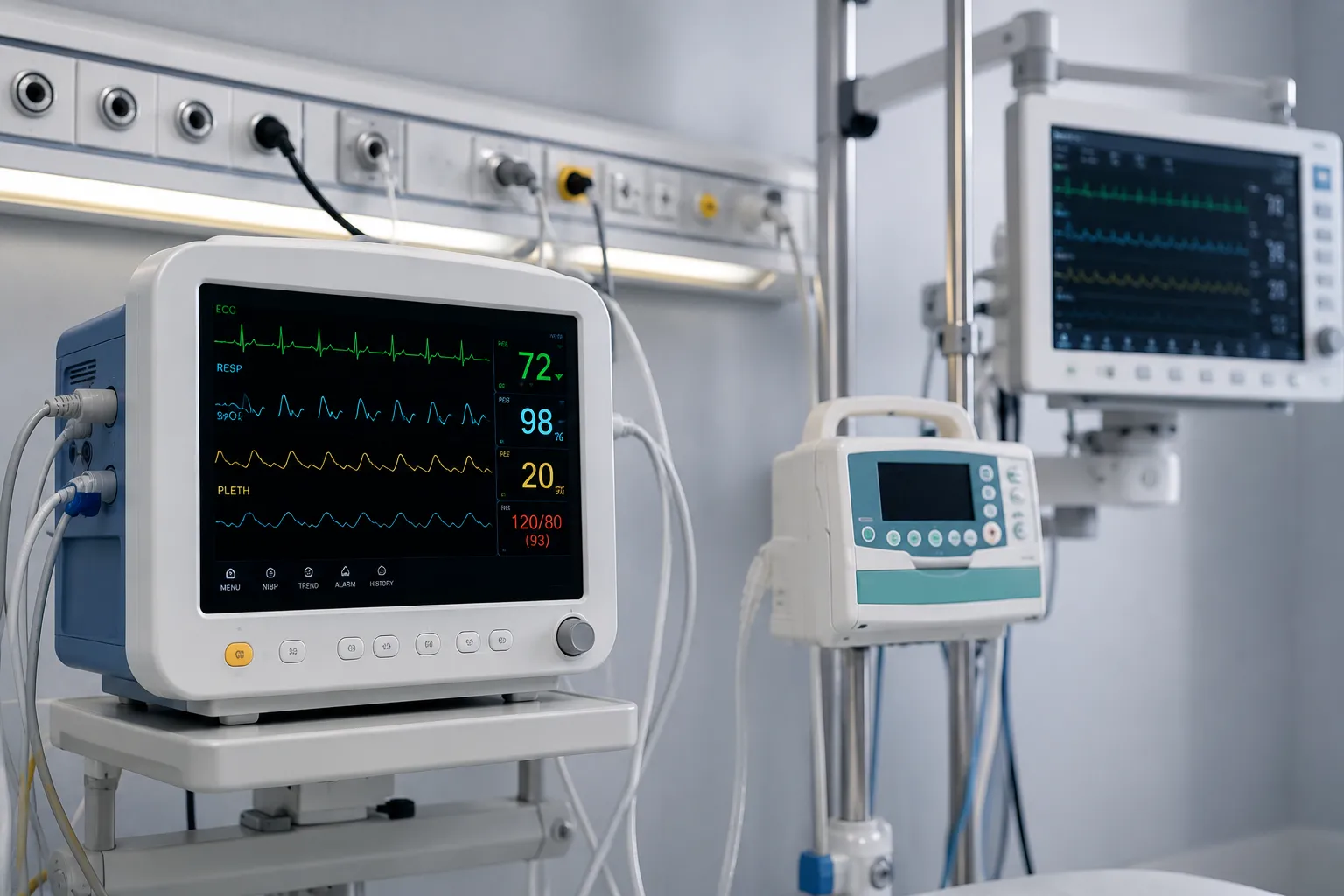
A patient monitor has always been good at measuring — heart rate, blood pressure, oxygen levels, breathing — and at sounding an alarm when a number crosses a threshold. What it has never done is understand. Artificial intelligence is beginning to change that, reading the streams of data a monitor produces and spotting the patterns that hint at trouble before a single threshold is crossed.
This article explains, in plain terms, what artificial intelligence in patient monitoring actually does, where it genuinely helps, and what to keep in mind before relying on it. It is written for clinical, procurement, and biomedical engineering teams across the UK, Europe, the US, the Gulf, and South Africa who are weighing up monitoring that promises to do more than measure.
The short version
-
AI in patient monitoring reads continuous vital-sign data to spot patterns, not just breach thresholds.
-
Its most valuable roles are to warn of deterioration early and to make alarms more meaningful.
-
It supports the clinician's judgement; it does not replace the person at the bedside.
-
Its usefulness depends on good data, careful validation and proper oversight.
From measuring to noticing
A traditional monitor treats each measurement in isolation and against a fixed limit: if the heart rate passes a set number, it alarms. That is useful but blunt, because a patient can be sliding into danger while each number still sits within its limits. Artificial intelligence works differently. By analysing many signals together, and how they change over time, it can recognise the shape of a developing problem before any one threshold is breached.
This shift — from measuring to noticing — is the heart of what AI adds to patient monitoring. It does not invent new vital signs; it reads the familiar ones more intelligently, looking for subtle, combined changes that a busy human eye might miss over hours of data.
Warning earlier, when it matters most
The clearest benefit is early warning. Much of the harm that befalls hospital patients stems from a deterioration that, in hindsight, had been building for hours. AI-based early-warning tools continuously monitor trends and can flag a patient who is beginning to slip, prompting a review while there is still time to act rather than after a crisis has occurred.
This matters most on general wards, where patients are checked only periodically, and a decline can go unnoticed between rounds. A system that watches without pause and raises its hand when a worrying pattern appears helps staff get to the right patient sooner — which is often the whole difference in the outcome.
Reading the rhythm of the heart
Another well-established role is in the heart's electrical signals. AI trained on vast numbers of traces can watch a continuous rhythm and pick out the fleeting, dangerous irregularities that a periodic glance would miss, flagging them for a clinician to confirm. Because these events can be brief and unpredictable, a tireless automated watcher is genuinely valuable here.
The principle is the same throughout: the software does not diagnose or treat; it draws attention. It turns a long, featureless stream of data into a short list of moments worth a human's close attention, which is exactly where a clinician's time is best spent.
Taming the alarms
Monitoring has a paradox: the more closely you watch, the more alarms you generate, and too many alarms are dangerous in themselves. When alerts sound constantly —most of them false —staff grow numb, and a real emergency can be lost in the noise—a well-documented problem known as alarm fatigue.
Artificial intelligence offers a way through. By judging the wider context of a reading rather than reacting to a single number, it can suppress the trivial alerts and make the important ones stand out. Fewer, better alarms mean staff can trust what they hear, which is a quiet but real improvement in safety.
Where AI helps in monitoring
|
Task |
What AI adds |
Why it matters |
|
Deterioration |
Warns of decline early |
Action before a crisis |
|
Rhythm analysis |
Flags fleeting events |
Catches what glances miss |
|
Alarm management |
Fewer, better alerts |
Counters alarm fatigue |
|
Remote monitoring |
Watches patients at a distance |
Care beyond the bedside |
A watch that reaches beyond the ward
Because the analysis is software, it can travel. The same intelligence that monitors an inpatient can monitor a patient at home via a wearable or portable monitor, alerting a clinical team when something changes. This is central to the virtual wards and remote-monitoring schemes that increasingly care for people outside the hospital, keeping a clinical eye on them without keeping them in a bed.
Questions worth asking a supplier
-
What data was the tool validated on, and how large and representative was it?
-
How does it perform for the kinds of patients you actually treat?
-
How does it integrate with your existing monitors, systems, and records?
-
How is its performance monitored once it is live on the ward?
-
Who is accountable, and how is it supported, if performance slips?
Continuous, not occasional
Part of what makes AI monitoring powerful is simply that it never looks away. A nurse checks a ward patient every few hours; an AI monitor watches every second in between, holding the whole trend in view rather than a series of snapshots. It is that unbroken attention, as much as any single clever calculation, that lets a slow decline be caught while it can still be reversed.
The flip side is that continuous watching only helps if what it produces is trusted and acted upon. A stream of alerts no one believes is worse than none, which is why the quality of the alarms, and the confidence staff have in them, matter as much as the underlying detection. The technology earns its place only when it gets the team to the right patient faster, not busier chasing the wrong ones.
What to keep firmly in mind
For all its promise, AI in patient monitoring earns trust only under conditions. When AI in software serves a medical purpose, it is a regulated medical device and should hold the appropriate approval for its intended use; the MHRA sets out how such software is classified in Great Britain, and the FDA frames the same requirements in the United States. Approval defines what a tool is actually cleared to do, which is not always what a demonstration suggests.
Beyond approval, the familiar cautions apply. A model is only as good as the data it was trained on, so it can perform worse on patients unlike those in that data — a fairness concern that bodies such as the Alan Turing Institute study closely. And the clinician must stay in charge: these tools flag and suggest, but a qualified professional interprets and decides. Used within those limits, the technology is a powerful extra pair of eyes.
An extra pair of tireless eyes
Artificial intelligence does not replace the patient monitor or the people who watch it; it makes both more capable. By noticing patterns rather than merely measuring numbers, issuing earlier warnings, and cutting through alarm noise, clinical teams can reach the right patient at the right moment. When understood as support rather than a substitute and held to proper standards, AI in patient monitoring is one of the more genuinely useful places the technology has found in the hospital.
More from Business
-
Buyers — source approved, well-documented equipment.
-
Suppliers — list your equipment and reach buyers worldwide.
-
Advertise — promote your products and services to a clinical audience.
-
Business overview — explore everything MediGear offers healthcare organisations.
Disclaimer
This article is general information, not clinical or procurement advice. Use AI monitoring software only within its approved intended use and under qualified clinical supervision; confirm current requirements with the relevant authority. medigear.uk accepts no liability for actions taken based on this content.
Genuine, approved, well-documented patient monitors — the dependable foundation that good AI reads from, wherever you work.
Frequently Asked Questions
It reads the continuous streams of vital-sign data that a monitor produces and looks for patterns, rather than simply alarming when a single number crosses a threshold. Its most valuable roles are early warning of deterioration, identifying fleeting heart-rhythm events, and making alarms more meaningful. It supports the clinician rather than replacing the person at the bedside.
By analysing several vital signs together and how they change over time, AI can recognise the shape of a developing problem before any single threshold is breached. This is especially useful on general wards, where patients are checked only periodically, and a decline can otherwise go unnoticed between rounds, prompting a review. At the same time,e there is still time to act.
Yes, that is one of its clearest benefits. Because it can judge the wider context of a reading rather than react to a single number, it can suppress trivial alerts and make important ones stand out. Fewer, better alarms mean staff can trust what they hear, which is a real improvement in safety in busy monitored areas.
No. These tools flag and suggest; a qualified professional interprets the finding and decides what to do. The software turns a long stream of data into a short list of moments worth close human attention, but the judgement, and the responsibility, remain firmly with the clinical team.
When AI software serves a medical purpose, it is a regulated medical device and should hold the appropriate approval for its intended use in your market. Its cleared intended use defines what it is actually allowed to do, which is not always what a demonstration implies, so confirming approval and intended use is an essential first step.
A model is only as good as the data it was trained on, so it can perform worse on patients unlike those in that data — a fairness concern worth probing with suppliers. Performance can also drift over time, so ongoing monitoring matters. And the tool must be used within its approved intended use and under qualified clinical supervision.