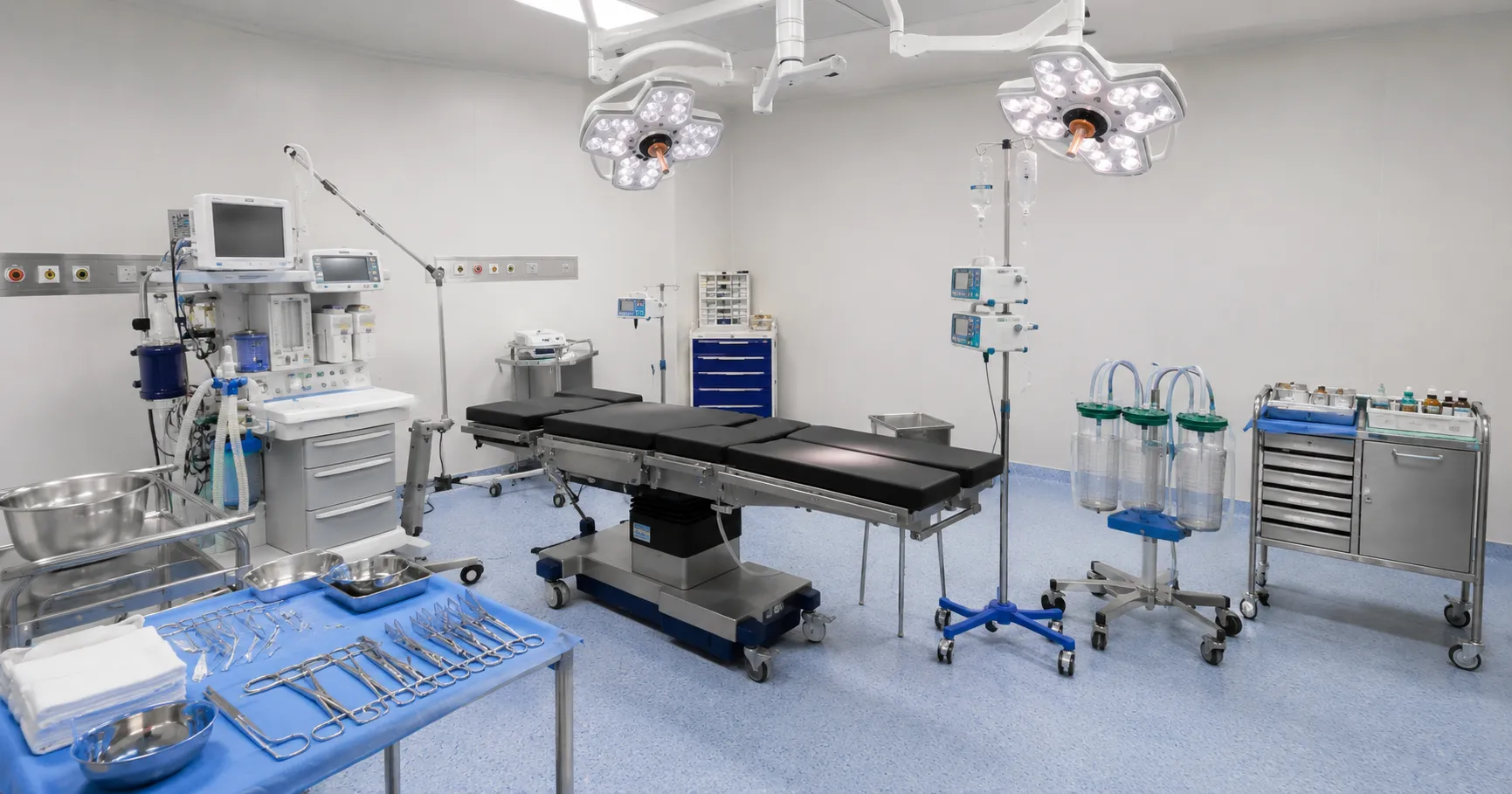
Theatre lighting is judged in the middle of a procedure, not in a showroom. What matters is whether the field stays lit when heads and hands move over it, whether tissue colour reads accurately, and whether the light can be repositioned with one gloved hand without drifting afterwards.
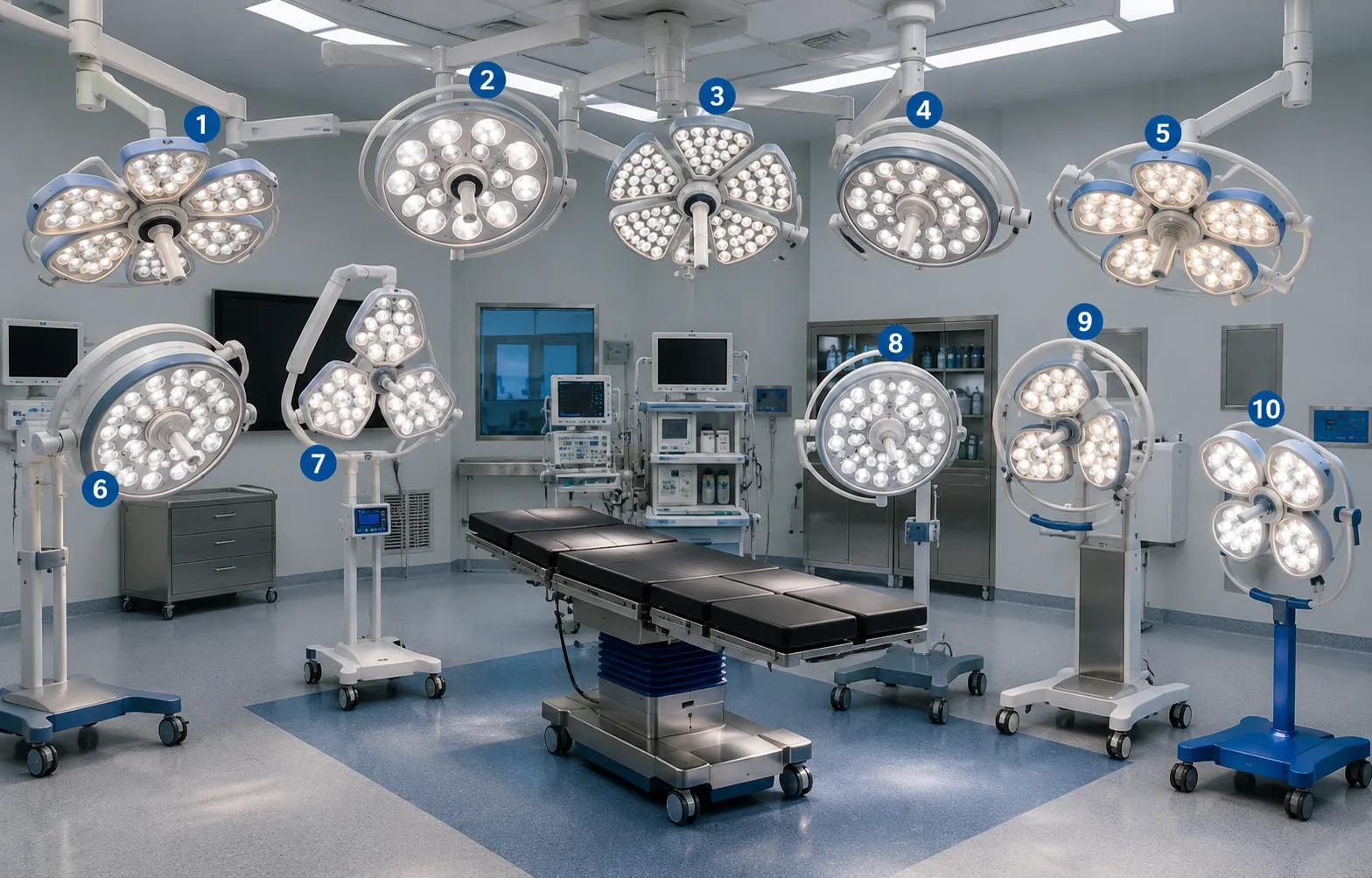
These ten lighting types cover main theatres, minor procedure rooms and mobile use. Each entry explains the design and the questions worth settling before installation.
What shadowless really means.
No light removes shadows entirely. Shadow control comes from multiple emitters arranged so that when part of the beam is blocked, the remaining sources still illuminate the field. That is why multi-emitter heads and dual-head arrangements perform better in practice than a single high-output source.
Colour rendering is the second factor. Accurate tissue colour depends on the light's rendering performance and colour temperature, and most modern heads allow the temperature to be adjusted for different procedures.
The ten surgical light types
1. Single-head ceiling-mounted lights
One suspended head on an articulated arm. Suited to minor procedure rooms and smaller theatres where a second head is not required.
2. Dual-head ceiling systems
Two heads on a common mount, giving improved shadow control and a second light for assistants. The standard arrangement in most main theatres.
3. Triple-head and satellite systems
A main head with additional satellites for deep cavity or complex procedures, providing several angles onto the same field.
4. Light and camera combinations
A head incorporating a camera for recording or teaching. Confirm the video output, recording arrangements and whether the camera needs its own service cover.
5. Mobile floor-standing lights
Wheeled units used for minor procedures, emergency areas and backup. Stability, castor quality and adjustment reach matter more than peak output.
6. Wall-mounted procedure lights
Space-saving heads for treatment rooms and clinics where a ceiling mount is impractical. Reach and locking stability should be tested with the intended room layout.
7. Examination and minor procedure lights
Lower-output lights for outpatient and treatment room work. They are not a substitute for a surgical head in a main theatre.
8. Lights designed for laminar flow theatres
Slimmer profiles and airflow-conscious head design intended to reduce disturbance to ventilation patterns. Compatibility with your ventilation design should be confirmed with the manufacturer.
9. Lights with adjustable colour temperature
Allow the surgeon to shift the light towards warmer or cooler tones for different tissue types, with controls at the head or on a wall panel.
10. Lights with battery backup provision
Continue operating during a mains interruption, either through an internal battery or the theatre's supported supply. Confirm which arrangement applies and how it is tested.
Installation and compatibility checks
-
Ceiling structure. Confirm the mounting arrangement, load capacity and any structural work required.
-
Arm reach and drift. Test positioning across the full range and confirm the head holds position under normal use.
-
Handle system. Check whether sterilisable handles are supplied, how many there are, and whether single-use covers are used.
-
Ventilation. Confirm head profile suitability with your theatre ventilation design.
-
Pendant coordination. Plan light positions alongside supply pendants and screens so arms do not collide.
-
Controls. Establish where intensity, focus and colour temperature are adjusted, and who may adjust them.
Maintenance and lifecycle
Modern heads use long-life emitters, which reduce routine lamp changes but do not eliminate maintenance. Arm joints, brakes and balance mechanisms need attention, since drift is the most common complaint from theatre teams as a light ages.
Agree planned maintenance intervals covering arm balance, brake performance, electrical safety testing and control function. Confirm the supply of sterilisable handless spare parts, availability, and expected support life for the emitter modules and control electronics.
Ensure the department receives published device safety alerts so any field safety notices reach the maintenance team promptly.
Final thoughts
Assess lights with the people who work under them, ideally in a theatre of comparable size. Most main theatres need a dual-head system with good shadow control and adjustable colour temperature, with a mobile light held for backup and minor work. Confirm ceiling structure, ventilation compatibility and handle supply before installation.
This article provides general procurement guidance for healthcare organisations. It is not clinical advice and does not replace manufacturer instructions or local theatre policy.