A resuscitation trolley is a system for quickly locating items. Its value lies in standardisation: if every trolley across a site holds the same items in the same drawer, a team arriving from another ward loses no time searching. Trolleys that have evolved locally, drawer by drawer, undermine that entirely.
The ten trolley types below cover ward, theatre, paediatric and specialist provision. Each entry explains its role and what to confirm before ordering.
Standardisation and the checking routine
Two decisions shape everything else. First, the contents list, agreed by the resuscitation committee and applied identically across the organisation. Second, the checking routine, which is short enough to be complete and specific enough to catch a missing item or an expired drug.
Tamper-evident seals support both. A sealed trolley with an intact numbered seal can be checked quickly from the outside, with a full contents check performed at the interval set by local policy or whenever a seal is broken.
The ten resuscitation trolley types
1. Standard ward resuscitation trolleys
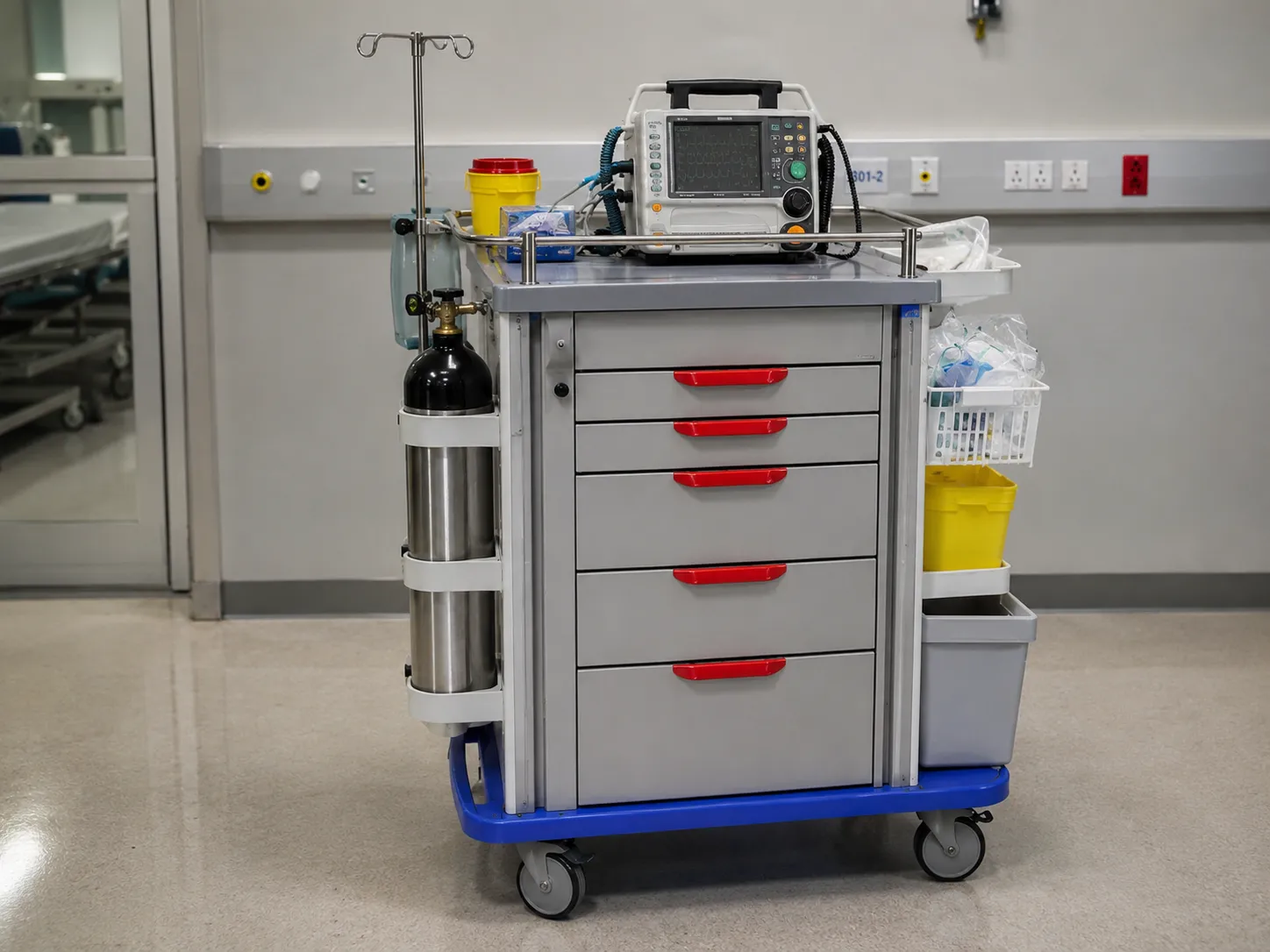
Multi-drawer trolleys with a defibrillator shelf, oxygen cylinder holder and sharps provision—the g—thel ward standard across most organisations.
2. Trolleys with sealed drawer systems
Drawers secured with numbered breakaway seals, allowing rapid external verification without opening and re-checking every compartment.
3. Trolleys with modular drawer inserts
Removable trays holding defined item sets, so a used tray can be exchanged for a sealed replacement and restocked away from the ward.
4. Paediatric resuscitation trolleys
Configured for age-range-based equipment and drug sizes, often with a length-based reference system. Kept visually distinct from adult trolleys.
5. Neonatal resuscitation trolleys
Sized for delivery and neonatal areas, with appropriate airway equipment and, in many units, integrated warming and gas provision.
6. Difficult airway trolleys
Dedicated trolleys holding airway equipment in a defined order, usually stored alongside rather than within the general resuscitation trolley.
7. Compact and narrow trolleys
Reduced footprint for clinics, outpatient areas and corridors where a full ward trolley cannot be manoeuvred easily.
8. Trolleys with integrated defibrillator mounting
Provide a secure mount and, in some designs, charging for the defibrillator to prevent it from being left elsewhere.
9. Trolleys with electronic access control
Use keypad or card access with audit logging. Confirm the fallback method when power fails, since access must never depend on a working battery.
10. Bags and mobile response packs
Portable alternatives for areas where a trolley cannot reach, such as stairwells or remote departments, carrying a subset of equipment storage and the route to the patient
A trolley that cannot reach the bed space quickly is a design failure regardless of its contents. Check castor size against door thresholds and lift gaps, confirm the trolley passes the narrowest point on its route, and test steering when loaded with a defibrillator and full cylinder. Storage location matters just as much: trolleys parked out of the way to keep corridors clear tend to be the ones that arrive late. Agree a visible, consistent parking position on every ward, and mark it, so anyone can find the trolley without asking.
What to confirm before ordering
-
Drawer layout. Confirm it matches your agreed contents list without improvised rearrangement.
-
Seal system. Establish seal type, supply and how breakages are recorded.
-
Defibrillator mounting. Verify the shelf or mount fits the specific device in use.
-
Cylinder holder. Confirm it accepts your oxygen cylinder size and secures it properly.
-
Accessories. Specify sharps holder, waste bin, glove box, suction mount and drip pole as required.
-
Cleaning. Verify approved agents for the surfaces and drawer materials used.
Checking, training and maintenance
Daily checks should be documented and simple: seal intact, defibrillator charged and self-test passed, cylinder contents adequate, trolley in position. Full contents checks follow local policy, with drug expiry tracked systematically rather than by memory.
Training should include locating the trolley, the drawer layout, seal breaking and how to break it, restocking, and re-requesting restocking for night staff and anyone rotating between sites, since layout familiarity is the point of standardising.
For maintenance, agree castor and brake servicing, drawer runner inspection, cylinder holder security checks and cleaning validation. Ensure the organisation receives published device safety alerts so field safety notices reach resuscitation and equipment leads.
Trolley layout should follow the agreed contents list rather than the other way round. Organisations standardising across sites can check current trolley ranges with verified suppliers.
Final thoughts
Standardise first, then buy the trolley that supports the standard. Identical layouts, sealed drawers, a defibrillator mount that fits your device, a visible parking position and a documented daily check will do more for arrest response than any individual feature on a specification sheet.
This article provides general procurement guidance for healthcare organisations. It is not clinical or resuscitation advice, and it does not replace manufacturer instructions, resuscitation training or local policy.