Blood storage equipment is judged on temperature stability rather than capacity. A cabinet that holds the maintained temperature at the centre of the chamber but drifts near the door is a problem; no amount of shelf space can compensate for it. It is exactly the sort of behaviour that temperature mapping exists to reveal.
The ten equipment types below cover storage, transport and monitoring across a transfusion service. Each entry explains its role and what to confirm before purchase.
Stability, mapping and alarms
Transfusion laboratories work to operate within temperature limits set out in national transfusion guidance, and equipment must maintain those temperatures reliably in real-world conditions, including during door openings and after a power interruption.
Temperature mapping demonstrates performance across the whole chamber rather than at a single sensor. Alarms then protect the stock day-to-day, locally, with escalation and independence sufficient that a fault in the cabinet does not disable the warning about it.
The ten equipment types
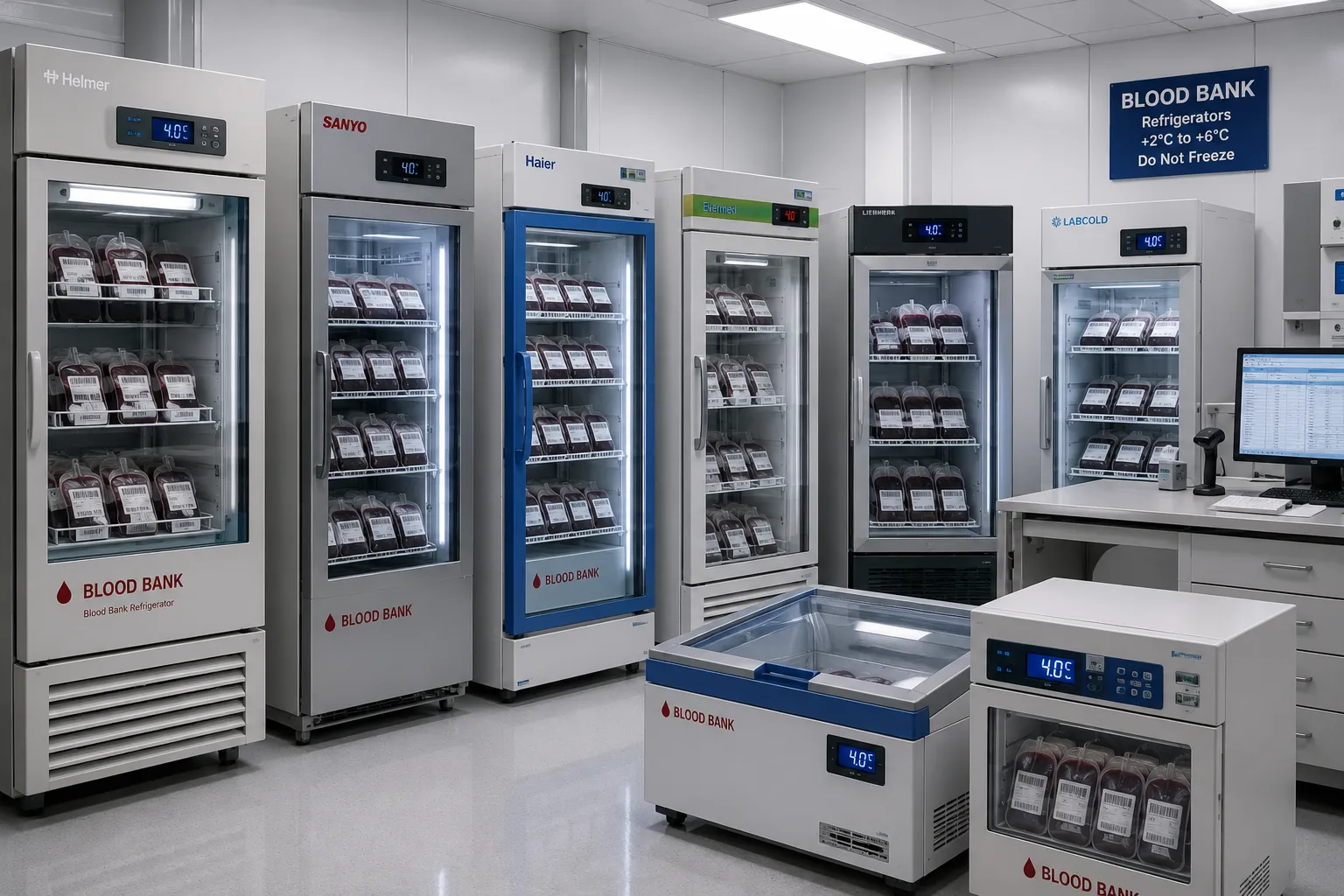
1. Upright blood bank refrigerators
Purpose-built cabinets with forced air circulation for even temperature distribution, glass or solid doors and integrated monitoring.
2. Under-counter blood refrigerators
Smaller cabinets for satellite fridges in theatre suites and remote issue points where a full-size unit is unnecessary.
3. Plasma freezers
Low-temperature cabinets for frozen components, with alarm and monitoring arrangements suited to the temperatures involved.
4. Platelet incubators with agitators
Maintain platelets at controlled temperature with continuous gentle agitation. Agitator failure alarms are as important as temperature alarms here.
5. Refrigerators with integrated data logging
Record chamber temperature continuously with retrievable records for quality assurance. Confirm the export format and retention arrangements.
6. Cabinets with independent alarm systems
Use a monitoring system separate from the cabinet's controller, so that a controller fault does not silence the warning.
7. Cabinets with access control
Restrict access to authorised staff and record access events; support functionality at remote issue fridges.
8. Blood transport boxes
Validated containers maintaining temperature during transfer between sites or departments. Validation for your journey times is the key question.
9. Portable temperature monitoring devices
Loggers accompanying transported components to demonstrate the temperature maintained throughout the journey.
10. Backup power and monitoring provision
Arrangements ensuring cabinets and their alarms continue through a mains interruption. Confirm which circuits are supported and how this is tested.
Siting, capacity and daily working
Position cabinets away from direct sunlight, heat sources and busy through-routes where doors are opened unnecessarily. Confirm ventilation clearance around the condensers and ensure the room temperature stays within the manufacturer's specified range. A warm environment can struggle in a warm one. Capacity should reflect peak stock rather than average holding, and shelf configuration should allow components to be located without lengthy door openings. Where a service runs satellite fridges, plan how stock rotation and monitoring are managed remotely before the units are installed.
What to confirm before ordering
-
Temperature stability. Ask for performance during door openings and recovery times.
-
Mapping. Confirm who performs temperature mapping and at what interval.
-
Alarm escalation. Establish local audible alarms, remote escalation and out-of-hours arrangements.
-
Data records. Confirm logging interval, export format and retention period.
-
Power arrangements. Verify backup supply provision and how it is tested.
-
Access control. Determine whether restricted access and event logging are required.
Validation, training and servicing
Commissioning should include temperature mapping, alarm testing at the set limits and verification of the recording system, all of which should be documented. Repeat mapping at the interval agreed with your quality team, and after any significant change to loading, siting or servicing.
Training should cover stock placement, keeping door openings brief, responding to alarms and the escalation route out of hours. Staff at satellite fridges need the same instruction as laboratory staff.
For servicing, agree on planned maintenance intervals, condenser cleaning, door seal inspection, sensor calibration, alarm testing, and spare parts availability. Ensure the service receives published device safety alerts so field safety notices reach the transfusion and engineering teams.
Mapping, alarm escalation and backup power arrangements belong in the specification from the start. Services planning cold chain provision can raise those points with the team at Medigear.uk.
Final thoughts
Buy for temperature stability, alarm reliability and recorded evidence. Confirm mapping and alarm escalation arrangements before installation, plan siting and capacity around real working patterns, and include calibration, seal inspection, and condenser cleaning in a planned schedule from the start.
This article provides general procurement guidance for healthcare organisations and laboratories. It is not clinical or transfusion practice advice, and it does not replace manufacturer instructions, national transfusion guidance or local quality procedures.