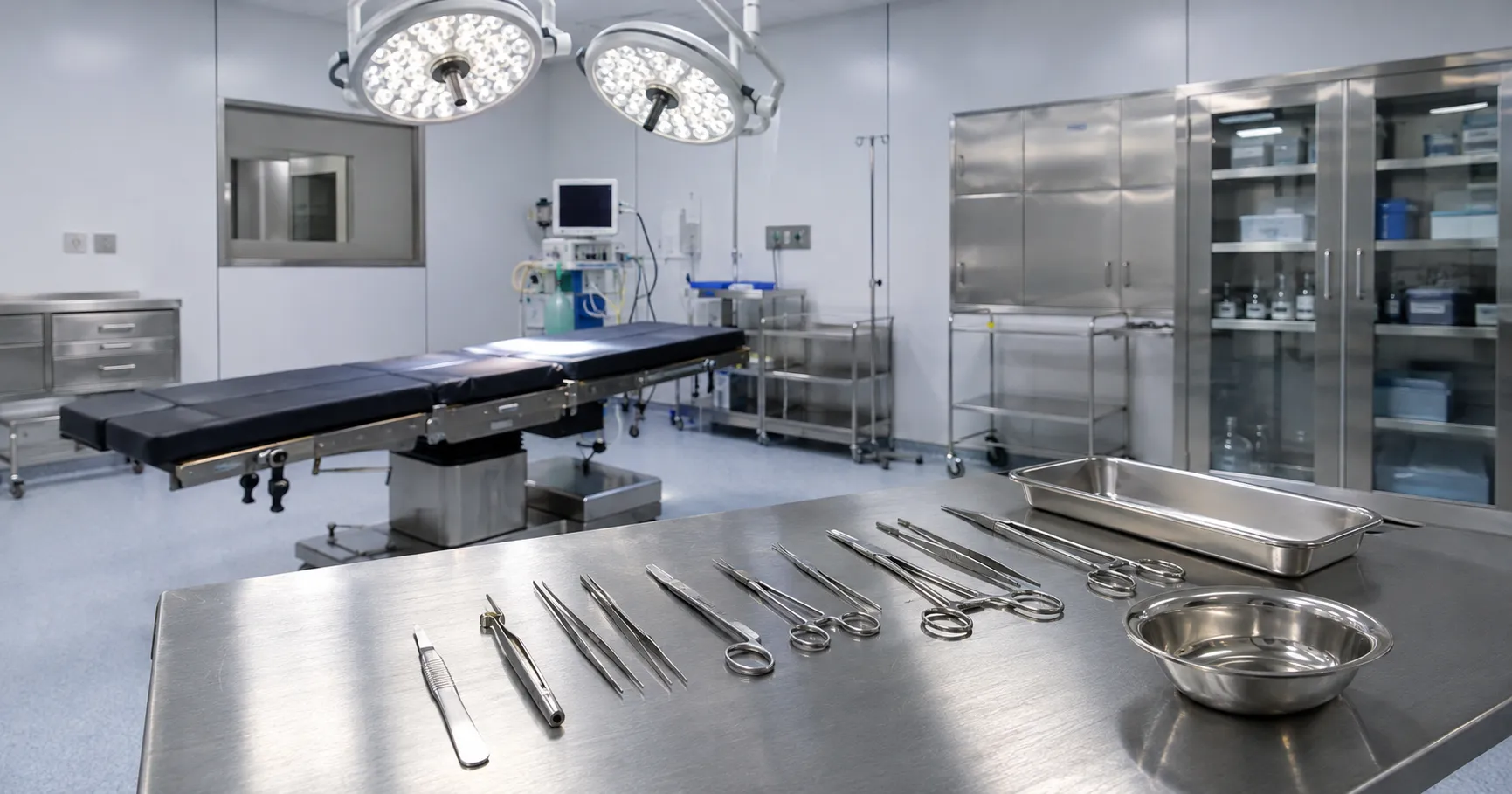
Every operating room runs on a shared vocabulary of surgical instruments. Whatever the speciality, a core set of cutting, holding, clamping and closing tools turns up again and again, because the basic tasks of surgery are the same beneath the specifics of any operation.
Knowing these instruments by the job they do, rather than as a long undifferentiated list, is how theatre teams keep sets organised, counted and ready. An instrument out of place or missing from a count stops an operation, so this core is managed with real discipline.
The fifty surgical instruments below are the ones found across almost any operating room. They are grouped into ten families of five by what they do, which is how sets are usually assembled and checked.
Why the basics matter
It is tempting to focus on the specialist instruments that make one operation different from another, but it is the basics that make every operation possible. A theatre that has its cutting, grasping, clamping, retracting and closing instruments in reliable order can support most of what surgery asks of it, so these families repay getting right. Grouping them this way follows the natural order of an operation, which is also how theatre teams learn and remember them.
The ten instrument families
The instruments fall into ten families: cutting, grasping, clamping, retracting, suturing, suction, probing, bone, access, and handling. Read together, they follow the shape of an operation from first incision to final closure.
Cutting and dissecting
Cutting instruments open tissue and divide it precisely. They are among the first instruments used in any procedure. Sharpness and condition matter here, so these instruments are inspected closely at every reprocessing.
-
Scalpel handles — holding surgical blades.
-
Surgical blades — making incisions.
-
Mayo scissors — cutting heavier tissue.
-
Metzenbaum scissors — fine tissue dissection.
-
Suture scissors — cutting sutures.
Grasping and holding
Grasping instruments hold tissue steady so the surgeon can work. Different forceps suit different tissues. Choosing the right forceps for the tissue protects it from damage, which is why the range is kept varied.
-
Tissue forceps — holding tissue.
-
Dressing forceps — handling dressings.
-
Allis forceps — grasping firm tissue.
-
Babcock forceps — holding delicate structures.
-
Sponge-holding forceps — holding swabs.
Clamping and occluding
Clamps close off vessels and hold structures in place. They are central to controlling bleeding. Because bleeding must be controlled quickly, a reliable set of clamps is always to hand.
-
Artery forceps — clamping vessels.
-
Mosquito forceps — fine clamping.
-
Kelly forceps — general clamping.
-
Kocher forceps — gripping tough tissue.
-
Bulldog clamps — gentle vessel occlusion.
Retracting and exposing
Retractors hold a wound open so the surgeon can see and reach the site. Good exposure underpins safe surgery. Good exposure makes an operation safer and quicker, so this family earns its place in almost every set.
-
Langenbeck retractors — holding wounds open.
-
Deaver retractors — deep retraction.
-
Self-retaining retractors — hands-free exposure.
-
Czerny retractors — retracting the wound edge.
-
Skin hooks — fine skin retraction.
Suturing and closure
Closure instruments bring tissue back together at the end of a procedure. Secure closure protects the result. Secure closure protects the whole result, so these instruments are checked and counted with particular care.
-
Needle holders — driving surgical needles.
-
Surgical needles — carrying suture.
-
Suture material — closing tissue.
-
Surgical staplers — rapid closure.
-
Ligation clips — securing vessels.
Suction and irrigation
Keeping the field clear lets the surgeon see and work. Suction and irrigation support this throughout. Keeping the field clear is constant work, so suction is set up and ready before an operation begins.
-
Yankauer suction — clearing the field.
-
Frazier suction — fine suction.
-
Poole suction — clearing larger volumes.
-
Irrigation syringes — flushing the site.
-
Suction tubing — connecting suction.
Probing and dilating
Some instruments explore or open passages and structures. They support access and assessment. These instruments support careful access and assessment, so they are chosen to suit the procedures a theatre performs.
-
Surgical probes — exploring tracts.
-
Dilators — widening openings.
-
Directors — guiding instruments.
-
Surgical sounds — assessing passages.
-
Trocars — creating access points.
Bone and orthopaedic
Working on bone needs a robust set of instruments. This family supports orthopaedic and similar work. Working on bone asks a lot of an instrument, so this family is chosen for strength and inspected for wear.
-
Bone rongeurs — removing bone.
-
Osteotomes — cutting bone.
-
Bone curettes — scraping bone.
-
Periosteal elevators — lifting tissue from bone.
-
Bone-holding forceps — gripping bone.
Access and specialty
Certain instruments open or reach specific areas. This family supports access across specialities. Reaching specific areas safely is what this family supports, so it is matched to the specialities a theatre serves.
-
Speculae — holding cavities open.
-
Cannulae — providing access.
-
Surgical catheters — draining or accessing.
-
Suction cannulae — targeted suction.
-
Biopsy forceps — taking samples.
Support and handling
Instruments need to be held, organised, and moved safely. This family supports the set itself. These items keep a set organised and countable, which is quietly essential to safe, efficient theatre work.
-
Instrument trays — organising sets.
-
Kidney dishes — holding instruments and fluids.
-
Gallipots — holding solutions.
-
Mayo stands — presenting instruments.
-
Sterilisation cases — protecting sets.
Buying and caring for instruments
Surgical instruments are precision tools used repeatedly, so quality and reliable reprocessing matter more than anything, since a worn or damaged instrument can compromise a procedure. Assembling and standardising sets around the operations a theatre actually performs keeps counts simple and instruments ready.
Because instruments are reprocessed constantly, they are chosen with their whole life in mind, from use through cleaning and sterilisation to storage. Working with the theatre team keeps sets aligned to how surgery is really carried out. It also helps to plan spares and replacements, since a single missing instrument can hold up a set, and a set held up can hold up a list. Theatres often source instrument sets from suppliers on Medigear.uk, chosen based on the operations they perform.
Before you order
-
Quality. Choose instruments that reprocess and last well.
-
Sets. Assemble sets around the operations performed.
-
Counting. Support reliable counts and traceability.
-
Reprocessing. Confirm cleaning and sterilisation.
-
Theatre team. Involve the team in set design.
Counting and traceability
An operation cannot safely end until every instrument is accounted for, so counting is a discipline built into theatre routine. Sets designed to be counted quickly and reliably, with clear traceability from tray to patient, support that discipline and reduce the risk of a retained instrument, which is why set design and counting go hand in hand.
Getting reprocessing right
Instruments spend as much time being cleaned and sterilised as they do in use, so how easily a set reprocesses shapes how smoothly a theatre runs. Choosing instruments that clean well and planning enough reprocessing capacity for a busy list keep sets flowing so a procedure is never held up waiting for a tray.
Reprocessing and safety
Surgical instruments are reprocessed between every patient, so inspection, cleaning, sterilisation and reliable counting are all fundamental to safe surgery. If an instrument is ever found to be faulty, staff should know how to report a medical device problem to the MHRA for investigation.
Pulling it together
Beneath the specifics of any operation, the same families of surgical instruments do the work. Grouping the fifty by function, choosing for quality and building sets around real operations turns a long list into ordered, ready theatre sets. Managed this way, the surgical instruments support safe surgery, procedure after procedure. Kept sharp, complete and countable, the same core sets serve theatre after theatre without drama. Beneath every speciality, it is these shared families that make surgery possible. For help assembling sets around a theatre's list, it is easy to reach the Medigear.uk team.
The notes above are general procurement guidance for healthcare organisations rather than clinical or surgical advice, and never replace manufacturer instructions or a team's own judgement.