
Which single component, if it failed tomorrow, would stop a clinic or a theatre list? That question is where a spare parts inventory for medical devices begins, because you cannot stock everything and you should not try. A well-built spare parts inventory holds the components whose failure carries the highest clinical and operational cost, at levels that match their failure rate and lead time, while avoiding cash tied up in parts you will rarely use. Criticality, not completeness, is the guiding rule.
The aim is to cut downtime, not to build a warehouse. This guide draws on manufacturer maintenance documentation and MHRA device-management guidance, and is written for biomedical, EBME and stores teams deciding what to hold and how much.
Identify critical spares by the impact of failure
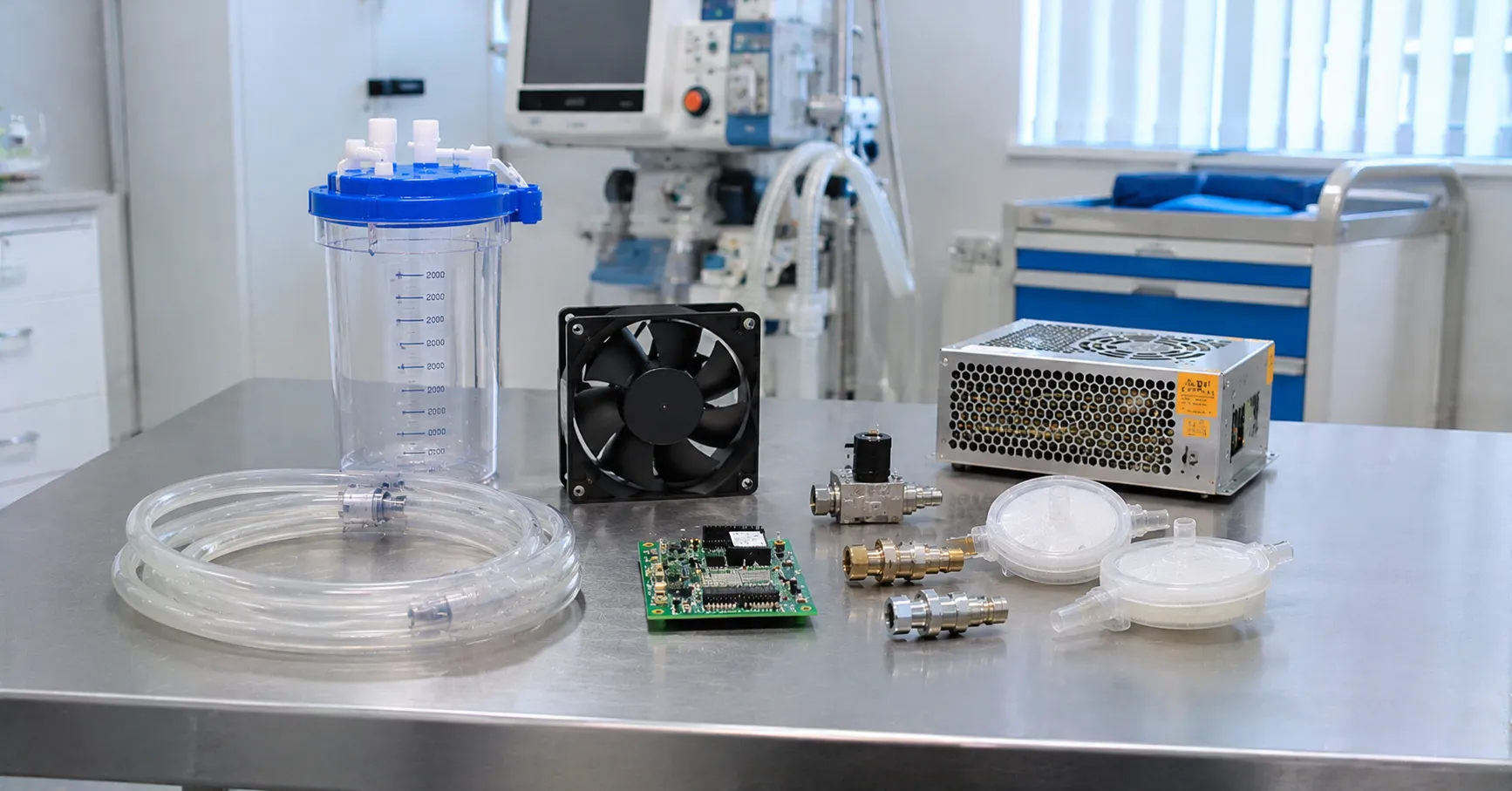
Rank potential spares by what happens when the part fails, not by how often you think it might. A component whose failure takes a critical device out of service, has a long replacement lead time, or is fitted to many units across the estate, is a critical spare and belongs in stock. Batteries, sensors, probes, seals, valves, tubing sets and common circuit boards often qualify. Low-impact parts that are cheap, quick to source and fitted to non-critical devices can be bought only when needed.
Set minimum and maximum stock levels
Every stocked part needs a minimum and maximum level and a reorder point, so replenishment is triggered automatically rather than discovered during a breakdown. Set the minimum from the part's failure rate and its supplier lead time, and the maximum to cap the cash and shelf space tied up. A reorder point set above zero, with a buffer for lead-time variability, means a replacement is on order before your last unit is consumed. Review the levels as usage data accumulates.
Manage lead times and single-source risk
Lead time is the reason a spares inventory exists, so record it for every critical part and stock more of anything with a long or unpredictable supply. Flag components available from only one supplier, because a single-source part with a long lead time is your highest supply risk. Where possible, qualify a second source or an approved compatible part, and hold deeper stock of anything you cannot source quickly. A part that takes twelve weeks to arrive needs very different cover from one available next day.
Plan for obsolescence and end of support
Spares planning and obsolescence are inseparable. As a device fleet ages, manufacturers withdraw parts and issue last-time-buy notices, after which the component is simply unavailable. Track end-of-support dates for your critical devices and make a considered last-time-buy of essential spares before the window closes, balanced against how long you intend to keep the equipment. Obsolescence that triggers a field safety notice may force action sooner, so watch supplier bulletins and the alerts published by the MHRA.
Storage, shelf life and parts traceability
A spare is only useful if it works when fitted, so storage and traceability matter as much as quantity. Store parts in controlled conditions, respecting temperature and humidity limits, and rotate stock so items with a shelf life, batteries, seals and sterile accessories, are used before they expire. Record batch or lot numbers against critical spares so a part can be traced if a recall arises. First-in, first-out rotation stops you discovering that your emergency battery went flat on the shelf.
Hold stock, consignment, supplier-managed or just-in-time
There is more than one way to secure spares, and the right mix depends on criticality and cash. Holding your own stock gives instant access but ties up capital and space. Consignment stock, owned by the supplier but held on your site, gives availability without paying until you use a part. A supplier-managed inventory outsources replenishment to the vendor against agreed levels. Just-in-time ordering minimises holding but only suits parts with short, reliable lead times. Most services blend these, and comparing terms across spare-parts suppliers on MediGear helps you strike the balance.
Use failure data to size the holding
Guesswork is expensive at both ends: too little stock causes downtime, too much ties up cash on shelves. Use your maintenance and repair history to see which parts actually fail, how often, and on which devices, then size the holding around that evidence rather than intuition. Mean time between failures for a given component, drawn from your own records or the manufacturer's data, tells you roughly how many you will consume in a year and therefore how deep to stock. As the data accumulates, refine the minimum and maximum levels so the inventory tracks real consumption rather than an initial estimate.
Decide between genuine and compatible parts
Not every spare has to be the manufacturer's own branded component, but the choice carries consequences. Genuine parts guarantee compatibility and usually preserve warranty and service cover, while approved compatible or refurbished parts can cut cost and ease obsolescence pressure. Before substituting, confirm that a compatible part will not void the device's certification or its service contract, and that it meets the same safety and performance specification. For safety-critical components, the risk rarely justifies the saving; for routine consumable parts, a qualified alternative can be a sensible way to keep an ageing fleet supported.
Keep the inventory linked to the asset register
A spares inventory works best when it is connected to the assets it supports. Linking each stocked part to the devices it fits, ideally within an asset-management or CMMS system, means you can see instantly whether a spare exists when a fault is logged, and which parts become redundant when a device is retired. That connection also stops you holding stock for equipment that has already left the estate, a common and quiet source of dead inventory. Regularly reconcile the spares list against the live device fleet so the holding always reflects what you actually run.
Assign ownership and review the holding
Spares management drifts without a clear owner, so name the person or team responsible for setting levels, approving purchases and reviewing the inventory. Schedule a periodic review, at least annually, to retire lines for equipment no longer in service, adjust levels against the latest usage data, and check upcoming obsolescence horizons. A holding that is set once and never revisited slowly fills with parts you no longer need while missing the ones you now do, so treat the review as the mechanism that keeps the inventory lean and relevant.
Sizing your spares holding
Work through this checklist before you commit stock and cash:
-
Critical spares ranked by clinical impact, lead time and how many units use them.
-
Minimum, maximum and reorder levels set from failure rate and supply lead time.
-
Lead time recorded for every critical part, with single-source risks flagged.
-
Second sources or approved compatible parts qualified where possible.
-
End-of-support dates tracked, with last-time-buy decisions made deliberately.
-
Controlled storage with shelf-life rotation for batteries, seals and sterile items.
-
Batch and lot traceability recorded against critical components.
Common spares-inventory mistakes
The pitfalls are consistent across services. Teams stock what is cheap and easy rather than what is critical, so the shelf is full but the device that fails is the one with no spare. They set no reorder points and discover a stockout during a breakdown. They ignore lead time and single-source exposure until a supplier fails to deliver, and they let shelf-life parts expire unused. Perhaps the costliest error is missing a last-time-buy before a part goes obsolete, leaving a still-serviceable device unrepairable and forcing early replacement.
Stocking smart, not deep
A good spare parts inventory is judged by uptime delivered per pound tied up, not by how full the shelves look. Concentrate on critical, long-lead and obsolescence-risk parts, automate reordering, and revisit the levels as real usage data builds. MediGear helps UK facilities source genuine and compatible spares from verified suppliers and compare holding options; when you are shaping your spares strategy, reach the team through the MediGear enquiry desk.
Disclaimer
This article is for informational purposes only. It is published by MediGear (medigear.uk) for general information and procurement guidance, and is not clinical, diagnostic, treatment, technical, engineering, legal or regulatory advice, nor a product endorsement, guarantee or substitute for professional assessment. MediGear does not provide medical consultations. Buyers should consult their clinical, biomedical, estates and regulatory contacts, and the manufacturer's documentation, and independently verify all specifications, certifications, compatibility and suitability before purchase. Specifications, certifications and availability are correct at the time of publication and may change without notice. MediGear is a medical-equipment distributor and does not sell medicines or pharmaceutical products.