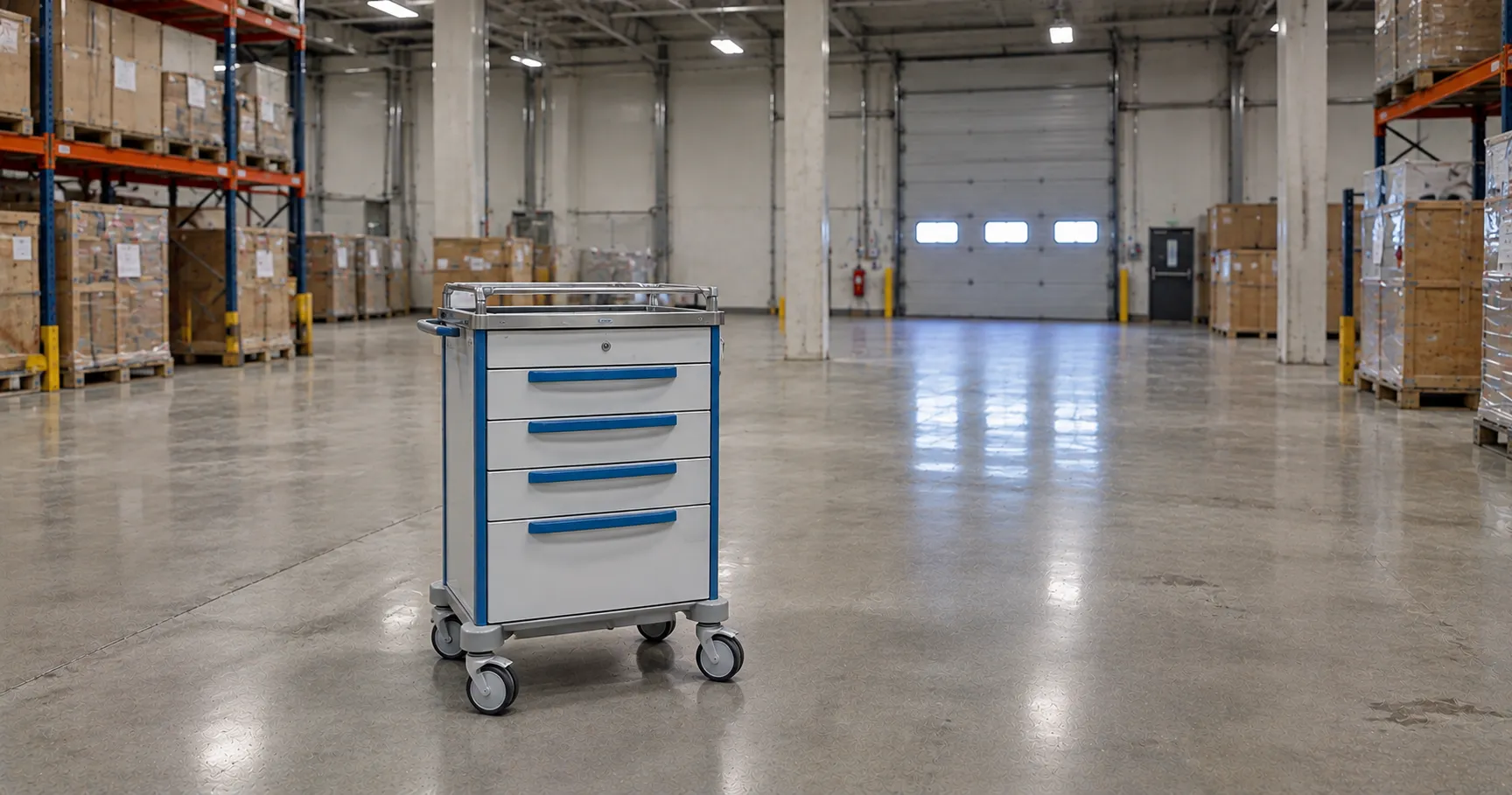
For everyday ward equipment mobility, buy a medical trolley with a load capacity it will actually carry and castors it can roll on before you look at anything else, because an under-rated or hard-to-steer trolley becomes a manual-handling problem within weeks. A general-purpose medical trolley moves dressings, monitors, medication, nd supplies around a ward all day, so its working load, tilting and braking, and ease of cleaning decide whether staff reach for it or leave it in a corner. Get those practical points right, and the drawer layout and finish follow easily.
Unlike a resuscitation crash cart, which is specified around a fixed emergency layout, a ward mobility trolley is a flexible transport platform, so this guide focuses on choosing one that carries the right load safely, steers well on your floors and meets your infection-control policy. It is written for UK ward managers, estates and procurement teams and draws on manufacturer specifications and UK workplace and device guidance.
Working load and what the trolley must carry
Start with an honest tally of the heaviest realistic load. A dressings and treatment trolley may carry only a few kilograms, but a trolley moving a patient monitor, a syringe-driver bank or a stack of supply baskets can approach or exceed 50 kg once loaded. Every medical trolley carries a stated safe working load, split between a total figure and a per-shelf or per-drawer limit, and exceeding it bends shelves and wrecks castors. Choose a trolley rated comfortably above your worst case, and keep the load low rather than stacked high, because top-heavy trolleys are the main cause of tipping. If the trolley will carry a specific device, confirm the shelf size and any mounting suits.
Castors, braking and steering on ward floors
Castors make or break a mobility trolley. For smooth vinyl ward floors and lift thresholds, specify castors of 100 to 125 mm with a smooth-rolling, non-marking tread, at least two of them braked, and ideally a central brake pedal so one press locks the trolley. A directional or total-lock castor helps a long trolley track straight instead of crabbing. Twin-wheel castors carry more load and roll over gaps more easily. Test a loaded sample on your actual floors and over the thresholds staff cross daily, because a trolley that judders or veers adds strain and, over time, increases the risk of manual-handling injury ryourteam must manage under HSE manual handling requirements.
Drawers, shelves and a configurable top
A ward trolley earns its place through sensible storage. Decide between open shelves for bulky baskets, a bank of shallow drawers for consumables, or a mix, and look for drawers that pull fully out on smooth runners and can be relabelled as needs change. A raised rim or lip on the top shelf keeps items from sliding off when you push. A pull-out writing shelf or a rail for a sharps bin, a waste bag, and glove boxes keeps everything within reach. Modular systems that accept ISO or standard-size trays let you reconfigure the same frame between a treatment round, a phlebotomy round and a stores run without buying a new trolley.
Wipe-clean surfaces and infection control
Because a mobility trolley travels between bays and bed spaces, cleanability is a specification, not an afterthought. Choose a medical trolley in powder-coated steel, anodised aluminium, or moulded ABS with smooth, sealed surfaces, rounded corners, and as few crevices as possible so you can fully wipe it down with your approved disinfectant between rounds. Some trolleys offer antimicrobial coatings, which supplement but never replace cleaning. Removable, dishwasher-safe drawers and trays make deep cleaning realistic. Confirm the surface tolerates the chlorine-based or hospital-grade cleaners your infection-prevention team already uses, as some finishes dull or corrode under strong solutions.
Height, ergonomics and safe pushing
A trolley is pushed dozens of times a shift, so ergonomics protect your staff. A worktop height around 90 cm suits most standing tasks, and a dedicated push handle set at a comfortable height beats gripping the frame or a drawer edge. Keep the loaded weight sensible, position heavier items low and central, and make sure the trolley clears standard door widths and lift cars. If a trolley is regularly pushed long distances or up ramps, the effort involved is a manual-handling consideration, so choosing free-rolling castors and a proper handle isn't a luxury; it's a way to reduce risk under the Manual Handling Operations Regulations that HSE enforces.
Comparing medical trolley types
Match the trolley to the round. A lightweight treatment or dressing trolley with two shelves suits clinical rounds and clean or dirty tasks. A drawer trolley or medicine round trolley adds lockable storage for controlled drugs and round stock. A procedure or anaesthetic trolley offers a deeper worktop and modular trays. A utility or stores trolley with open shelving and higher load rating moves supplies and equipment in bulk. Instrument and monitoring trolleys add a device shelf and cable management. Rather than buying one trolley for everything, most wards hold two or three types, but standardising on a single modular frame across them keeps spares and training simple.
Materials and durability across a working life
A ward trolley bought once should last many years of daily knocks, so the material matters. Powder-coated steel is strong and cheap but can chip and, once bare, corrode, so check the coating quality and the weld finish at joints. Anodised aluminium resists corrosion and is lighter, which helps with pushing, though it dents more easily. Moulded ABS or polymer trolleys are light, warm to the touch, and have no welds to fail, so they suit clean clinical rounds well. Whichever you choose, inspect the edges and corners for smooth, sealed finishes rather than sharp folds that trap dirt, and separate the frame warranty from the wear-part warranty, since castors, runners and drawers wear long before a good frame does. A slightly dearer trolley with replaceable wear parts usually outlasts two cheap ones.
Accessories that extend a ward trolley
The right accessories turn a basic frame into the trolley ward actually needs, so check the accessory range before you commit. Common additions include an IV pole that clamps to the frame, an oxygen cylinder holder, a catheter or utility rail, a drainage-bag hook, tip-out bins for small consumables, a sharps-bin bracket, a waste-bag ring and a pull-out writing shelf. A keyboard or tablet mount suits trolleys used for electronic observations. Confirm accessories fit without tools and do not compromise the trolley's stability or safe working load once fitted. Buying a frame that accepts a wide range of accessories means you can reconfigure one design as ward needs change, rather than replace it
Ward trolley buying checklist
Run through these points with each supplier before ordering ward mobility trolleys:
-
Confirm the total and per-shelf safe working load exceeds your heaviest realistic load
-
Specify c00 to 125 mm castors with at least two brakes, a central brake, and test them loaded on your floors.
-
Check drawers and trays pull out fully, relabel easily and are removable for deep cleaning.
-
Verify surfaces are non-porous, rounded and compatible with your infection-control disinfectant.
-
Confirm the worktop height, push handle and overall width suit staff and your door and lift dimensions.
-
Ask whether the frame is modular so it can be reconfigured between rounds.
-
Check accessory mounts for sharps bins, waste bags, glove boxes and IV poles.
-
Confirm UK spares for castors, drawers and runners, plus warranty length.
Common mistakes when buying a ward trolley: choosing based on appearance and price, then finding the castors are too small for the load; the trolley judders and drifts. Another is under-rating the load, so shelves sag and drawers jam within months. Buyers also pick fixed, non-removable drawers that trap soil and fail an infection-control check, or a trolley too wide for a bay door. Ignoring the push handle and worktop height turns a daily task into an ergonomic strain. Specifying the load, castors and cleanability first, then testing a loaded sample, prevents both
Making the right choice for your ward
A ward mobility trolley is a simple kit that is easy to get wrong. Buy for the real load, insist on castors and braking that roll and stop cleanly on your floors, choose surfaces your infection team can sign off, and set the height and handle for comfortable pushing. Standardise on a modular frame so one design covers several rounds. As a UK medical-equipment distributor, MediGear helps facilities compare verified trolley suppliers rather than push one brand, and the team is happy to help through the contact page.
Disclaimer
This article is for informational purposes only. It is published by MediGear (medigear.uk) for general information and procurement guidance. It is not clinical, diagnostic, treatment, technical, engineering, legal or regulatory advice, nor a product endorsement, guarantee or substitute for professional assessment. MediGear does not provide medical consultations. Buyers should consult their clinical, biomedical, estates and regulatory contacts, and the manufacturer's documentation, and independently verify all specifications, certifications, compatibility and suitability before purchase. Specifications, certifications and availability are correct at the time of publication and may change without notice. MediGear is a medical-equipment distributor and does not sell medicines or pharmaceutical products.