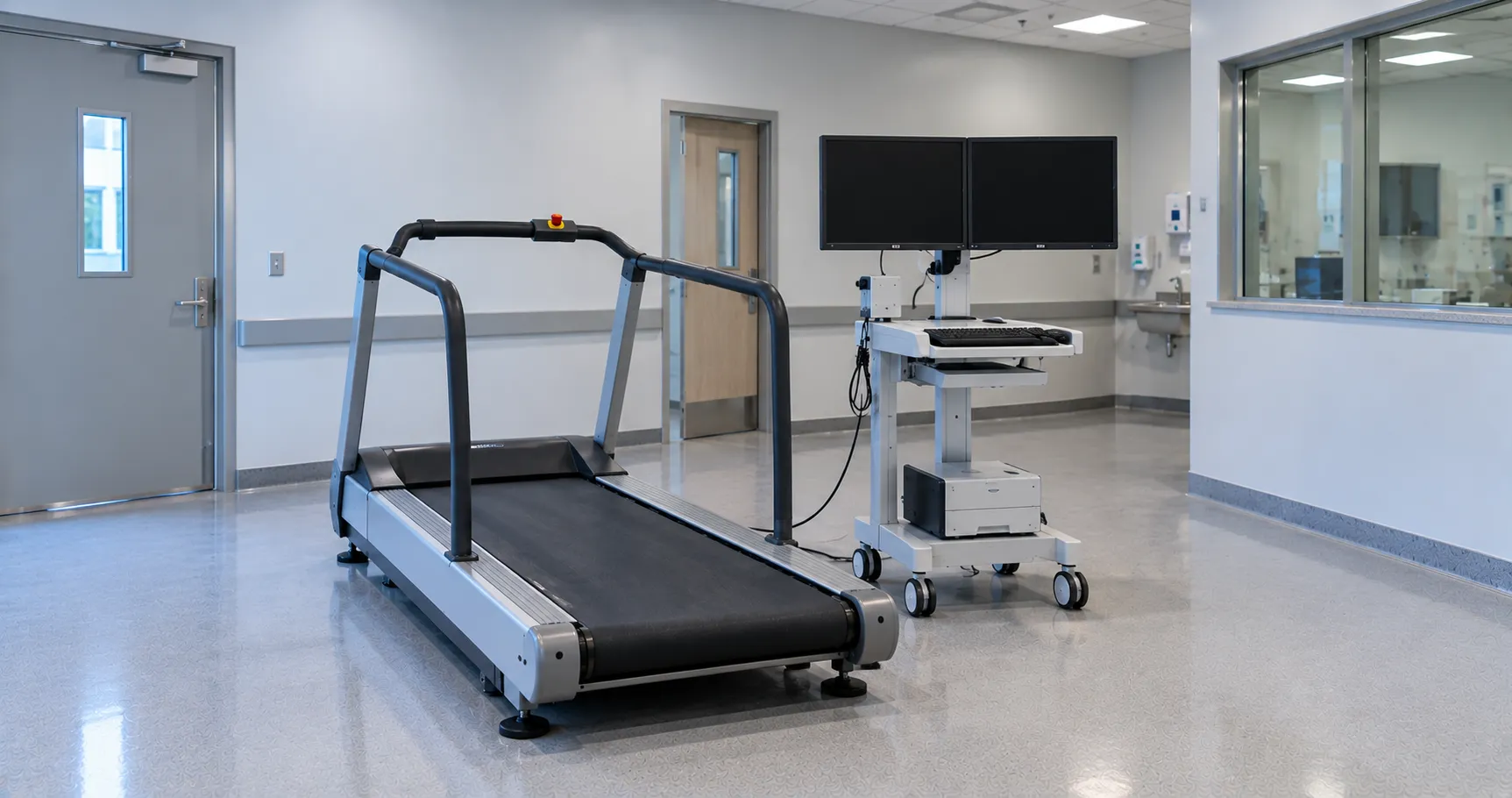
A patient steps onto the belt, the incline lifts, the pace quickens, and twelve ECG leads track every beat as the heart is pushed toward its limit. That controlled walk is the job of a stress test treadmill, the motorised platform at the centre of exercise cardiology and the standard way to unmask ischaemia, exercise-induced arrhythmia and abnormal blood-pressure responses that stay hidden at rest. The treadmill is only half the story: it works as a matched pair with an exercise ECG and blood-pressure system, and buying one without specifying the other is a common and costly mistake.
For a procurement lead, the practical question is how the belt, the controller,r and the diagnostic electronics fit together, and whether the whole assembly will pass electrical safety and serve the clinic reliably for a decade.
What the treadmill does during an exercise test
The defining feature of a cardiac stress test treadmill is programmable, automatic control of speed and gradient. Standard protocols such as Bruce and modified Bruce step the workload up at fixed intervals, and the treadmill must change belt speed and incline precisely on cue, driven by the connected ECG software rather than by hand. That distinguishes it from a fitness treadmill, which is never designed to be steered by a diagnostic system or to hold calibration across thousands of staged tests. Smooth low-speed running matters too, because many patients start at a slow walk and any belt judder corrupts the ECG trace.
The exercise ECG and monitoring that complete the system
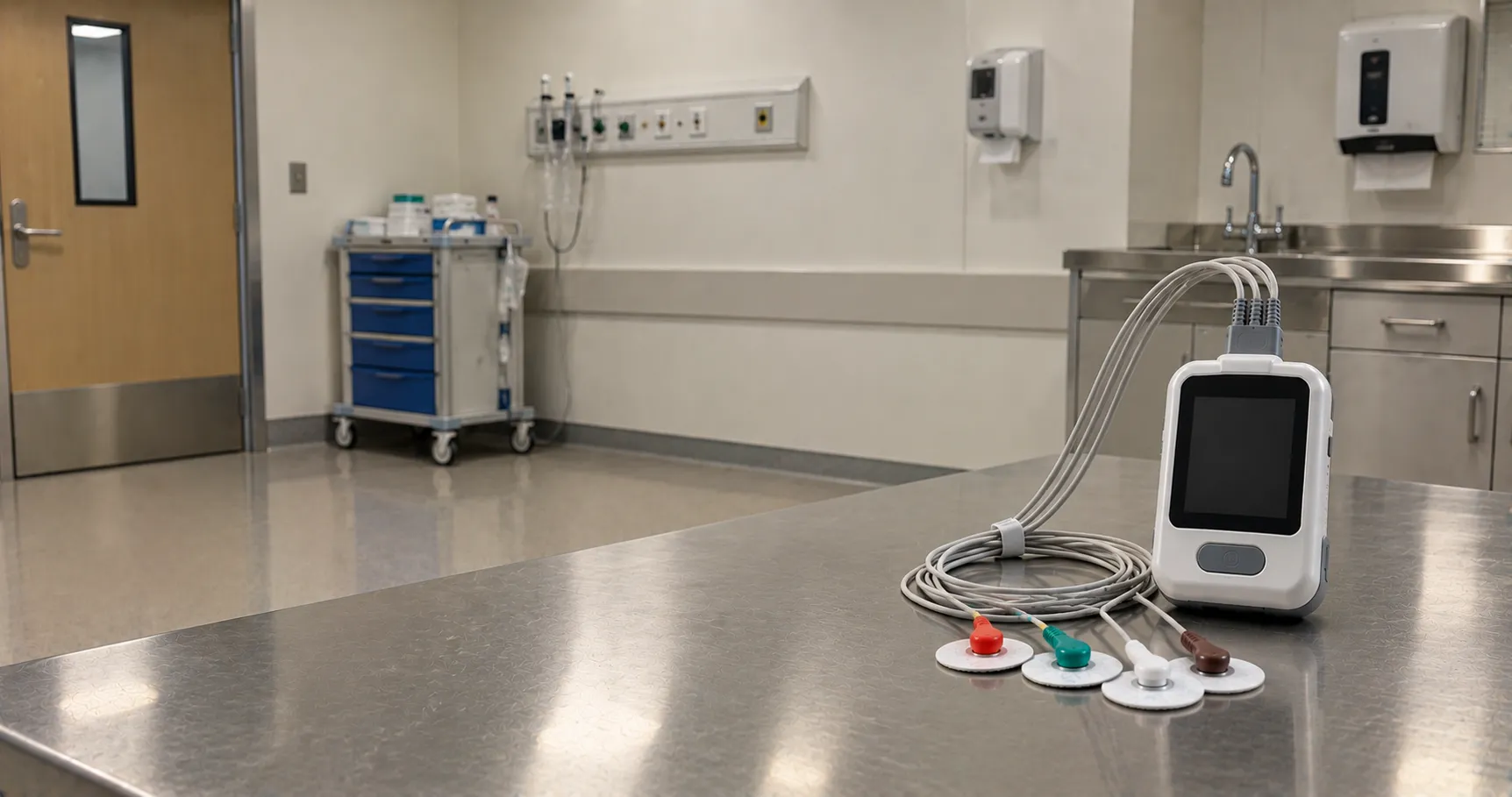
A stress-test treadmill is procured as part of a stress-testing system: the belt, a diagnostic 12-lead exercise ECG, an automated non-invasive blood-pressure module, and analysis software that logs ST-segment changes at each stage. The ECG front end must suppress the movement and muscle noise talking generates, so signal quality under motion is a genuine differentiator between systems. Confirm what the software captures, how it stores the report and whether it exports into your cardiology or patient record system. Test protocols and interpretation sit with the clinical team; the referral context for exercise testing is set out in the clinical guidance issued by NICE on chest pain and stable angina, not by the equipment specification.
Load rating, belt size and the patient safety rail
Specify the treadmill to the patients you actually see. Maximum user weight is the headline figure and clinical models are typically rated well above consumer machines; a genuinely bariatric-capable belt is a separate, higher-rated build, not a marketing label. Belt dimensions decide who can be tested safely, and taller or unsteady patients need a longer, wider deck with sturdy side and front handrails. An emergency stop within the operator's reach and, on many models, a safety lanyard are essential, because the person being tested may be symptomatic. A low step-on height and a front rail help frail patients mount and dismount without stumbling.
Protocols the treadmill has to deliver
A protocol defines the workload during an exercise test, and the treadmill has to reproduce it exactly every time. The Bruce protocol raises both speed and gradient every three minutes and is the most widely used. At the same time, he modified Bruce protocols start more gently, and slower ramp protocols suit older or deconditioned patients who cannot manage abrupt jumps. Because the connected software steps the belt through these stages automatically, any lag or overshoot in speed or incline changes the metabolic demand and undermines comparability between tests. When you evaluate a stress test treadmill, ask how many protocols are pre-loaded, whether you can build custom protocols for specific patient groups, and how quickly the belt reaches and holds each commanded stage.
Where exercise testing fits across care settings
A stress test treadmill is not only a hospital cardiology kit. Community diagnostic centres, cardiac rehabilitation units and some larger GP federations run exercise testing to triage chest pain and assess functional capacity, and the specification shifts with the setting. A rehabilitation service may prioritise a low step-on height and generous handrails for less mobile patients, while a high-throughput diagnostic hub values fast turnaround and durable belts. Space and floor loading also differ: these are heavy machines, and the room needs adequate clearance around the deck for staff access and safe patient dismount. Match the build, footprint and patient-support features to where the treadmill will actually work, rather than buying a single generic model for very different services.
Electrical safety and standards for a stress test treadmill
Because a stress test treadmill is connected to a patient through ECG electrodes, it is medical electrical equipment. It is built to the general standard IEC 60601-1 for basic safety, with the diagnostic electrocardiograph portion meeting IEC 60601-2-25 for diagnostic electrocardiographs and, where continuous rhythm surveillance is used, IEC 60601-2-27 for ECG monitoring equipment. It must carry UKCA or CE marking and is regulated as a medical device under the UK Medical Devices Regulations 2002, overseen by the UK device regulator, the MHRA. A consumer gym treadmill meets none of this, which is why it can never be substituted into a clinical exercise-testing room. Ask for the declaration of conformity and the electrical-safety test certificate at handover.
Keeping a stress test treadmill accurate and serviceable
Speed and gradient must stay true, so a stress test treadmill needs periodic verification that the belt runs at the commanded pace and the incline reaches the commanded angle, or the workload delivered no longer matches the protocol. Belts and running decks are wear items with a defined service life, and the drive motor and elevation mechanism need scheduled maintenance. Build planned preventive maintenance into the contract, and ensure consumables such as belts, ECG electrodes, and blood-pressure cuffs are readily available. This guide is compiled from manufacturer documentation and UK regulatory sources and is intended for procurement teams, not as clinical advice.
Data, connectivity and the patient record
An exercise test produces a structured report, and where that report goes matters as much as how it is captured. A modern stress test treadmill and its ECG software should store each study with its ST-segment trends and blood-pressure log, then export a clean report into your cardiology information system or electronic patient record rather than trapping it in a standalone PC. Ask about the export format, whether results can be pushed automatically, and how patient demographics are pulled in to avoid manual re-keying. Data security and backup also deserve a look, since these systems hold clinical records. Good connectivity turns the treadmill from an island into part of the diagnostic pathway, and it is worth confirming before purchase rather than discovering the gaps afterwards.
Specifying a stress test treadmill: buyer checklist
Before you commit, work through the points that separate a clinical system from a gym machine:
-
Maximum tested patient weight, and whether a true bariatric build is required.
-
Deck length and width versus the height and stability our patient group needs. needs
-
Automatic speed and incline control that the ECG software can drive directly.
-
ECG signal quality under motion, and how the report exports to your systems.
-
Handrails, front rail, low step-on height and a reachable emergency stop.
-
IEC 60601-1 conformity, UKCA or CE marking and the safety-test certificate.
-
Calibration method for belt speed and gradient, and its recommended interval.
-
Consumable supply and a preventive-maintenance schedule for belt and motor.
Running costs beyond the purchase price
The quote for a stress test treadmill is a starting figure. Over a decade you will replace belts and decks, buy ECG electrodes for every test, recalibrate speed and incline, and pay for annual service visits and electrical-safety testing. A quiet, well-damped drive and a serviceable elevation mechanism lower that lifetime bill more than a low sticker price suggests. Warranty length on the motor and frame, spares availability and engineer response time all belong in the comparison. Weighing those factors across vendors is where a marketplace earns its keep, and buyers can compare suppliers on equal terms. through MediGear
Choosing well for your service
A stress test treadmill is judged less by top speed than by steady low-speed running, honest calibration, patient-safe dimensions and clean integration with its ECG partner. Match the belt to your patients and the electronics to your records, and confirm the standards before purchase. As a UK medical-equipment distributor, MediGear helps facilities line up compliant stress-testing systems and consumables and start a specification with us via the MediGear enquiry desk.
Disclaimer
This article is for informational purposes only. It is published by MediGear (medigear.uk) for general information and procurement guidance. It is not clinical, diagnostic, treatment, technical, engineering, legal or regulatory advice, nor a product endorsement, guarantee or substitute for professional assessment. MediGear does not provide medical consultations. Buyers should consult their clinical, biomedical, estates and regulatory contacts and the manufacturer and independently verify all specifications, certifications, compatibility, and availability before purchase; specific specifications and availability are correct at the time of publication and may change without notice. MediGear is a medical-equipment distributor and does not sell medicines or pharmaceutical products.