A ventricular assist device is a mechanical blood pump, surgically connected to a failing heart, that takes over the work of moving blood around the body when the native muscle can no longer manage it alone. Unlike a pacemaker or a resynchronisation implant, which correct the heart's electrical timing, a ventricular assist device physically pumps blood — drawing it from a weak ventricle and driving it into the aorta or pulmonary artery through a continuous-flow rotor. For procurement and clinical-engineering teams, that makes it a mechanical circulatory support system with its own consumables, controllers and servicing demands, quite distinct from any rhythm device.
Nothing below is treatment advice. It gathers what a biomedical engineer or contract lead needs to specify a durable mechanical pump and its wearable hardware, pulled together from device instructions for use, the published circulatory-support standards and MHRA guidance, so a mechanical-circulatory-support programme can be scoped on equipment and support terms while candidacy for the pump stays with the transplant and heart-failure team.
Where a ventricular assist device fits in the treatment pathway
These pumps serve several defined roles, and knowing which your service supports shapes what you buy. As a bridge to transplant, the device keeps a patient alive and mobile while they wait for a donor heart. As destination therapy, it is a long-term implant for patients who are not transplant candidates. It can also act as a bridge to recovery, giving a stunned heart time to heal, or a bridge to decision while the team assesses candidacy. A ventricular assist device programme therefore sits inside a specialist cardiac centre with surgical, perfusion and intensive-care capability, and equipment planning has to reflect that whole ecosystem rather than the pump alone. The intended role also affects volumes: a destination-therapy caseload builds a growing population of long-term patients who each need ongoing consumables and support, whereas a bridge-to-transplant service turns over its patients as donor hearts become available. Forecasting that population is the first step in sizing a realistic contract.
Continuous-flow pumps and how blood is moved
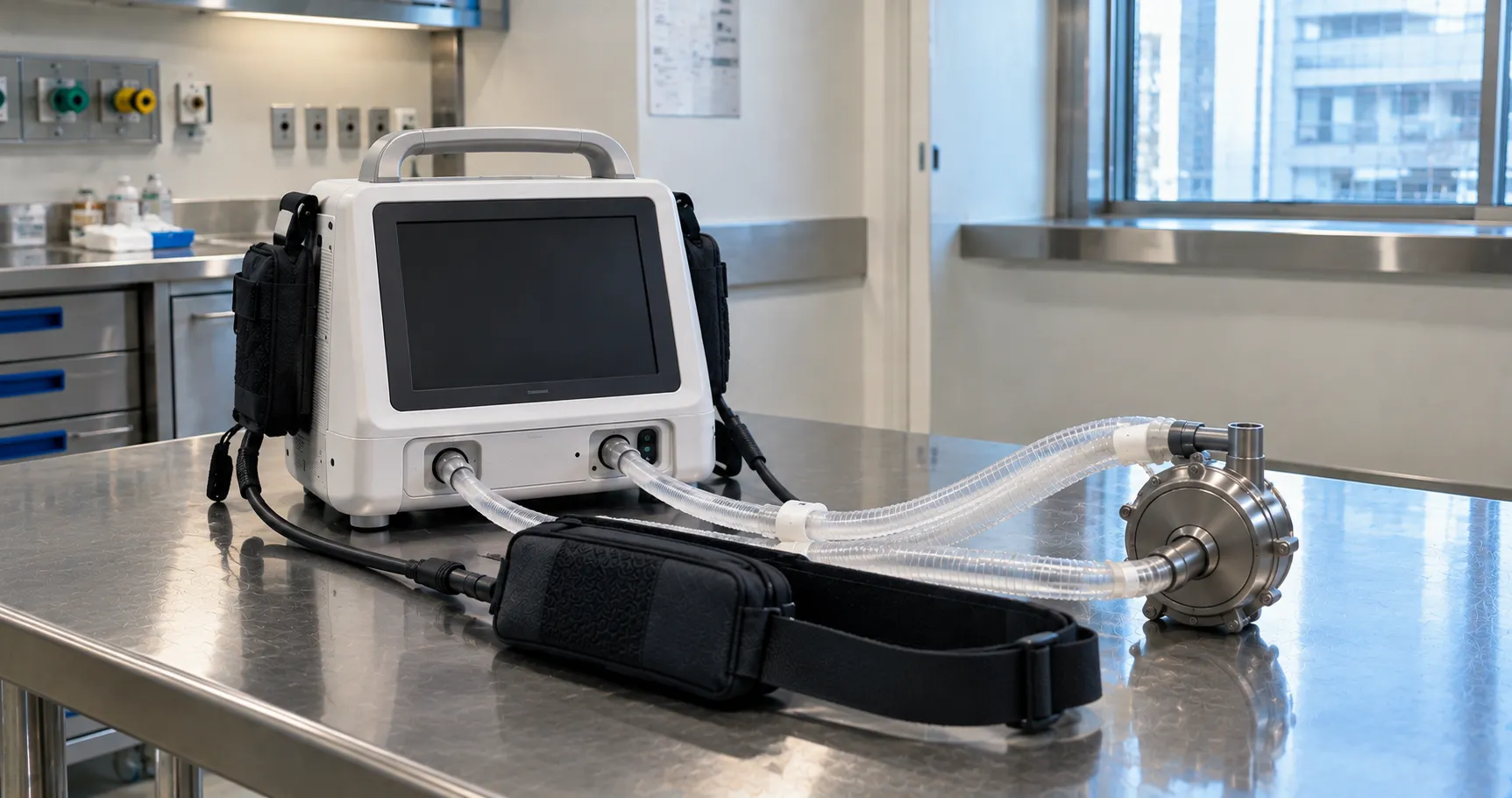
Most current durable devices are continuous-flow pumps, a marked shift from the bulky pulsatile designs of earlier generations. Inside the pump housing, a single rotor — either an axial impeller or a magnetically or hydrodynamically suspended centrifugal disc — spins at thousands of revolutions per minute to generate steady forward flow measured in litres per minute. Because the flow is continuous rather than pulsatile, many patients on a durable ventricular assist device have a faint or absent conventional pulse, which changes how blood pressure is measured and monitored. Suspended-rotor centrifugal designs aim to reduce blood-cell damage and pump thrombosis, two of the central engineering challenges in circulatory support.
LVAD, RVAD, BiVAD and total artificial hearts
The most common configuration is the left ventricular assist device (LVAD), which supports the left ventricle—the chamber that drives systemic circulation. A right ventricular assist device (RVAD) supports the right side, and when both are needed, the arrangement is a biventricular assist device (BiVAD). A total artificial heart is a different proposition again: it replaces both ventricles and the four valves entirely rather than assisting a native heart. Each configuration carries different cannulation, controller and power requirements, so a catalogue decision starts with which chambers your programme most often needs to support.
The driveline, controller and power system
A durable ventricular assist device is not fully internal. The implanted pump connects through a percutaneous driveline—a cable passing through the skin, usually in the abdomen—to an external controller worn by the patient. The controller manages pump speed, records alarms and connects to power. Patients run on rechargeable batteries during the day and a mains power module at rest, whose purchase is never just the pump: it includes the pump, the driveline, the controller, multiple battery sets, chargers, the mains unit, and the sterile surgical implant kit. The driveline exit site is also a lifelong infection-management point, so dressing consumables and patient training form part of the true cost.
Regulation and standards for circulatory support
An implantable ventricular assist device is an active implantable medical device, regulated in Great Britain under the Medical Devices Regulations 2002 (UK MDR 2002) and overseen by the Medicines and Healthcare products Regulatory Agency. Devices must carry valid conformity marking — UKCA or CE under the arrangements currently in force — and buyers should verify status directly with the MHRA rather than taking it on trust from a brochure.
The relevant technical standard for these pumps is ISO 14708-5, which sets requirements specifically for implantable circulatory support devices, sitting under the general active-implantable standard ISO 14708-1. The external controller and its power electronics fall under the general medical electrical safety standard IEC 60601-1. Ask each supplier to name the exact standards their declaration of conformity covers and to provide the supporting technical file for your device records.
Anticoagulation, monitoring and the blood-pump trade-off
Driving blood through a mechanical rotor introduces engineering compromises a buyer should understand. Contact between blood and pump surfaces raises the risk of clot formation and bleeding, even when anticoagulation is used to counter it. Hence, patients on a durable ventricular assist device need careful, lifelong anticoagulation and regular monitoring. Pump parameters — speed, estimated flow and power draw — are tracked continuously, because a rising power trend can signal thrombus forming on the rotor. Newer fully suspended centrifugal designs were developed specifically to lower rates of pump thrombosis and blood-cell trauma, and any comparison between products should look closely at the published haemocompatibility record rather than flow figures alone.
Durable implants versus short-term support
Not every pump is a long-term implant. Short-term percutaneous and surgically placed devices provide days to weeks of support in acute settings. In contrast, a durable ventricular assist device is designed for months or years and life outside the hospital. The two categories differ in cannulation, controller complexity, mobility and cost, so a centre often needs both, matched to different patient pathways. Being clear about which duration your service is buying for prevents specifying an acute device for a chronic need, or the reverse.
Servicing, spares and the running cost of a ventricular assist device
Because a ventricular assist device is life-sustaining, its support contract matters as much as its clinical data. External components wear out: controllers, batteries, and chargers all have finite service lives and must be replaced on schedule, and a programme needs guaranteed spares held close to the patient population. Continuity of supply is a patient-safety issue, not a convenience — a battery that cannot be replaced promptly is a clinical emergency. Buyers should scrutinise field-support response times, loan-unit availability, training for community and paramedic teams, and how firmware updates to the controller are validated and rolled out. National commissioning routes through the NHS also shape which centres run these programmes and how they are funded; NHS resources provide wider context on specialised cardiac services
Ventricular assist device buying checklist
-
Define the clinical role — bridge to transplant, destination therapy or recovery — and the chambers you most often support.
-
Confirm pump type (axial or centrifugal) and its published flow range and haemocompatibility features.
-
List every external component supplied: controller, driveline, battery sets, chargers and mains module.
-
Verify conformity marking and the ISO 14708-5 and IEC 60601-1 coverage in the declaration.
-
Check spares stockholding, controller and battery replacement schedules and guaranteed response times.
-
Confirm driveline dressing consumables and the training package for patients and community teams.
-
Clarify firmware update validation and any remote or telemetry monitoring available.
-
Agree warranty terms, loan-unit cover and total contract cost over the expected support period.
Comparing programmes on this basis, rather than headline pump price, is what protects both patients and budgets. MediGear helps specialist centres identify and compare verified circulatory-support suppliers, and procurement teams can set out their requirements through the MediGear buyer channel to receive like-for-like proposals.
The bottom line for circulatory support procurement
A ventricular assist device is one of the most demanding purchases a cardiac centre makes, because the decision commits the service to a long relationship covering the pump, its wearable hardware, consumables and round-the-clock support. Judge it on the whole system — pump performance, external component reliability, regulatory conformity and the depth of field support — rather than on the implant in isolation. Get that balance right, and a circulatory-support programme delivers dependable, life-sustaining help to patients whose own hearts can no longer keep pace.
Disclaimer
This article is for informational purposes only. It is published by MediGear (medigear.uk) for general information and procurement guidance. It is not clinical, diagnostic, treatment, technical, engineering, legal or regulatory advice, nor a product endorsement, guarantee or substitute for professional assessment. MediGear does not provide medical consultations. Buyers should consult their clinical, biomedical, estate, and regulatory contacts, review the manufacturer's documentation, and independently verify all specifications, certifications, compatibility, and suitability before purchase. Specifications, certifications and availability are correct at the time of publication and may change without notice. MediGear is a medical-equipment distributor and does not sell medicines or pharmaceutical products.