Fractional flow reserve wire: pressure, not pictures
A common misconception is that a fractional flow reserve wire takes an image of a coronary narrowing. It does not. A fractional flow reserve wire is a thin coronary guidewire with a pressure sensor near its tip that measures blood pressure inside the artery, so the lab can grade how much a stenosis genuinely restricts flow. That is a physiology measurement, not an angiographic picture. The angiogram shows the shadow of a narrowing; the FFR wire tells you whether that narrowing is actually starving the heart muscle downstream of pressure. In many borderline lesions those two things disagree, which is exactly why the wire earns its place, because the number it returns often decides whether a lesion gets a stent or medication.
How a fractional flow reserve wire grades a stenosis
The core measurement is a ratio of pressures. The sensor reads the pressure distal to the lesion, and the guide catheter reads aortic pressure at the coronary ostium. Fractional flow reserve is the distal pressure divided by the aortic pressure, measured at maximal hyperaemia, when the small vessels downstream are fully dilated and resistance is at its lowest and most stable. Under those conditions the pressure ratio tracks the drop in achievable blood flow the stenosis is causing. A value of 1.0 means no meaningful gradient; the lower the number, the more the lesion limits flow. A cut-off around 0.80 is widely used in practice to separate lesions that warrant treatment from those that do not, and the National Institute for Health and Care Excellence has assessed pressure-wire assessment for guiding intervention.
FFR, iFR and the non-hyperaemic ratios
Achieving maximal hyperaemia traditionally means giving adenosine, which takes time and can be uncomfortable for the patient. Resting or non-hyperaemic indices were developed to avoid it. The instantaneous wave-free ratio and similar resting indices measure the pressure ratio during a specific quiet window of diastole when resistance is naturally low, so no drug is needed. Their thresholds differ from FFR; a value around 0.89 is commonly used for the instantaneous wave-free ratio. Many modern consoles report both a hyperaemic FFR and a resting index from the same fractional flow reserve wire, letting the operator choose the workflow that suits the case. The physiology principle is the same throughout: measure pressure across the lesion and infer the effect on flow.
Inside the wire: sensor, shaft and handling
A pressure wire is built on the standard 0.014-inch coronary guidewire platform, so it can double as the workhorse wire that delivers a balloon or stent after the measurement. The pressure sensor sits a short distance back from the tip, typically at the junction of the radiopaque tip and the shaft, so it reads distal pressure once advanced past the lesion. Sensors are usually piezoresistive or optical. Handling is a genuine trade-off: a dedicated workhorse wire torques and crosses better than a sensor-laden wire, so operators weigh measurement against deliverability. Two practical steps protect accuracy: normalising the wire pressure to the guide pressure before crossing, and checking for signal drift after the pull-back, since an uncorrected drift can shift the reading enough to change the decision.
Adenosine, hyperaemia and the practical workflow
For a hyperaemic FFR, the team induces maximal hyperaemia, most often with intravenous or intracoronary adenosine, then records the lowest stable pressure ratio. A pull-back, drawing the wire slowly back across a diffusely diseased vessel, shows where the pressure recovers and helps localise which segment is doing the damage, which matters when several lesions sit in series. Resting indices skip the drug and read the pressure ratio at baseline. Either way, the fractional flow reserve wire converts an ambiguous angiogram into a defensible, documented number that supports the treatment decision.
Where FFR sits alongside intracoronary imaging
Physiology and imaging answer different questions and are complementary rather than interchangeable. A fractional flow reserve wire measures the functional impact of a lesion on flow. Intravascular ultrasound and optical coherence tomography instead image the vessel wall, sizing the lumen, the plaque and, after treatment, how well a stent is expanded and apposed. A lab often uses physiology to decide whether to treat and imaging to guide and check the stent. Keeping that distinction clear avoids buying one when the clinical question actually needs the other.
Standards, single-use wires and MHRA oversight
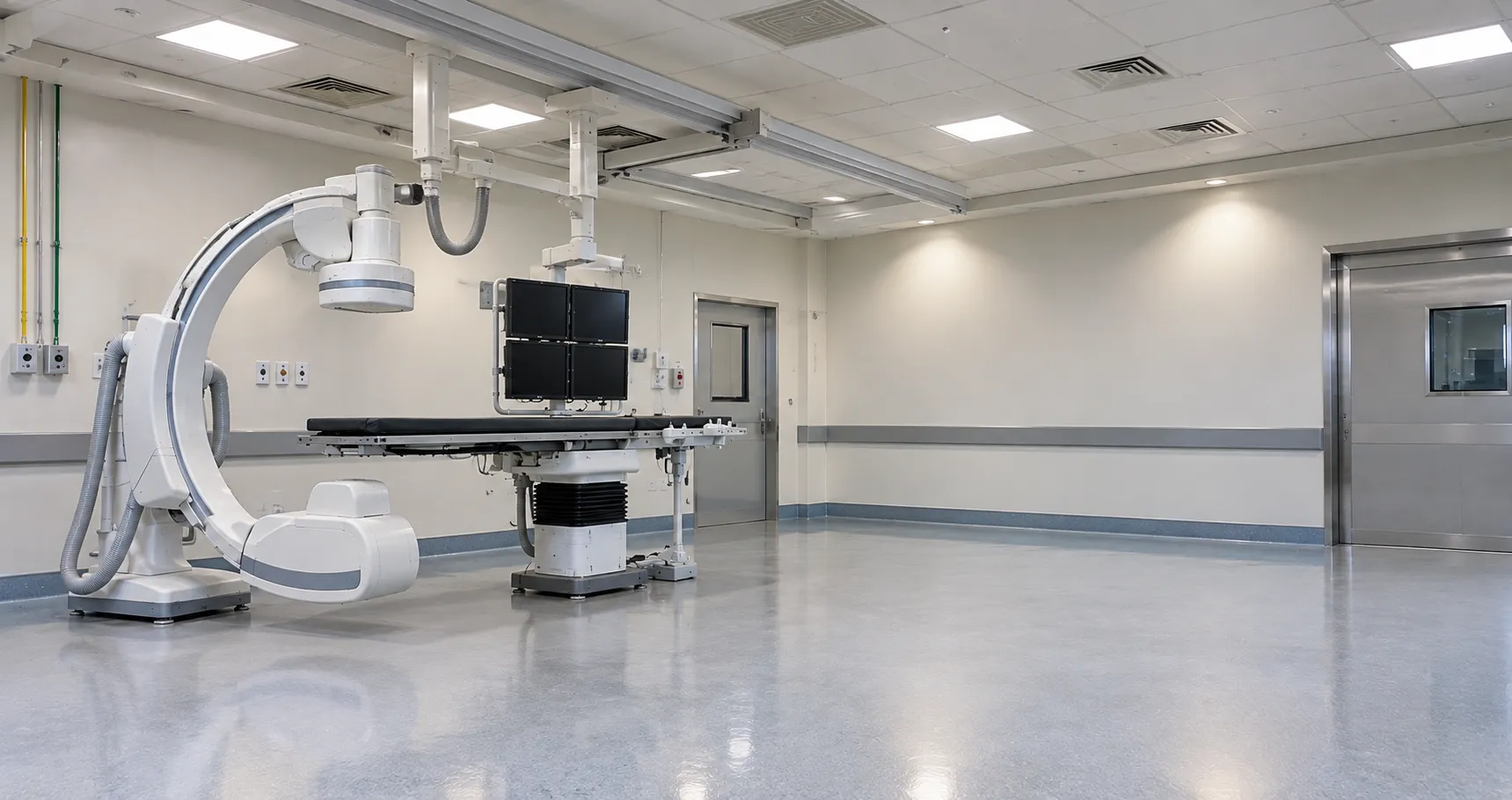
The pressure wire is a sterile, single-use device regulated under the UK Medical Devices Regulations 2002, with UKCA or recognised CE marking and the Medicines and Healthcare products Regulatory Agency as the regulator. The console or analyser that displays and records the pressures is medical electrical equipment built to IEC 60601-1, and it runs in a cath lab whose fluoroscopy meets IEC 60601-2-43 with radiation use under IR(ME)R 2017. This guide draws on manufacturer instructions for use and published UK regulatory guidance, and is written for procurement and cath-lab teams rather than for patients.
Reading a pull-back across serial disease
When several narrowings sit in the same vessel, a single spot reading can mislead, because each lesion affects the pressure the next one sees. A slow pull-back, drawing the fractional flow reserve wire back from distal to proximal while recording, shows where the pressure steps up and which segment contributes most. That lets the operator target the lesion that matters instead of stenting the whole vessel. On systems with co-registration, the pressure trace can be mapped onto the angiogram so the pressure drops line up with the visible anatomy.
Pitfalls that can skew a reading
A pressure wire only helps if the number is trustworthy, and several traps can distort it. Signal drift over the case is the classic one, which is why checking the wire against the guide pressure after the pull-back is essential. A guide catheter that damps or partially occludes the ostium falsely lowers aortic pressure and skews the ratio, so the operator disengages or uses a side-hole catheter as needed. Incomplete hyperaemia gives an FFR that is falsely high, and a sensor not advanced far enough past the lesion misses the true distal pressure. Sound technique and a clear workflow protect against all of these.
Where physiology fits across the service
Pressure-wire assessment is used well beyond the obvious single borderline lesion. It informs decisions in multivessel disease, helps judge an intermediate lesion found during a procedure aimed at another target, and supports a more selective, evidence-based approach to stenting. That breadth is part of the value case: a physiology platform that sits idle is hard to justify, but one used routinely earns its keep across a wide range of cases.
Fractional flow reserve wire buying checklist
Weigh these points before committing to a physiology platform:
- Decide whether you need hyperaemic FFR, resting indices, or both, and confirm the console reports what your operators want.
- Check wire handling and crossing quality, since a wire that measures well but delivers poorly slows the case.
- Confirm the connection type, wired or wireless, and how quickly a wire normalises and whether drift is easy to detect.
- Ask about integration with your haemodynamic and reporting systems so readings are captured, not transcribed by hand.
- Compare per-wire price and any per-use console fees against your annual physiology caseload.
- Clarify adenosine supply, dosing workflow and staff training if you rely on hyperaemic measurement.
- Verify service cover, software updates and loan arrangements for the console.
Running costs and the console decision
As with most cath-lab kit, the per-case consumable is where the money goes. The single-use pressure wire is the recurring cost; the console is a smaller, one-off outlay, though some platforms add a per-use software charge. Model spend against how many physiology cases you actually do, and factor in adenosine and staff time for hyperaemic studies. MediGear is a UK medical-equipment distributor that helps facilities compare verified suppliers of cath-lab consoles and consumables; procurement teams can begin on the buyers page or review options from suppliers.
The verdict
A fractional flow reserve wire replaces eyeballing an angiogram with a measured, defensible number for how much a stenosis limits flow. Choose the platform on the indices your operators use, the wire's handling and the true per-case cost, and keep physiology clearly separate from imaging in your buying plan. Specified well, the pressure wire makes borderline lesions a decision you can stand behind.
Disclaimer
This article is for informational purposes only. It is published by MediGear (medigear.uk) for general information and procurement guidance, and is not clinical, diagnostic, treatment, technical, engineering, legal or regulatory advice, nor a product endorsement, guarantee or substitute for professional assessment. MediGear does not provide medical consultations. Buyers should consult their clinical, biomedical, estates and regulatory contacts, and the manufacturer's documentation, and independently verify all specifications, certifications, compatibility and suitability before purchase. Specifications, certifications and availability are correct at the time of publication and may change without notice. MediGear is a medical-equipment distributor and does not sell medicines or pharmaceutical products.