
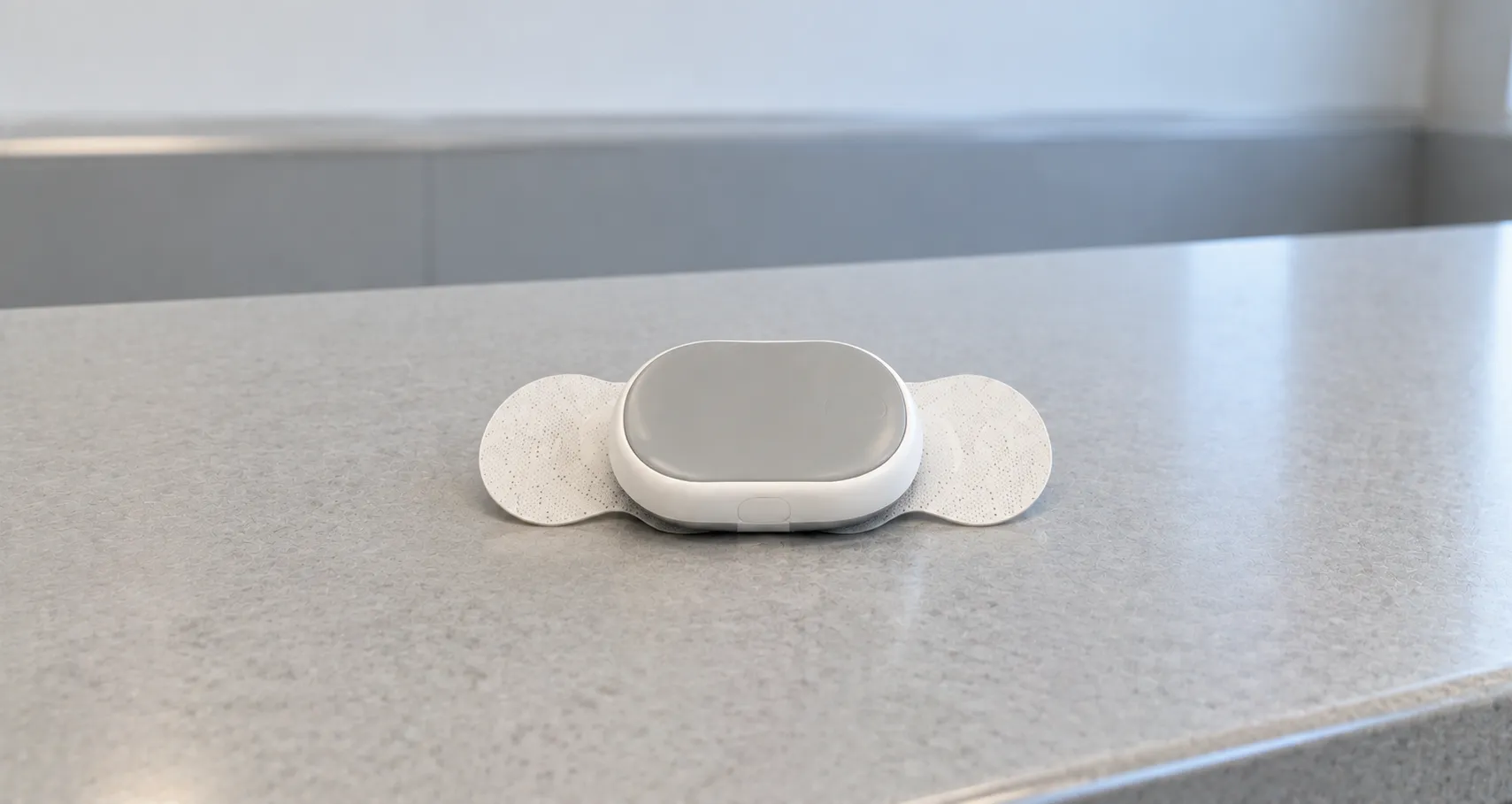
An ambulatory ECG patch is a single-use adhesive sensor that sticks to the chest and records a continuous single-lead ECG for several days, typically up to 7 to 14 days, with no wires, no lead box, and nothing for the patient to manage. The whole recorder, battery, electrodes,s and memory sit inside one lightweight adhesive patch. That wire-free, wear-and-forget form is what defines it and what drives its main advantage: patients keep it on and keep living normally, so the recording runs uninterrupted for far longer than a traditional wired study.
For a cardiology service, the ambulatory ECG patch is bought to solve an adherence and duration problem. It captures a long, continuous single-lead trace that is easy to wear, then goes back for analysis, so the buying questions centre on wear time, skin tolerance, and how the analysis and reporting are delivered.
One adhesive patch, no wires
Unlike a Holter recorder, which hangs from the belt or neck and connects to several electrodes by wires, an ambulatory ECG patch integrates the electrodes and recorder into a single stick-on unit. There is nothing to unclip, no leads to snag, and usually no buttons beyond an optional symptom marker. This matters more than it sounds: the most common reason a wired study fails is a lead that lifts or a patient who removes the device. Removing the wires removes those failure points, which is why the patch form has become popular for extended monitoring where comfort over many days is the deciding factor.
Why longer wear lifts diagnostic yield
The clinical case for an ambulatory ECG patch is duration. A comfortable, water-resistant patch worn for up to two weeks records far more time than a 24- or 48-hour test, and more recording time means a higher chance of catching an arrhythmia that only appears occasionally. Because the trace is continuous rather than triggered, it also captures asymptomatic episodes the patient would never have flagged. The patch therefore fills the space between a short continuous Holter and a symptom-triggered event monitor: continuous like the Holter, but long enough to rival the surveillance window of an event recorder.
The single-lead trade-off
The compromise is that most ambulatory ECG patches record a single lead. That is excellent for detecting and quantifying rhythm, atrial fibrillation burden, pauses,s and ectopy, which is what the test is usually ordered for. It is not designed for the multi-lead morphology or detailed ST analysis a 12-lead Holter provides. Buyers should be clear about the clinical question: if the service needs rhythm surveillance with high adherence over many days, the single-lead patch is ideal; if it needs multi-lead ST information, a wired recorder remains the better tool. Choosing the wrong one wastes the study and the patient's time.
Adhesive, skin tolerance and water resistance
Because the patch is stuck to the skin for up to two weeks, the adhesive and the electrode gel are central to whether the study succeeds. A good patch stays attached through showering, exercise,se and sweat, and its water resistance lets patients wash normally without removing it. Skin reactions to the adhesive are the main tolerability issue, so hypoallergenic materials and correct placement matter. The materials in prolonged skin contact are assessed for biocompatibility to the ISO 10993 series, which is worth confirming for any single-use skin-adhesive device.
Applying the patch and patient instructions
An ambulatory ECG patch is usually applied in clinic in a few minutes: the skin is prepared, the patch is positioned on the chest and pressed firmly to seal the adhesive. From there, the patient goes home with simple instructions, since there is nothing to charge or manage. Most patches carry an event marker the patient taps when they feel a symptom, and many pair with an app or a paper diary to note what they felt and when. Clear application technique and patient instruction protect the recording, because a poorly sealed patch or a confused symptom log undermines an otherwise long, clean trace.
Standards and biocompatibility for an ambulatory ECG patch
An ambulatory ECG patch is medical electrical equipment built to IEC 60601-1, with the particular requirements for ambulatory electrocardiographic systems in IEC 60601-2-47 governing the recording performance. As a device in prolonged contact with skin, its patient-contact materials are evaluated for biocompatibility under the ISO 10993 series. The patch is placed on the UK market under the UK Medical Devices Regulations 2002 and carries UKCA or recognised CE marking, with oversight from the Medicines and Healthcare products Regulatory Agency. This guide is compiled from manufacturer documentation and UK regulatory guidance for procurement teams, and NHS diagnostic pathway context is available from the NHS.
The analysis and reporting workflow
Most patches are worn, then either returned to a laboratory or posted back for the recorded data to be extracted and analysed by software and over-read by a physiologist. The output is a report summarising rhythm, atrial fibrillation burden, pauses and any symptomatic events the patient marked. When comparing patch systems, look closely at this workflow: turnaround time, whether analysis is in-house or a bureau service, report clarity, and how results reach the cardiology record all shape the real service. For a disposable device, the analysis and reporting arrangement is as important as the patch itself.
Specifying an ambulatory ECG patch service
Before adopting an ambulatory ECG patch, weigh the factors that decide value and yield:
-
Maximum continuous wear time, from a few days up to 14 days, against your target study length.
-
Water resistance and adhesive quality for reliable wear through showering and exercise.
-
Single-lead performance for rhythm and atrial fibrillation burden, and whether that fits the clinical question.
-
Biocompatibility of skin-contact materials to ISO 10993, and hypoallergenic options for sensitive skin.
-
Conformance to IEC 60601-1 and IEC 60601-2-47 for ambulatory ECG, and valid UKCA or CE marking.
-
Analysis model: in-house software versus a bureau service, and typical report turnaround.
-
Cost per patch and how results integrate with your cardiology reporting system.
Where the patch sits against Holter and event monitors
It helps to place the ambulatory ECG patch against its neighbours. A Holter monitor gives multi-channel detail but is usually worn for only a day or two and depends on wired electrodes staying put. An event monitor stretches surveillance across weeks but only records around triggered symptoms. The patch takes the middle ground: continuous recording like a Holter, but comfortable enough to wear for one to two weeks like an event monitor, at the price of a single lead. For a service whose main question is how much atrial fibrillation a patient has, or whether daily symptoms have an arrhythmic cause, that combination of continuous capture and long, high-adherence wear is often the best fit.
Cost per patch and the disposable model
The ambulatory ECG patch flips the usual cost structure. There is little or no capital recorder to buy; instead, each study consumes a single-use patch, so the cost is per patient and scales directly with volume. That can suit a service with variable demand, but the per-study price and any bundled analysis fee need careful comparison against the total cost of running a reusable Holter fleet. A distributor view helps here: MediGear lets UK facilities compare verified ambulatory ECG patch suppliers and their analysis packages, either through the buyers page or by browsing current suppliers.
Where the patch fits your pathway
An ambulatory ECG patch is defined by its wire-free, single-use, long-wear form, and that is exactly what makes it strong for extended rhythm surveillance with high patient adherence. Be honest about the single-lead trade-off, check the adhesive and water resistance, confirm biocompatibility and the standards, and scrutinise the analysis and reporting deal as hard as the patch. Placed correctly in the pathway, the patch captures the long, uninterrupted trace that shorter or wired tests struggle to deliver.
Disclaimer
This article is for informational purposes only. It is published by MediGear (medigear.uk) for general information and procurement guidance, and is not clinical, diagnostic, treatment, technical, engineering, legal or regulatory advice, nor a product endorsement, guarantee or substitute for professional assessment. MediGear does not provide medical consultations. Buyers should consult their clinical, biomedical, estates and regulatory contacts, and the manufacturer's documentation, and independently verify all specifications, certifications, compatibility and suitability before purchase. Specifications, certifications and availability are correct at the time of publication and may change without notice. MediGear is a medical-equipment distributor and does not sell medicines or pharmaceutical products.