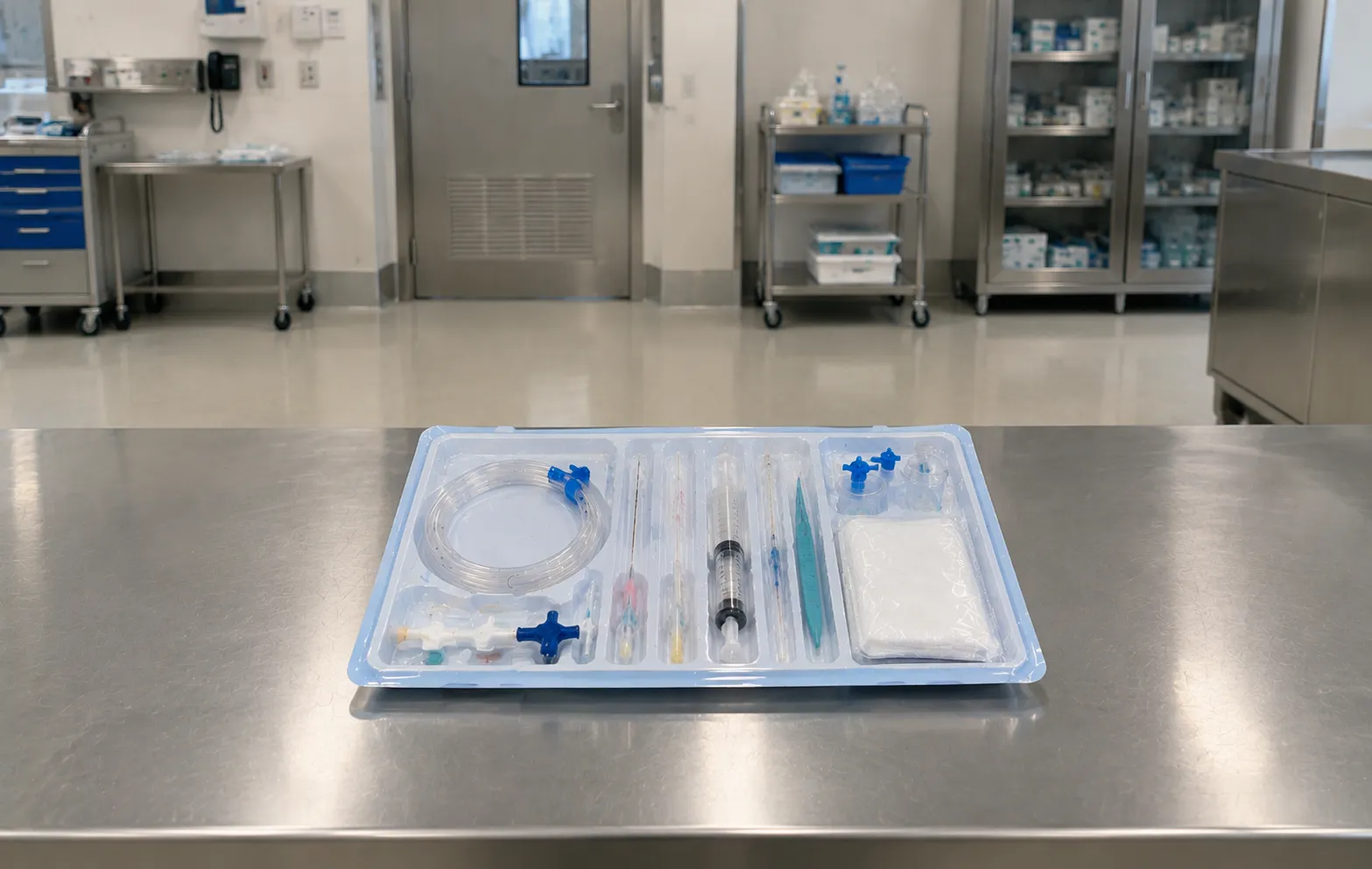
Pericardiocentesis kits are sterile, single-use procedure sets that a clinician uses to drain fluid from the pericardial sac around the heart. When an effusion builds up and starts to squeeze the heart, the kit supplies everything needed to place a needle, feed a guidewire a,nd leave a soft drainage catheter sitting in the pericardial space. This is a procedure pack, not capital equipment, so for a procurement team the questions are about what the tray contains, how it is used, and how often it needs restocking.
Picture a patient with a large effusion arriving in a resus bay or cardiac day unit. The team reaches for a pre-assembled tray rather than gathering loose components, because one sealed pack saves minutes and guarantees the right needle, wire and catheter are together and in date.
Inside a pericardiocentesis kit: the components that matter
Most pericardiocentesis kits are built around the Seldinger technique, so the contents follow a predictable chain. There is a long introducer needle or cannula, usually short-bevelled and often echogenic, to reach the pericardial space. A J-tipped guidewire threads through the needle and holds position while the needle is withdrawn. One or more dilators open the tract, and a multi-hole pigtail drainage catheter, typically in the region of 6 to 8.5 French, is fed over the wire and coiled in the sac so it sits against the fluid without scraping the myocardium. The pack usually adds a three-way tap, a connecting line, a drainage bag or bottle, a scalpel, syringes, and a retention suture or fixation device. Some trays include a self-sealing valve and a guarded needle to reduce sharps risk.
How the drainage actually works
The procedure is a controlled version of vascular access. Under imaging, the operator advances the needle toward the effusion, aspirates to confirm fluid, then passes the guidewire. The needle is exchanged for the pigtail catheter over that wire, the wire is removed, and the catheter is aspirated and connected to the drainage bag. Because the catheter carries multiple side holes and a curled tip, it drains a moving pericardial space far more safely than a rigid needle left in place. For a large effusion t, the catheter can stay in for a day or two to let the sac empty gradually and to measure output, which is why the fixation and closed-drainage parts of the kit matter as much as the needle.
Subxiphoid, apical or parasternal: the access route
The route the operator takes shapes which kit features matter. The classic subxiphoid approach comes in below the breastbone and aims up toward the left shoulder, and it suits a large effusion that pools inferiorly. An apical approach enters near the cardiac apex on the left chest, while a parasternal route sits beside the sternum; both are chosen under echo when the fluid collects there. Different routes favour different needle lengths and wire stiffness, so if your operators have a settled preference, match the kit's needle length and guidewire to it rather than accepting a generic tray that fits none of them well.
Kit tiers: quick aspiration versus full drainage sets
Pericardiocentesis kits are sold at more than one level. A basic set may hold little more than a long needle, a short catheter and a syringe for a quick emergency aspiration, while a full drainage set adds dilators, a soft pigtail catheter, a closed drainage bag and fixation for an indwelling drain. The right tier depends on whether your service performs quick emergency taps, planned drainage that stays in for days, or both. Many centres stock a full drainage kit as standard because it also covers the emergency case, whereas a bare aspiration set does not cover the planned one.
Why echo guidance changed pericardiocentesis
Blind, landmark-based drainage still has a place in a peri-arrest emergency, but planned pericardiocentesis is now overwhelmingly done under ultrasound. Echo lets the operator pick the shortest, safest route to the largest fluid pocket, keep clear of the liver and lung, and watch the wire and catheter go in. That is why echogenic needles are a genuine selling point: a tip that shows clearly on ultrasound is easier to steer. When you specify pericardiocentesis kits, ask whether the needle is designed for ultrasound visibility and whether the wire length suits the access route your operators prefer.
Fixation, output monitoring and catheter removal
Leaving a catheter in the pericardium for a day or two turns the kit into a small closed-drainage system. The catheter is secured with the supplied suture or adhesive fixation device so it cannot migrate, then attached to a bag through a three-way tap that lets staff aspirate and measure drainage volume. Nursing teams record output and watch for a sudden change, and the catheter is flushed periodically to prevent it from blocking. When drainage falls away, nd imaging confirms the sac is empty, the catheter is simply withdrawn. A kit that includes a reliable fixation device and a clearly graduated drainage bag makes all of this cleaner.
Aspiration, sampling and the diagnostic side
Draining an effusion is often also a diagnostic step. The fluid removed is frequently sent for laboratory analysis to work out why it collected, whether that is infection, malignancy, or inflammation, so the kit's syringes, three-way tap, and sample port make sampling clean and closed. A tap that lets staff draw a sample without breaking the circuit protects sterility and lowers the infection risk of an indwelling catheter. When comparing kits, look at how easily the drainage set supports both continuous drainage and intermittent sampling.
Single-use status and MHRA regulation
A pericardiocentesis kit is a sterile, single-use medical device. In Great Britain, it falls under the UK Medical Devices Regulations 2002 and must carry valid UKCA or recognised CE marking, with the Medicines and Healthcare products Regulatory Agency acting as regulator and the route for any field safety notices. Single-use means the tray is used once and discarded; components are not reprocessed in-house. Check the sterilisation method stated on the pack, usually ethylene oxide or gamma irradiation, and always check the expiry date, because a kit that sits in a rarely-touched resus store can quietly go out of date. This guide draws on manufacturer instructions for use and current MHRA guidance, and is written for procurement and clinical-engineering teams rather than for patients.
Where the kits are used, and in what volume
Pericardiocentesis kits live in cardiology cath labs, cardiac day units, emergency departments, intensive care and acute medical units. A tertiary cardiac centre may use them regularly for malignant or inflammatory effusions; a district general might keep only a few on the shelf for emergencies. That pattern drives the real procurement decision, which is not the unit price but the stockholding: enough in-date kits at every point of care that a tamponade is never met with an empty shelf. For the clinical background to draining a pericardial effusion, NICE is the reference for guidance, and NHS service context sits with the NHS.
Before you stock pericardiocentesis kits: a buyer checklist
Run through these points before committing to a supplier or agreeing a standing order:
-
Confirm the catheter size range and length, and that the pigtail is multi-hole and soft-tipped for pericardial use.
-
Check whether the introducer needle is echogenic and suited to ultrasound-guided access.
-
Verify the drainage set: three-way tap, connecting line, bag or bottle capacity a, nd a secure fixation or suture device.
-
Confirm UKCA or CE marking, the sterilisation method and a realistic shelf life for low-turnover stores.
-
Check the guidewire tip and length match your operators' preferred subxiphoid or apical approach.
-
Ask about sharps-safety features such as a guarded needle or self-sealing valve.
-
Establish restock lead time and whether kits can be spread across resus, cath lab, nd ICU on one order.
Running costs and stock rotation
The cost story here is not one big number but many small ones. Each kit is a consumable, and total spend depends on annual usage plus the waste from trays that expire unused in emergency stores. A sensible first-in, first-out rotation policy with regular expiry checks keeps that waste down. Because the kits sit in several departments, standardising on one or two references makes training simpler and lets you buy at better volume. MediGear is a UK medical-equipment distributor that helps facilities compare verified suppliers and single-use procedure packs; buyers can start on the buyers page or review listings from suppliers.
The bottom line
A pericardiocentesis kit succeeds or fails on the quality of its needle, wire and pigtail catheter, and on whether an in-date tray is on the shelf when a tamponade arrives. Specify the catheter size, the echogenic needle and a secure closed-drainage set, then manage the stock so expiries never catch you out. Get those two things right,t and the kit does exactly what it should: turn a dangerous effusion into a controlled, drained space.
Disclaimer
This article is for informational purposes only. It is published by MediGear (medigear.uk) for general information and procurement guidance, and is not clinical, diagnostic, treatment, technical, engineering, legal or regulatory advice, nor a product endorsement, guarantee or substitute for professional assessment. MediGear does not provide medical consultations. Buyers should consult their clinical, biomedical, estates and regulatory contacts, and the manufacturer's documentation, and independently verify all specifications, certifications, compatibility and suitability before purchase. Specifications, certifications and availability are correct at the time of publication and may change without notice. MediGear is a medical-equipment distributor and does not sell medicines or pharmaceutical products.