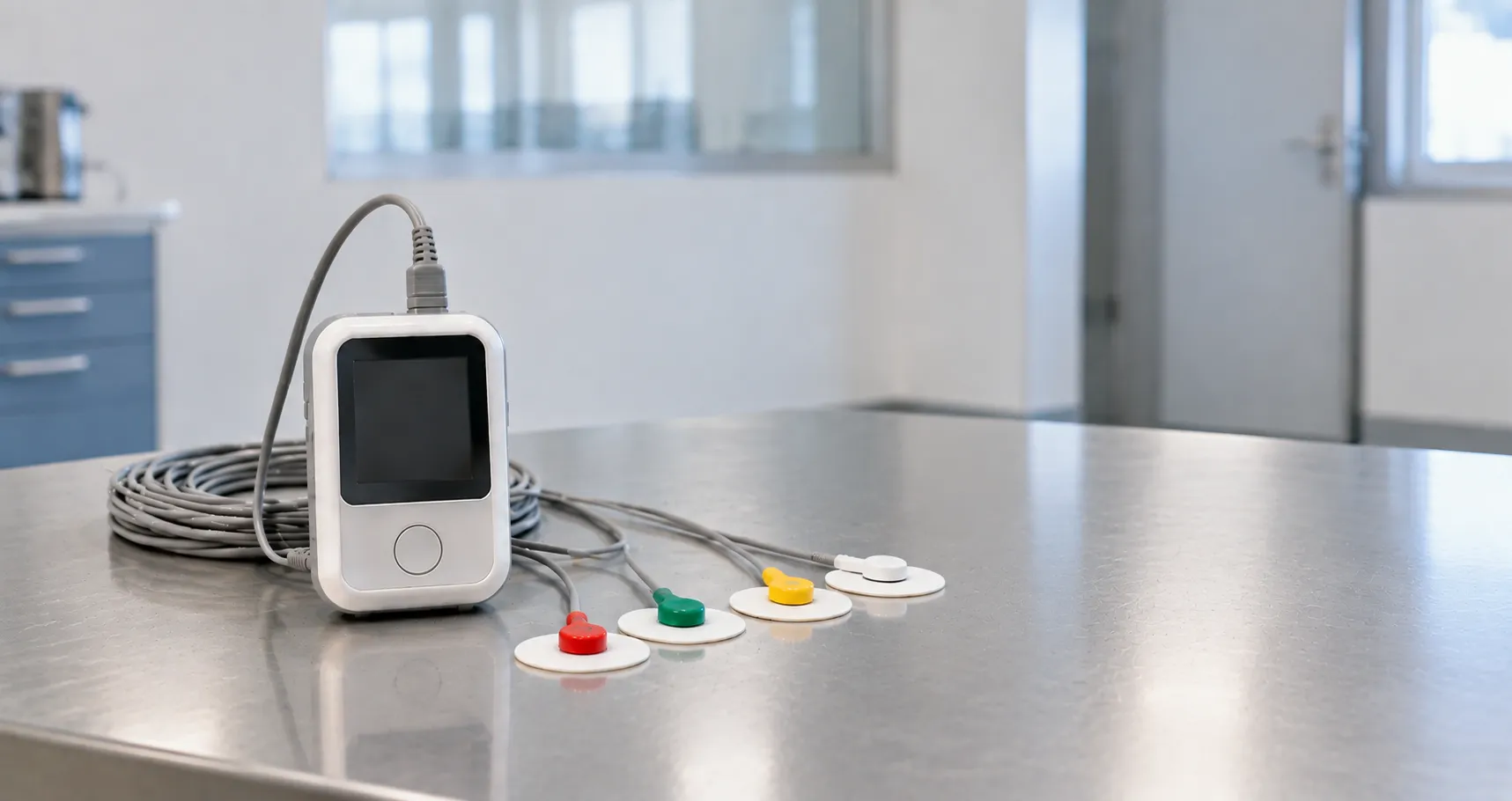
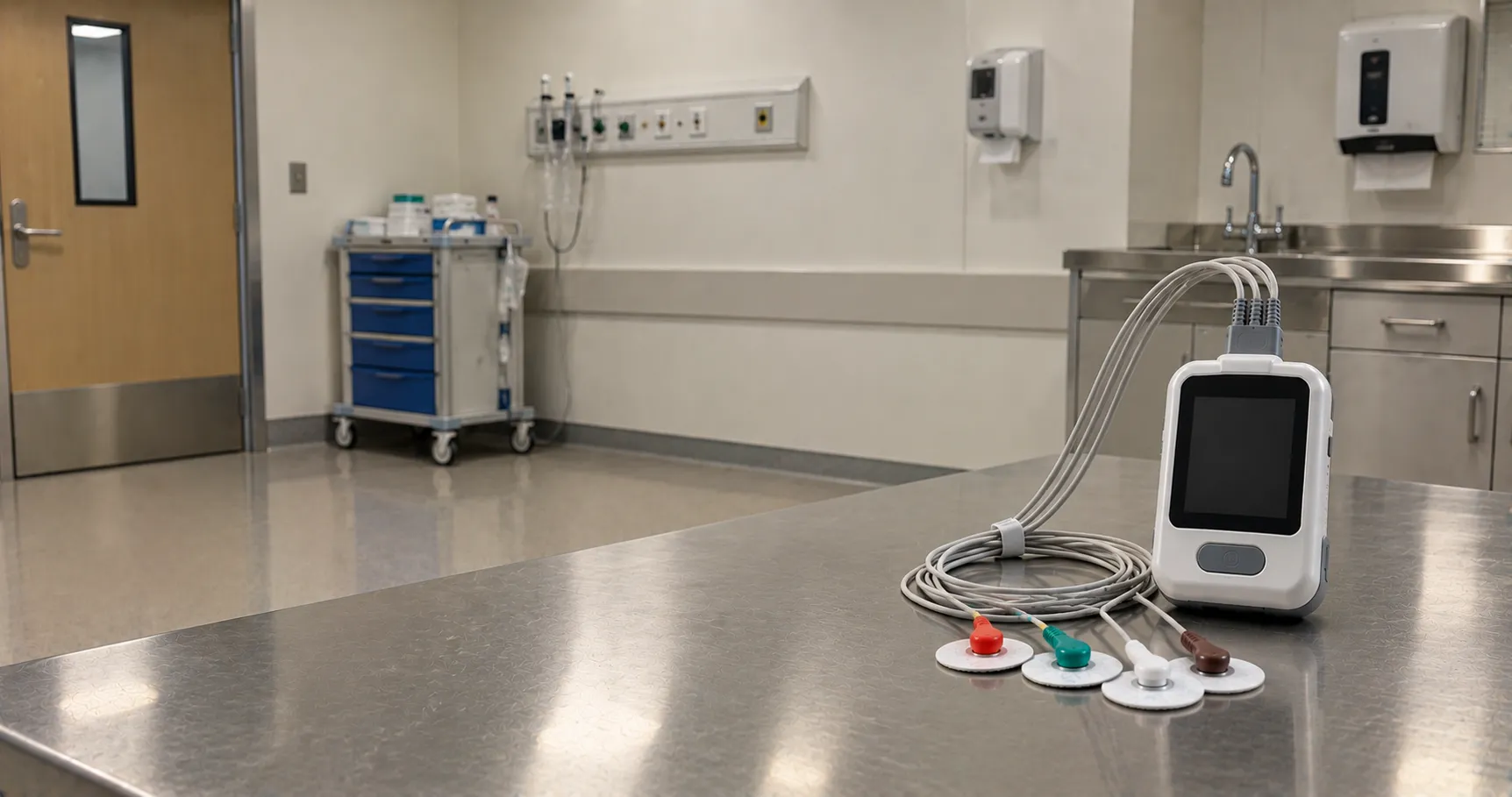
When palpitations or dizzy spells come and go over weeks, an event monitor records them: a patient-worn ECG device that saves a short strip around a symptom, usually when the patient presses a button, rather than storing every beat continuously. That triggered, symptom-linked recording is the defining feature. It lets a patient wear the monitor for weeks and capture only the moments that matter, making an event monitor the natural next step when a 24- to 48-hour continuous test comes back clear but symptoms keep returning.
For a cardiology or procurement lead, an event monitor's value is diagnostic yield over time. It trades the completeness of a continuous recording for a much longer surveillance window, so it is chosen for the symptom pattern, not as a general-purpose recorder. Understanding that lane is the key to buying and deploying it well.
Triggered recording, not a continuous trace
The key contrast is with a Holter monitor, which records everything for a day or two. An event monitor does not keep the whole trace. Instead it stores brief, timestamped strips tied to symptoms, so a patient can wear it for up to about a month and still generate a manageable set of clips to review. This is why event monitors suit infrequent symptoms that a continuous recorder is statistically likely to miss. The trade-off is that anything the patient does not trigger, and that the device does not auto-detect, is not saved, so patient understanding of when and how to activate the recorder is central to a useful study.
Looping versus non-looping event monitors
Event monitors come in two main forms, and the difference matters clinically. A non-looping, or post-event, recorder only starts saving after the patient presses the button, so it captures the symptom and what follows but not the rhythm just before it. A looping, or pre-event, recorder is worn with electrodes in continuous contact and holds a rolling buffer in memory, so when the patient triggers it, the device saves the seconds before and after the press. For a brief arrhythmia that causes a symptom and then passes, the pre-event loop is far more useful, because the onset is exactly what a cardiologist wants to see.
Handheld recorders versus continuously worn monitors
The two forms also differ in how the patient carries them. A non-looping handheld recorder is a small unit the patient applies to the chest or holds against it only when a symptom starts, which suits people who get a clear warning and can react. A looping event monitor is worn continuously with electrodes in place, so it is ready the moment a symptom begins and can also record automatically. Handheld devices are simpler and cheaper but demand a cooperative, forewarned patient; worn loop recorders capture more but need reliable electrode contact over many days. Matching the form to the patient group is part of specifying the service.
How long patients wear an event monitor
An event monitor is a weeks-long test. Typical monitoring periods run about two to four weeks, which lets it catch symptoms that appear only every few days. Non-looping handheld recorders may be applied by the patient only when a symptom starts, while looping recorders stay on continuously with electrodes in place. The longer window is the point: it increases the chance that an intermittent event occurs while the device is on. The patient can trigger a recording. How well the patient understands the device shapes that yield as much as the wear period does. A patient who has been shown when to press the button, how to note what they felt and how to keep the electrodes in contact returns far more usable clips than one sent home with a rushed handover, so building genuine hook-up and education time into the fitting appointment is part of getting a diagnostic study rather than an optional extra.
Auto-triggering and symptom correlation
Many looping event monitors add automatic detection, so the device saves a strip when it recognises a fast, slow or irregular rhythm even if the patient does not press the button. This catches asymptomatic episodes and events that leave the patient unable to react in time. Correlation still matters: pairing a patient-reported symptom with the ECG at that timestamp is often what makes the study diagnostic, so a clear event button and reliable timestamping are practical priorities. NICE publishes clinical guidance on investigating palpitations and suspected arrhythmia, and the NHS provides pathway context.
Standards and marking for an event monitor
An event monitor is medical electrical equipment built to IEC 60601-1, with the particular requirements for ambulatory electrocardiographic systems in IEC 60601-2-47, the same family that governs Holter recorders. That standard covers the recorder and the accuracy of the stored ECG. In Great Britain, an event recorder falls under the UK Medical Devices Regulations 2002. It must show a valid UKCA or recognised CE marking, as verified by the Medicines and Healthcare products Regulatory Agency. This guide draws on manufacturer documentation and UK regulatory guidance and is written for UK buyers, not patients.
Specifying an event monitor
Before choosing an event monitor for a service, work through the features that decide diagnostic yield and workflow:
-
Looping (pre-event) versus non-looping recording, and whether you need the pre-symptom buffer.
-
Automatic arrhythmia triggering and patient-activated capture.
-
Maximum wear period and how many events the device can store between downloads.
-
CA clearsymptom button, accurate timestamping, and an easy way to log what the patient felt.
-
Electrode and consumable compatibility, plus skin tolerance for weeks of wear.
-
Built to IEC 60601-1 and IEC 60601-2-47 for ambulatory ECG, with current UKCA or CE marking.
-
Analysis and reporting workflow, and how clips export into your cardiology record.
Skin contact and wearability over weeks
Because a looping event monitor is worn continuously for weeks, reliable electrode contact and skin comfort decide whether the study succeeds. Electrodes that dry out or lift break the recording exactly when a symptom might occur, so the electrode type, how often the patient is asked to replace them, and skin tolerance over a long wear period all matter. Some patients react to adhesives, and a device that is uncomfortable or awkward to keep on iets taken off, ending the study early. When specifying an event monitor, treat wearability and the electrode replacement routine as clinical variables, not minor details, because they directly govern how much usable data a weeks-long test returns.
Memory, downloads and what the report shows
An event monitor only has to store the clips it captures, not a continuous trace, so onboard memory is modest, but the number of events it can hold before a download matters over a multi-week wear period. Some looping recorders are downloaded in clinic at the end of the study; others let the patient transmit clips remotely over a phone line or through a smartphone app, so a technician can review them as they arrive rather than waiting for the unit to come back. The final report pairs each captured strip with the patient's symptom note and any auto-detected events, so a cardiologist can see whether a palpitation coincided with a real arrhythmia. When comparing devices, check event capacity, how clips are retrieved and how clearly the report links symptom to rhythm.
Reprocessing and the running cost
Most event monitors are reusable recorders that come back, are cleaned and reissued, so consumables are the electrodes and any single-use accessories used per patient, plus the analysis or reporting licence. Because the device is worn for weeks, patient education and reliable unit return affect throughput as much as the hardware. When comparing options, weigh how many recorders you need to cover a multi-week wear period across your caseload, since each patient ties up a device far longer than a Holter study does. MediGear helps UK facilities compare verified event monitor suppliers; explore the buyers page or current suppliers.
Matching the monitor to the symptom pattern
An event monitor is defined by triggered, symptom-linked recording over a long window, and that is exactly what makes it right for palpitations and dizziness that appear only now and then. Decide first whether you need a looping recorder with a pre-symptom buffer and automatic detection, confirm how captured clips reach the reporting team, and check that the analysis workflow fits your service. Chosen for the right symptom pattern, an event monitor picks up the intermittent rhythm a continuous test keeps missing.
Disclaimer
This article is for informational purposes only. It is published by MediGear (medigear.uk) for general information and procurement guidance; it is not clinical, diagnostic, treatment, technical, engineering, legal or regulatory advice, nor a product endorsement, guarantee or substitute for professional assessment. MediGear does not provide medical consultations. Buyers should consult their clinical, biomedical, estates and regulatory experts, review the manufacturer's documentation, and independently verify all specifications, certifications, compatibility, and suitability before purchase. Specifications, certifications and availability are correct at the time of publication and may change without notice. MediGear is a medical-equipment distributor and does not sell medicines or pharmaceutical products.