Centrifuges are among the hardest-working instruments in a laboratory and among the least specified. A machine chosen on capacity alone may lack the force a protocol requires, or hold a rotor that does not accept the tubes the laboratory actually uses. Both problems surface on the first busy morning.
The ten centrifuge types below cover routine clinical processing. Each entry explains its role and what to confirm before purchase.
Force, not speed, defines the protocol
Protocol specifications use relative centrifugal force rather than revolutions per minute because the force produced depends on the rotor radius as well as the speed. Two machines running at the same speed with different rotors will not deliver the same separation.
When comparing machines, ask for the force achieved with the specific rotor-and-tube configuration the laboratory intends to use. A specification quoted with the fastest available rotor tells you little about performance with your carriers loaded.
The ten centrifuge types
1. Benchtop swing-out rotor centrifuges
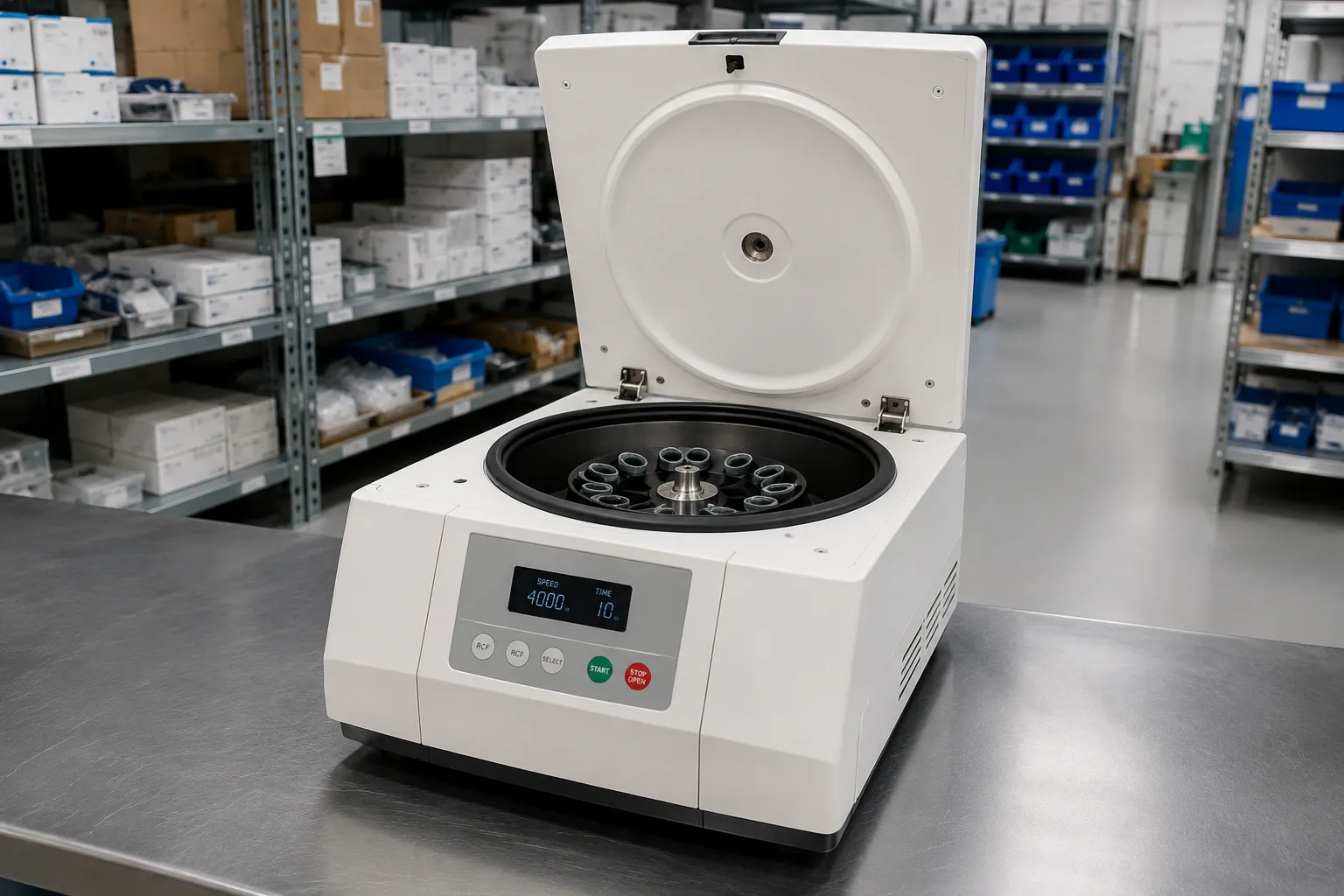
Buckets swing horizontally during the run, producing a flat sediment interface. Widely used for serum and plasma separation in routine processing.
2. Benchtop fixed-angle centrifuges
Tubes are held at a set angle, enabling faster settling in many applications where sediment forms against the tube wall.
3. Compact clinical centrifuges
Small-footprint machines for side rooms, clinics and near-patient work where a full laboratory instrument is not practical.
4. Microcentrifuges
High-speed machines for small tubes, used in molecular and specialist work where sample volumes are small.
5. Haematocrit centrifuges
Dedicated machines spinning capillary tubes at high speed for packed cell volume measurement, usually with a reading device.
6. Urine sediment centrifuges
Configured for the tube formats and forces used in urine microscopy preparation, often with a defined preset for the protocol.
7. Cytocentrifuges
Deposit cells directly onto slides for microscopy, with dedicated chambers and filter cards forming consumable centrifuges with interchangeable rotors
Accept several rotor and carrier options on one drive, allowing a laboratory to cover different tube formats without a second machine.
9. Centrifuges with sealed rotors and lids
Provide containment during the run and support the handling of samples that require it. Confirm which sealing arrangement the manufacturer specifies.
10. Floor-standing high-capacity centrifuges
Large-volume machines for laboratories processing high sample numbers, usually with cooling and extensive programme storage.
Balancing, containment and daily use
Most centrifuge faults trace back to loading. Tubes must be balanced by weight in opposing positions, buckets must be seated correctly, and carriers must be checked for cracks or corrosion. An imbalance alarm is a protection, not a routine occurrence, and repeated triggering suggests a training or workflow problem rather than a machine fault. Containment matters equally: aerosols generated during a run are managed by sealed rotors, lids and correct tube selection, so the laboratory's safety assessment should determine which arrangement is required before a machine is chosen.
What to confirm before ordering
-
Rotor and carriers. Confirm they accept the exact tube sizes the laboratory uses.
-
Force achieved. Ask for the relative centrifugal force with your intended configuration.
-
Capacity. Match tube numbers per run to peak workload rather than average.
-
Programme storage. Check whether protocols can be stored and locked to prevent drift.
-
Noise and heat. Consider bench siting, ventilation clearance and sound output.
-
Consumables. Confirm supply for cytocentrifuge chambers, filter cards and capillary tubes.
Calibration, maintenance and records
Speed and timer accuracy should be verified at defined intervals, with results recorded. Many laboratories include this in their quality management schedule alongside temperature and pipette checks.
Rotors need their own attention. Inspect for corrosion, keep them clean and dry, and follow any manufacturer guidance on service life, since rotor failure is the most serious mechanical risk a centrifuge presents.
Agree planned maintenance intervals, lid interlock testing, motor and drive inspection, electrical safety testing and spare-parts availability. Ensure the laboratory receives published device safety alerts so field safety notices reach the technical team.
The rotor and carrier configuration should be specified before the machine is chosen. The availability of the particular tube can be confirmed with verified laboratory suppliers.
Final thoughts
Specify the rotor before the machine. Confirm the force achieved with your tubes, match capacity to peak workload, agree containment arrangements with your safety assessment, and put speed verification and rotor inspection into the laboratory's routine schedule from the day of installation.
This article provides general procurement guidance for laboratories and healthcare organisations. It is not clinical or laboratory practice advice, and it does not replace manufacturer instructions or local safety policy.