Piped medical gases reach almost every clinical area of a hospital, delivering oxygen, medical air, and vacuum to the bedside through a carefully engineered system. The medical gas equipment behind this runs from the supply source, through the pipeline, to the outlets and the devices that regulate and deliver gas to patients.
This is safety-critical infrastructure, so every part of it is designed, installed, and maintained to strict standards. A pipeline system is planned as a whole and worked on only by competent people, since a fault can affect many patients at once across the areas it serves. Understood as one connected system rather than a collection of parts, a pipeline is far easier to plan, run and keep safe.
The twenty-five medical gas equipment items below cover the core of a piped system. They are grouped by their place in the system, which is always planned and maintained under the standards and competent-person arrangements that medical gases require. Grouping them this way follows the gas from source to bedside, since each stage depends on the one before it.
Following the gas through the system
The items fall into five groups: source and supply, pipeline and distribution, terminal and outlets, delivery and regulation, and safety and monitoring. Together they cover getting medical gases safely from the source to the patient, and seen as a whole they show the path each gas takes.
Source and supply
Every piped system starts with a reliable supply of each gas, sized for the hospital's demand. This group provides and backs up that supply. Because everything downstream depends on it, the supply is sized and backed up with particular care.
-
Manifolds — supplying gas from cylinders.
-
Cylinder supply systems — supporting the gas supply.
-
Medical air plant — generating medical air.
-
Vacuum plant — providing medical vacuum.
-
Oxygen supply systems — supplying piped oxygen.
Pipeline and distribution
The pipeline carries each gas safely through the building to where it is needed. This group covers the distribution network and its controls. The ability to isolate an area safely is central here, since it lets work happen without affecting the whole hospital.
-
Pipeline components — carrying gas through the building.
-
Area valve service units — isolating areas safely.
-
Isolation valves — controlling the flow.
-
Pipeline fittings — supporting the network.
-
Distribution networks — routing gas to areas.
Terminal and outlets
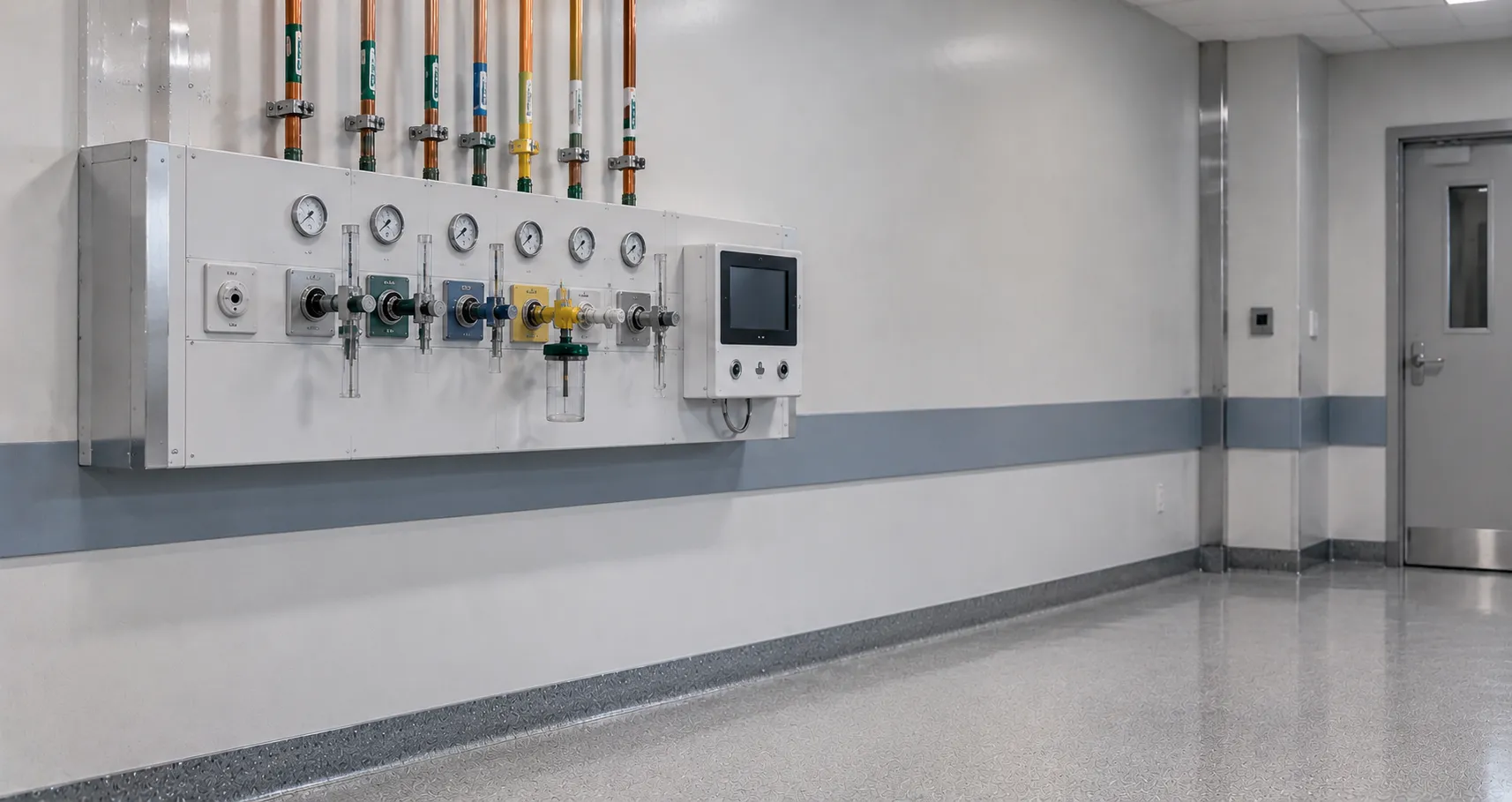
At the point of care, terminal units and outlets deliver each gas to the bedside. This group is where the system meets the clinical area. This is where a hospital-wide system meets a single bedside, so reliability at the outlet matters enormously.
-
Terminal units — outlets delivering gas at the point of care.
-
Wall outlets — wall-mounted gas outlets.
-
Bed head units — bringing gases to the bedside.
-
Pendant outlets — supplying gas at the bedside.
-
Ceiling supply units — delivering gas from above.
Delivery and regulation
Delivering gas to a patient safely relies on regulating its flow and pressure. This group controls how gas reaches the patient. Accurate control of flow and pressure is what turns a piped supply into safe delivery to a patient.
-
Flowmeters — controlling gas flow.
-
Pressure regulators — regulating gas pressure.
-
Suction regulators — controlling medical vacuum.
-
Oxygen regulators — regulating oxygen delivery.
-
Gas hoses — connecting devices to outlets.
Safety and monitoring
Because piped gases are safety-critical, monitoring and safety controls run through the whole system. This group keeps the system safe and watched. Running quietly in the background, this group is what makes a safety-critical system genuinely safe.
-
Gas alarms — alerting to supply problems.
-
Pressure monitoring — tracking system pressure.
-
Gas detection — supporting safety.
-
Emergency shut-off — isolating gas in an emergency.
-
Test equipment — supporting safety checks.
Safety, testing and upkeep
Medical gas systems are safety-critical, so planned maintenance, testing, alarm checks and competent-person arrangements are fundamental rather than optional. Staff should know how to report a problem with medical gas equipment to the MHRA, and it helps to keep the estates team subscribed to the MHRA's device alerts and recalls covering this equipment.
Records and drawings
Safe work on a gas system depends on knowing exactly how it is built, so accurate records and up-to-date drawings are as much a part of safety as any valve or alarm. Keeping them current supports maintenance, testing and any future change, and it is easily overlooked until the day it is badly needed.
Planning the system
Medical gas systems are safety-critical infrastructure, so they are planned, installed and maintained under strict standards and by competent people, with estates and medical gas expertise involved throughout. Because a fault can affect many patients at once, safety, alarms and monitoring are as central as the pipeline itself.
Pipeline projects are best planned with estates and a Medigear.uk partner.
The whole system is planned together, from the source and supply through to the outlets, so capacity, distribution and safety all fit the hospital's demand. Matching the system to current and likely future demand keeps a hospital supplied reliably as its services change.
It also helps to plan for resilience, since supply must never fail. Backup supply, clear alarms and emergency isolation mean a problem is contained and managed safely rather than allowed to spread.
It also helps to keep clear records and drawings of the whole system, since safe work depends on knowing exactly how it is built. Accurate documentation supports maintenance, testing and any future changes, and it is as much a part of safety as the hardware.
Points to settle
-
Standards. Plan and maintain under medical gas standards.
-
Competent people. Involve estates and medical gas expertise.
-
Whole system. Plan source, distribution and outlets together.
-
Resilience. Confirm backup supply, alarms and isolation.
-
Demand. Match capacity to current and future demand.
The system in short
Piped medical gases quietly support care across almost the whole hospital. Grouping the twenty-five medical gas equipment items by their place in the system, planning under strict standards, and building in resilience turn the list into safe, dependable infrastructure. Planned and maintained this way, the medical gas equipment supplies patients reliably wherever they are cared for. Planned and maintained as one safe system, piped gases support care reliably across the whole hospital.
For component supply and advice, it helps to contact the Medigear.uk team.
This article provides general procurement guidance for healthcare organisations. It is not clinical or medical gas engineering advice, and it does not replace manufacturer instructions, medical gas standards or expert advice.