Starting in healthcare means learning a new language almost overnight, and the medical terms below are a grounding in the words and equipment new staff will meet on their very first shifts. From a set of vital signs to a syringe driver, understanding these medical terms turns a bewildering environment into a familiar one. Some departments review equipment for new healthcare staff for buyers on Medigear.uk as part of planning.
Because new staff encounter terms across every part of a hospital, these medical terms are best understood by the setting they belong to, from the ward to the theatre. Grouping the terms this way helps a newcomer build a picture of how a hospital talks about its work.
The 100 medical terms below are grouped into 10 sets of 10, ranging from vital signs to general clinical language. Grouping them this way follows how new staff actually meet these words.
The ten sets of terms
The terms fall into ten sets: vital signs, ward terms, equipment terms, theatre terms, monitoring terms, emergency terms, infection control terms, medication terms, diagnostic terms, and general clinical terms.
Vital signs
These are the basic measurements of a patient's condition. These are among the first words a new member of staff will hear on a shift. Buyers can also ask the Medigear.uk team about equipment for new healthcare staff.
-
Blood pressure — the pressure of blood in the arteries
-
Heart rate — how many times the heart beats each minute
-
Respiratory rate — how many breaths are taken each minute
-
Temperature — how warm the body is
-
Oxygen saturation — how much oxygen the blood carries
-
Pulse — the beat felt as the heart pumps
-
Blood glucose — the sugar level in the blood
-
Consciousness level — how alert a patient is
-
Capillary refill — how quickly colour returns to skin
-
Pain score — a rating of a patient's pain
Ward terms
These describe the flow of care on a ward. Understanding these terms lets a newcomer follow the flow of care on a ward.
-
Admission — a patient being taken onto a ward
-
Discharge — a patient leaving hospital care
-
Handover — passing information between shifts
-
Observation — the regular checking of a patient
-
Care plan — the agreed plan for a patient
-
Ward round — the team's review of patients
-
Bed management — organising ward beds
-
Escalation — raising concern with the team
-
Referral — sending a patient to another service
-
Fluid balance — tracking fluids in and out
Equipment terms
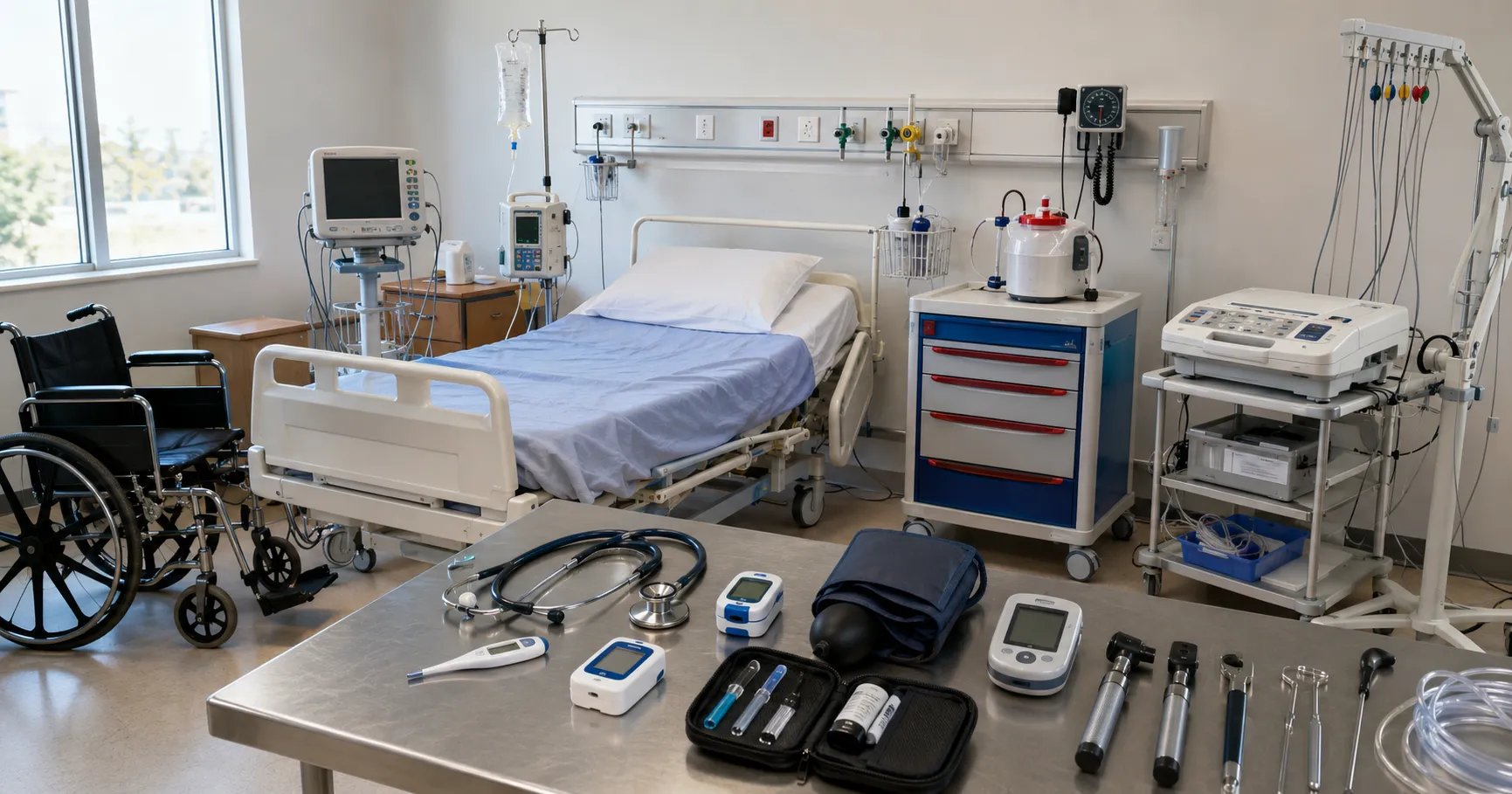
These name the devices new staff will use. Knowing the device behind each word connects language to real practice.
-
Monitor — a device showing vital signs
-
Infusion pump — a device giving fluids steadily
-
Nebuliser — a device turning medicine into mist
-
Catheter — a tube draining or delivering fluid
-
Cannula — a tube giving access to a vein
-
Ventilator — a machine supporting breathing
-
Defibrillator — a device restarting the heart
-
Suction unit — a device clearing fluids
-
Oximeter — a device reading blood oxygen
-
Syringe driver — a device giving small steady doses
Theatre terms
These belong to the operating department. These terms belong to one of the most specialised parts of a hospital.
-
Anaesthesia — medicine that removes sensation
-
Sterile field — the clean area around surgery
-
Scrub — cleaning hands before surgery
-
Incision — a surgical cut
-
Suture — a stitch closing tissue
-
Diathermy — using energy to seal tissue
-
Recovery — care straight after surgery
-
Prep — preparing skin for surgery
-
Drape — sterile covering around the site
-
Consent — a patient's agreement to treatment
Monitoring terms
These describe how patients are watched. These words describe how patients are watched and how monitors behave.
-
Baseline — a starting measurement for comparison
-
Trend — the direction a measurement is moving
-
Alarm limit — the point that triggers an alert
-
Waveform — a traced signal on a monitor
-
Lead — a wire carrying a heart signal
-
Probe — a sensor placed on the patient
-
Sensor — a device detecting a measurement
-
Calibration — setting a device to read correctly
-
Artefact — a false reading from interference
-
Telemetry — monitoring sent wirelessly
Emergency terms
These arise when a patient deteriorates. In an emergency, understanding these terms quickly can matter enormously.
-
Resuscitation — restoring breathing and circulation
-
Cardiac arrest — the heart stopping
-
Triage — sorting patients by urgency
-
Crash call — a call for the emergency team
-
Recovery position — a safe position for the unconscious
-
Airway — the passage for breathing
-
Breathing — the movement of air in and out
-
Circulation — the flow of blood
-
Defibrillation — a shock to restart the heart
-
Escalation of care — moving to a higher level of care
Infection control terms
These keep infection from spreading. These terms underpin the everyday work of keeping patients free from infection.
-
Asepsis — keeping an area free of germs
-
Sterilisation — destroying all microorganisms
-
Disinfection — reducing germs on a surface
-
Personal protective equipment — gear that protects staff
-
Hand hygiene — cleaning hands to prevent spread
-
Isolation — separating an infectious patient
-
Decontamination — cleaning equipment thoroughly
-
Barrier nursing — nursing behind protective barriers
-
Cross-infection — infection passing between patients
-
Antimicrobial — something that acts against germs
Medication terms
These belong to giving medicines safely. Getting these terms right is central to giving medicines safely.
-
Dose — the amount of medicine given
-
Prescription — the written order for a medicine
-
Administration — the act of giving a medicine
-
Contraindication — a reason not to give a medicine
-
Side effect — an unwanted effect of a medicine
-
Titration — adjusting a dose to effect
-
Bolus — a single quick dose
-
Continuous infusion — a steady flow of medicine
-
Route — the way a medicine is given
-
Controlled drug — a restricted medicine
Diagnostic terms
These belong to finding out what is wrong. These words describe how a hospital finds out what is wrong.
-
Diagnosis — the naming of a condition
-
Sample — material taken for testing
-
Specimen — a sample sent to the laboratory
-
Assay — a laboratory test of a substance
-
Biopsy — a tissue sample for examination
-
Screening — testing apparently well people
-
Culture — growing organisms from a sample
-
Reagent — a substance used in a test
-
Result — the outcome of a test
-
Reference range — the normal range for a result
General clinical terms
These are used across the whole hospital. These general terms appear in almost every conversation about a patient.
-
Acute — coming on suddenly
-
Chronic — lasting a long time
-
Prognosis — the likely course of a condition
-
Symptom — something a patient notices
-
Sign — something a clinician observes
-
Syndrome — a group of features occurring together
-
Comorbidity — another condition alongside the main one
-
Vital — essential to life
-
Stable — not changing for the worse
-
Deterioration — getting worse
Learning the language of care
Every profession has its language, but few are as dense as healthcare's, where a single handover can contain dozens of specialist terms. Learning these medical terms early on allows a new member of staff to follow what is happening and contribute safely. Fluency in the language is part of becoming a confident practitioner.
Terms and equipment together
Many medical terms are inseparable from the equipment they describe, so learning the word and the device together makes both stick. Knowing that a cannula provides venous access, or that an oximeter measures oxygen saturation, connects language to practice. Understanding terms and equipment as one speeds a newcomer's confidence.
Why the same words matter
Shared terms let a team communicate quickly and safely, so that everyone means the same thing by an alarm limit or an escalation. Consistent language reduces error, especially in an emergency when there is no time to explain. Learning the accepted terms is learning to be understood.
Terms that carry weight
Some medical terms carry particular weight because acting on them wrongly can cause harm, such as contraindication, controlled drug or cardiac arrest. New staff are wise to learn these carefully and to ask when unsure. Respecting the weight of certain terms is part of safe practice.
Asking is part of learning.
No newcomer knows every term, and a good team expects questions rather than guesswork, especially where safety is concerned. Asking what a word or device means is a sign of care, not weakness. A culture where asking is welcomed is one where these terms are learned safely.
Using this glossary well
A glossary like this is best used a few terms at a time, matched to what a new member of staff is actually meeting on shift, so the words are learned in context rather than by rote. Because understanding grows with use, revisiting the terms as duties expand cements them far better than a single reading.
Terms are only a starting point, and local guidance, senior colleagues and formal training fill in the detail behind each word. Treating this list as a foundation to build on, rather than a complete education, is the way to use it well.
Points to keep in mind
-
In context. Learn terms matched to real shifts.
-
With equipment. Pair each term with its device.
-
Shared meaning. Use the accepted words consistently.
-
Weighty terms. Learn safety-critical terms carefully.
-
Ask freely. Question anything unclear.
A grounding for confident practice
These one hundred medical terms give new healthcare staff a grounding in the language and equipment of care, turning a confusing first week into a foundation to build on. Learned in context and paired with the equipment they describe, these medical terms help a newcomer follow, contribute and grow into confident, safe practice.
A language learned by using it
Medical language is learned less from a textbook than from the ward itself, where terms are met, used and gradually understood in the flow of real care. A glossary gives a head start, but confidence comes with use. The language becomes natural only through practice.
Terms that keep patients safe
A surprising amount of patient safety rests on shared language, so that an instruction is understood the same way by everyone who hears it. When terms are used carefully and consistently, error becomes less likely. Clear language is a safety measure in its own right.
From bewildered to fluent
Every experienced member of staff was once bewildered by the same terms, and fluency comes to everyone who keeps learning and keeps asking. A newcomer who feels lost among the words is exactly where everyone began. The distance from bewildered to fluent is crossed one shift at a time.
Equipment as vocabulary
For new staff, much of the vocabulary of healthcare is really the names of equipment, so learning the devices is learning the language. Each device met and understood adds a word to a newcomer's fluency. Knowing the kit is a large part of knowing the work.
Abbreviations and shorthand
Healthcare is full of abbreviations and shorthand that can baffle a newcomer, and learning the common ones alongside their full terms is part of finding one's feet. Because aviation abbreviations can cause harm, new staff are wise to confirm rather than guess when they encounter an unfamiliar one. Over time the shorthand becomes second nature, but early caution is sensible. Asking what an abbreviation means is always safer than assuming, especially when it comes to medicines or equipment.
Learning never quite stops.
Even experienced staff keep encountering new terms as equipment and practice evolve, so learning the language of care is a habit rather than a task with a fixed end. New devices bring new words, and staying current is part of professional life. A newcomer who embraces continual learning early is well prepared for a whole career of it. The hundred terms here are a beginning, not a boundary, and the vocabulary keeps growing throughout a working life. Departments often supply equipment for new healthcare staff from suppliers on Medigear.uk as part of their service.
Servicing and safety
Understanding equipment terms goes hand in hand with using equipment safely, so new staff should learn local training and safe-use guidance for every device. They should also know how to use the MHRA's Yellow Card scheme to report device problems if a device is found faulty.
Medical terms in short
Healthcare has a dense language, and learning its core medical terms early builds a newcomer's confidence. Grouping the one hundred terms by setting, pairing each with its equipment and learning them in context turns a bewildering vocabulary into a working foundation. Learned this way, medical terms help new staff practise safely and well.
This overview offers general educational and procurement guidance on medical terms and equipment and is not clinical advice; local policy and formal training always take precedence.