
Routine Refraction Work
Cylinder to 8 dioptres and a 45 millimetre minimum pupil distance cover the great majority of adult presentations. For a practice whose caseload sits within those spans, the narrower ranges cost nothing, and what is finally prescribed remains a clinical judgement. Most adult refraction falls well inside. Caseload decides whether it matters. Adult refraction rarely exceeds those spans. Judgement about prescribing stays clinical. Extremes are genuinely uncommon in practice. Most caseloads sit well inside.
Practices Watching Cost
An instrument matched to the work costs less than one carrying range that goes unused. Where extremes of cylinder or narrow pupil separations are rare, the wider siblings are paying for capability a practice will not reach. Unused range still costs money. Matched instruments cost less. Wider siblings charge for unreached capability. Caseload composition decides sensibly. Reaching for range never used is wasteful. Sensible matching saves money.
Busy Lists Needing Speed
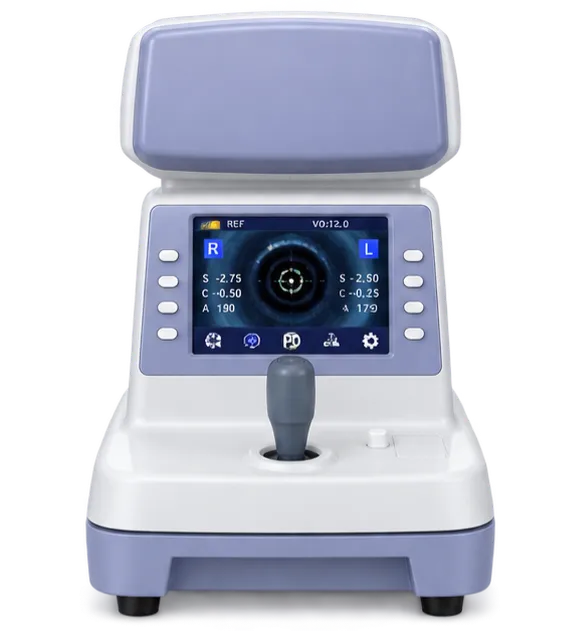
Automatic fogging, automatic pupil distance measurement and automatic capture together mean little operator input per patient, which suits a practice refracting many people in succession. Operator input falls to positioning. Sequences move quickly through a list. Many patients pass through in succession. Consistency follows from that automation. Little input is required per patient. Lists move through more quickly.
Services Checking Specifications
Three points on this card need settling before purchase: the axis notation, the conflicting pupil figures and the absent corneal rows. A practice comparing instruments should resolve them rather than assume. Assumption would be unwise here. Three points deserve resolving. Comparison depends upon resolved figures. Purchase should follow confirmation. Three points sit unresolved upon this card. Resolution precedes any commitment.