


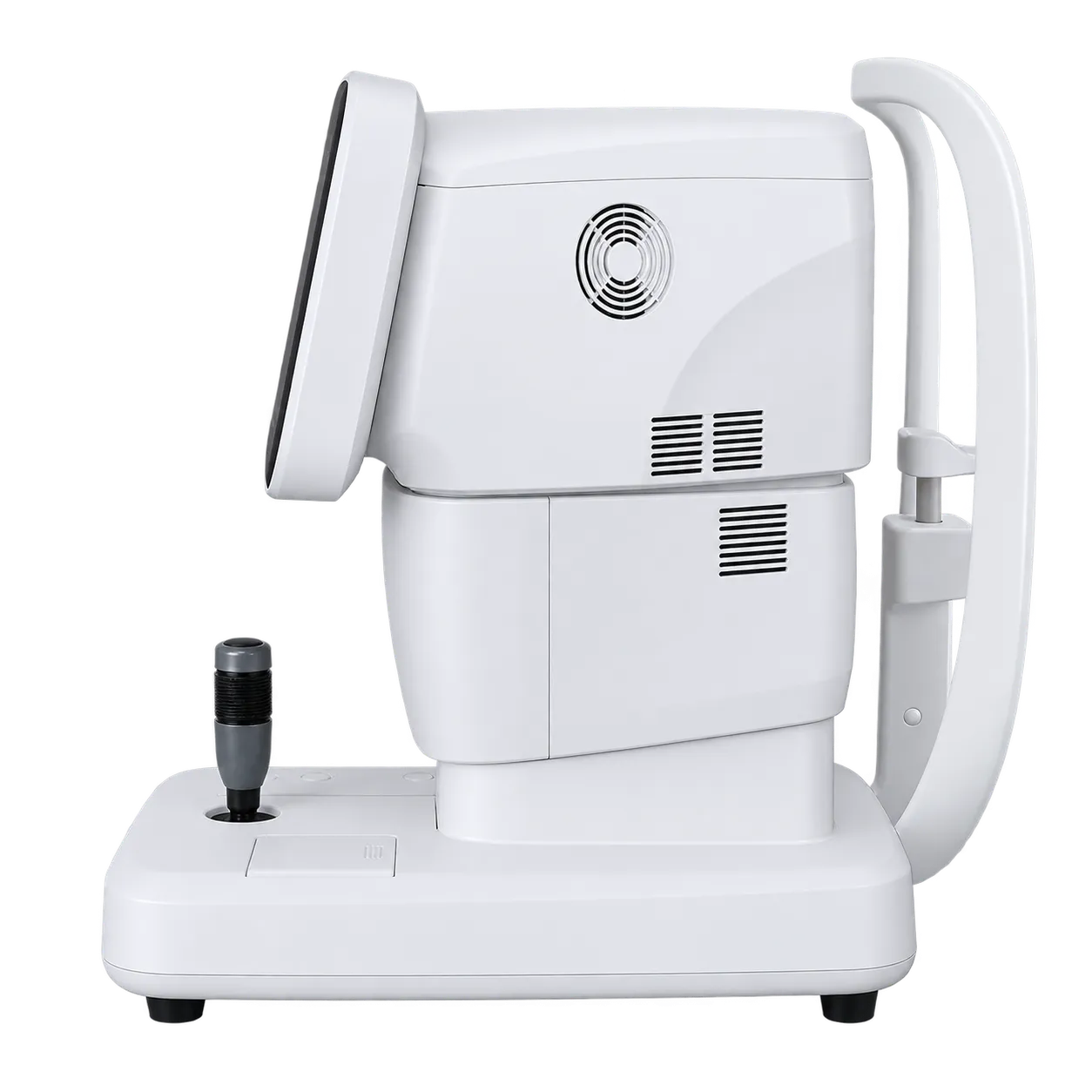
Cataract surgery services, refractive practices, ophthalmology clinics and eye hospitals use the OA-2000 to measure the eye before lens surgery. Ophthalmologists, optometrists and ophthalmic technicians operate it, and the readings inform intraocular lens power selection, toric planning and the study of corneal shape.
The OA-2000 suits lists that include hard eyes. Fourier-domain scanning penetrates dense cataract, and vector scans help maintain the measurement rate in lens opacity. Manual measurement is available, and a Bluetooth link hands very mature lenses to the Tomey AL-4000 handheld ultrasound unit, so a hard eye stays on the same list.
Axial length from 14 to 33.5 mm, anterior chamber depth, lens thickness, corneal thickness, corneal radius, pupil diameter and white-to-white come from a single measurement. Placido topography maps corneal shape for post-LASIK eyes and irregular astigmatism, and OKULIX ray tracing can use topography, axial length, lens thickness and pachymetry data. Display resolution is 0.01 mm, and 1 µm for corneal thickness, so each reading is shown to a fine step. Pupil diameter runs from 1.5 to 13 mm and white-to-white from 7 to 16 mm.
Haigis, Hoffer Q, Holladay 1, Olsen, SRK/T, Shammas-PL and SRK/T Double K formulas are built in, and surgeons can preset formulas and preferred IOL models. A 10.4-inch touchscreen shows the results, a thermal printer gives a record, and the SD card slot, USB and LAN pass data on. The unit weighs about 24 kg and sits on a stable table. Screens cover measurement, IOL calculation, toric planning and dual-view measurement, and the supply is 100–240 V AC at 50/60 Hz.