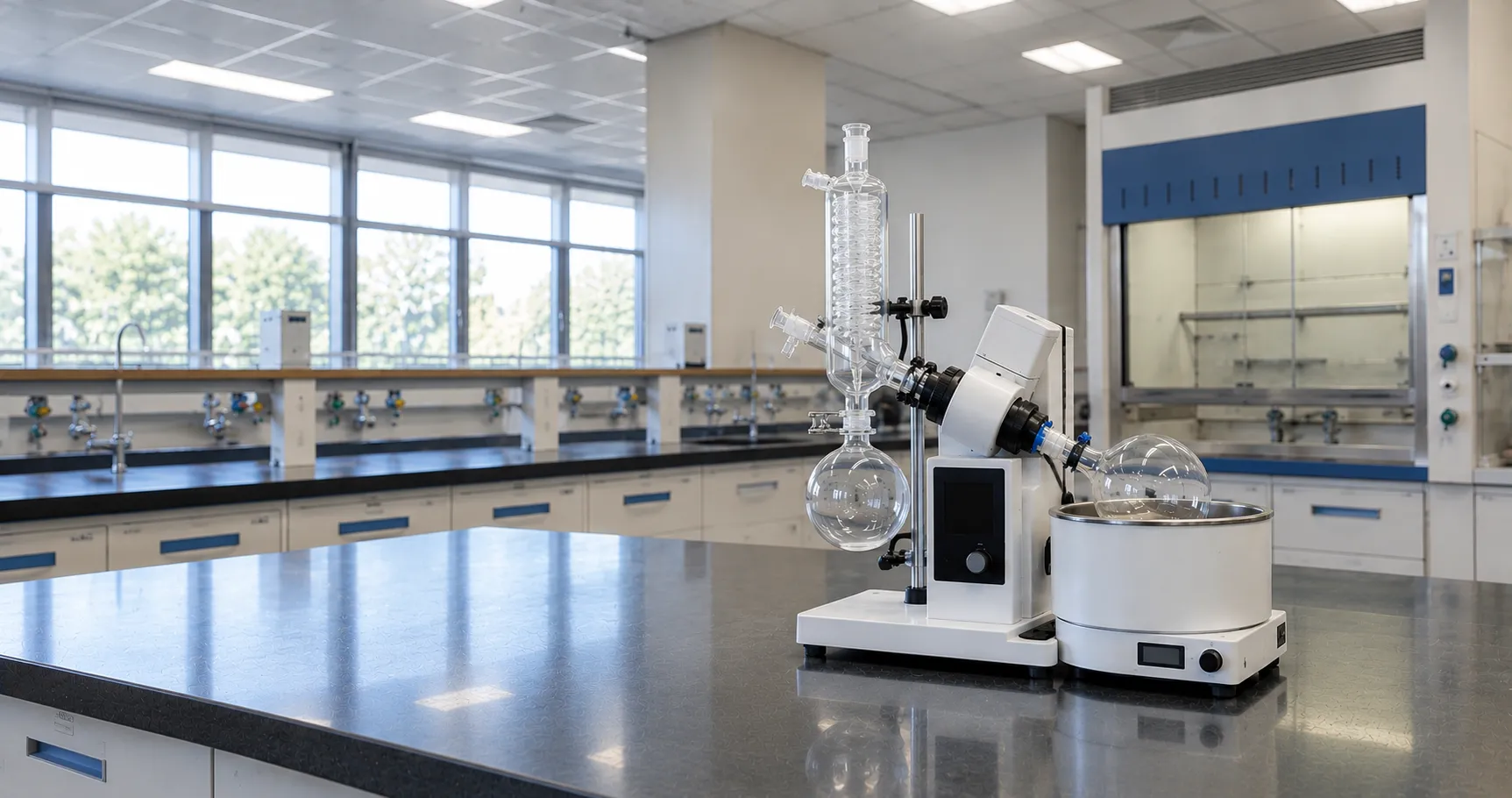
A rotary evaporator, or rotovap, removes a volatile solvent from a sample by spinning the flask under reduced pressure over a heated water bath, so the solvent boils gently at a low temperature and is then condensed and collected. Lowering the pressure drops the solvent's boiling point far below its atmospheric value, which lets heat-sensitive compounds be concentrated without thermal damage. It is a standard kit for concentrating extracts, recovering solvent after synthesis and drying products in analytical, pharmaceutical and natural-product laboratories.
For a buyer, the choices are the flask capacity, the type of vacuum source, the condenser format and the degree of automation. Each affects throughput, the range of solvents you can handle and how much solvent you recover rather than vent.
How Solvent Removal Works
Four things act together. The motor rotates the evaporating flask so a thin film of liquid spreads over the warm glass, greatly increasing the surface area for evaporation and preventing bumping. The heated water bath supplies the energy to evaporate the solvent. A vacuum lowers the pressure, and therefore the boiling point, so the solvent evaporates at bath temperatures that are safe for the sample. The vapour then travels to a condenser, where cooling turns it back to liquid that drains into a receiving flask. The rule of thumb is to keep the bath, vapour and coolant temperatures well separated so evaporation and condensation both proceed reliably.
The Key Components
Rotating flask and drive
A rotating evaporating flask, commonly 250 ml to 3 litres, sits in the bath at an angle and spins at an adjustable speed. Rotation is what distinguishes a rotovap from simple distillation and is the reason it works so gently.
Heating bath
A water or oil bath, typically controllable up to about 95°C for water and higher for oil, warms the flask. Digital baths hold temperature closely, which matters for reproducible, gentle evaporation.
Condenser
Vertical coil, diagonal and cold-trap (dry-ice) condensers are available. Low-boiling solvents need efficient cooling, so many labs pair the condenser with a recirculating chiller rather than mains water, both to reach low coolant temperatures and to save water.
Vacuum Sources and Control
The vacuum source sets which solvents you can remove and how gently. A diaphragm (membrane) pump is chemically resistant and oil-free, ideal for most solvents; a rotary-vane oil pump reaches a deeper vacuum for very high-boiling residues but needs solvent protection. The single biggest efficiency gain is a vacuum controller that regulates pressure to the target for each solvent, which prevents bumping and foaming, speeds the run and cuts solvent loss. Automated systems can sense the boiling point and step the pressure down through a run without operator attention.
Solvent Recovery and the Environment
A well-run rotovap recovers most of the solvent as clean liquid in the receiving flask instead of venting it. Good recovery depends on a cold enough condenser and a controlled vacuum, so the vapour condenses before it reaches the pump. A practical guide is to keep the coolant about 20°C below the vapour temperature and the vapour about 20°C below the bath, which balances evaporation against condensation and maximises capture. This is both an economic benefit, since recovered solvent can often be reused or disposed of properly, and a safety and environmental one, since it keeps solvent vapour out of the laboratory air. Solvent vapours must still be managed under the relevant control-of-substances regulations, and the Health and Safety Executive publishes guidance on handling hazardous substances at work.
Key Specifications a Buyer Must Check
Compare units on flask capacity and the maximum evaporating volume; bath type, size and top temperature; rotation speed range; condenser type and cooling surface area; and the lift mechanism. A motorised lift that raises the flask out of the bath automatically on power failure or at the end of a run is an important safety feature, protecting both sample and operator. Check the glassware coating options, as protective plastic-coated glass reduces the hazard if a flask implodes under vacuum, and confirm the ground-glass joint sizes match your existing flasks.
Standards, Materials and Safety
The instrument should conform to IEC 61010-1 for electrical safety and carry UKCA or CE marking. Because the system operates under vacuum with heat and flammable solvents, safety design matters: implosion guards or coated glassware, a bath over-temperature cut-out, and secure clamping all reduce risk. Never apply vacuum to scratched or star-cracked glass. Where flammable solvents are used, the vacuum pump and any electrical parts should be appropriate for the atmosphere, and vapours must be extracted or trapped rather than released into the room.
Cleaning, Maintenance and Consumables
Keep ground-glass joints lightly greased or use joint clips so the system holds vacuum; a leak shows up as a pressure that will not pull down. Inspect seals and the rotary vacuum seal, which wears and is a common cause of poor vacuum, and replace it as a routine spare. Drain and clean the condenser and traps, change bath water to prevent scale and biofilm, and check the chiller coolant. Diaphragm pumps need periodic valve and diaphragm replacement; oil pumps need oil changes and a solvent trap. Budget for glassware breakage, seals and pump service kits.
Where Rotary Evaporators Are Used
Synthetic and medicinal chemistry labs use them to remove reaction solvents; natural-product and food laboratories concentrate plant and flavour extracts; pharmaceutical QC and analytical labs prepare and concentrate samples; and academic teaching labs use compact bench units. Scale ranges from small 1-litre bench rotovaps to large 20-litre industrial-scale systems for pilot work. Matching flask size, bath capacity and vacuum source to your throughput and solvents avoids over-buying a large system or throttling a busy lab with an undersized one.
Procurement Checklist
Before specifying a rotary evaporator, confirm the following:
-
Flask capacity and maximum volume matched to your typical and peak batch sizes.
-
Vacuum source (chemically resistant diaphragm versus deep-vacuum oil pump) suited to your solvents.
-
Vacuum controller for automatic, solvent-specific pressure regulation and better recovery.
-
Condenser type and a recirculating chiller capable of the coolant temperature your low-boiling solvents need.
-
Motorised lift and safety features, including implosion protection and bath over-temperature cut-out.
-
Glassware joints and coatings compatible with your existing flasks and hazard controls.
-
Consumables and spares, vacuum seals, pump service kits, bath and chiller maintenance items.
Total Cost of Ownership
Purchase price is only the start. A controlled vacuum and an efficient chiller cut run times and recover expensive solvent, which pays back quickly in a busy lab. Running costs include chiller electricity, pump servicing, replacement seals and inevitable glassware breakage. A system that vents solvent through poor condensation wastes reagent and loads the extraction system, so specifying good cooling and vacuum control is an economy, not a luxury. Coated safety glassware costs more up front but avoids the disruption and hazard of an implosion, and a spares kit of seals and clips held on the shelf prevents a cheap part from idling an expensive instrument. Standardising joints and spares across the lab keeps maintenance simple and lets one chiller or pump serve several rotovaps.
Conclusion
A rotary evaporator removes solvent gently by spinning the flask under vacuum over a warm bath and condensing the vapour for recovery, protecting heat-sensitive compounds. Choose flask size, vacuum source, condenser and chiller to match your solvents and throughput, insist on IEC 61010 conformity and proper implosion and over-temperature safety, and keep seals and service kits in stock. To compare rotovaps, chillers, pumps and glassware or arrange servicing, contact the MediGear team or list your requirements through our buyer services.
Disclaimer
This article is for informational purposes only. It is published by MediGear (medigear.uk) for general information and procurement guidance, and is not clinical, diagnostic, treatment, technical, engineering, legal or regulatory advice, nor a product endorsement, guarantee or substitute for professional assessment. MediGear does not provide medical consultations. Buyers should consult their clinical, biomedical, estates and regulatory contacts, and the manufacturer's documentation, and independently verify all specifications, certifications, compatibility and suitability before purchase. Specifications, certifications and availability are correct at the time of publication and may change without notice. MediGear is a medical-equipment distributor and does not sell medicines or pharmaceutical products.