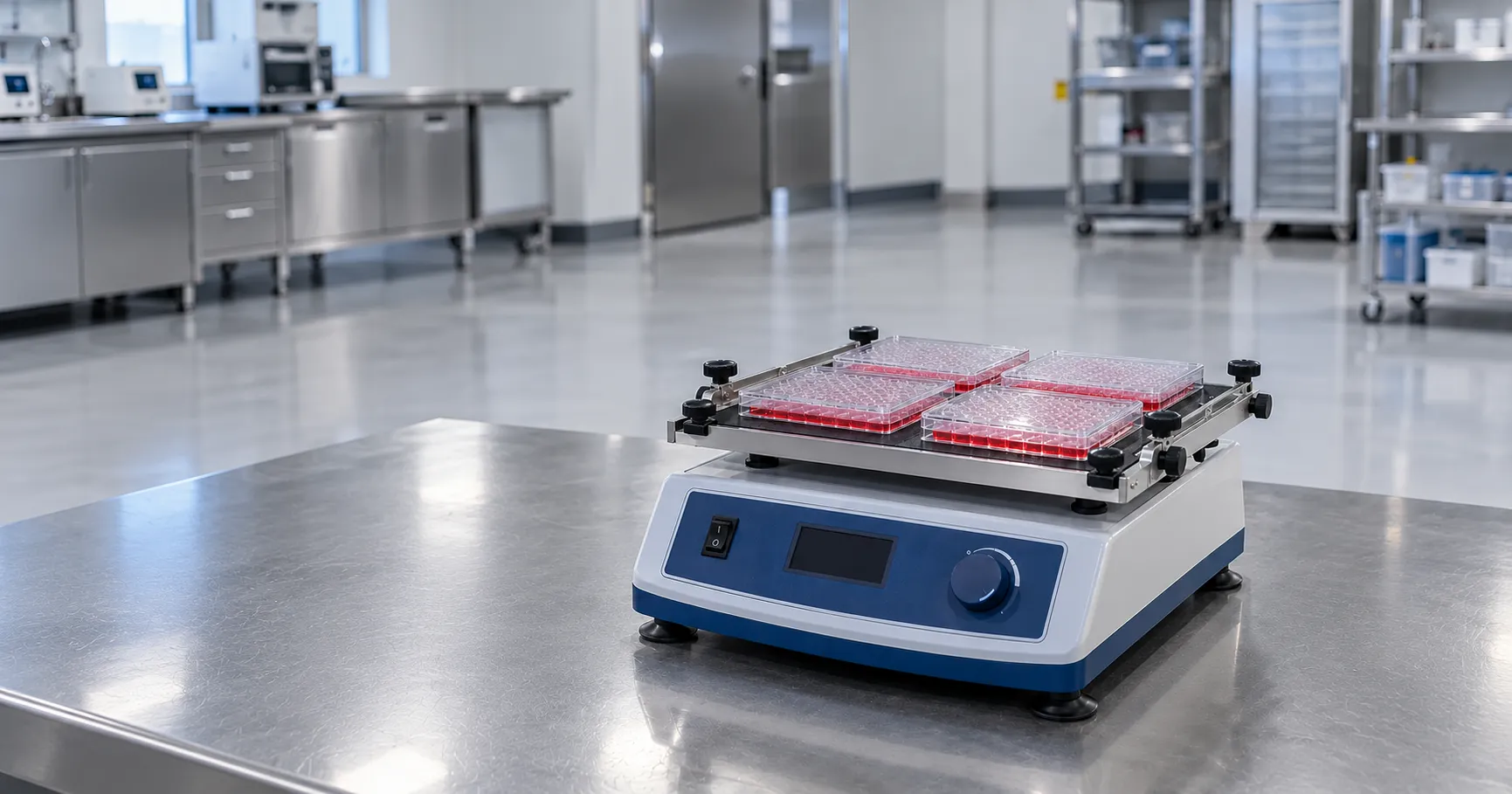
An orbital shaker is a benchtop or floor-standing platform that moves in a smooth, wide circular path so vessels clamped on top are agitated gently and continuously. It mixes culture plates, flasks and bottles by swirling their contents, keeping cells suspended, aerating cultures and blending reagents over minutes to days rather than the seconds of a vortex.
The platform describes a horizontal circle of a set diameter at a set speed. Because the orbit is comparatively large and the speed low, the liquid rotates as a gentle wave, which suspends and oxygenates without the harsh shear a vortex applies to a single tube.
How orbital motion mixes a plate or flask
A counterweighted eccentric drive moves the whole platform in a circle, typically an orbital diameter of about 15 to 25 millimetres (often 19 or 25 mm), at speeds usually between 25 and 500 revolutions per minute. In a microplate, the wave lifts and rotates the well contents to keep suspensions even; in a shake flask, it drives the swirling that maximises gas exchange at the liquid surface for aerobic cultures. Larger orbits suit flasks and better oxygen transfer, while smaller orbits suit microplates and lower liquid volumes.
Orbital shaker versus vortex mixer
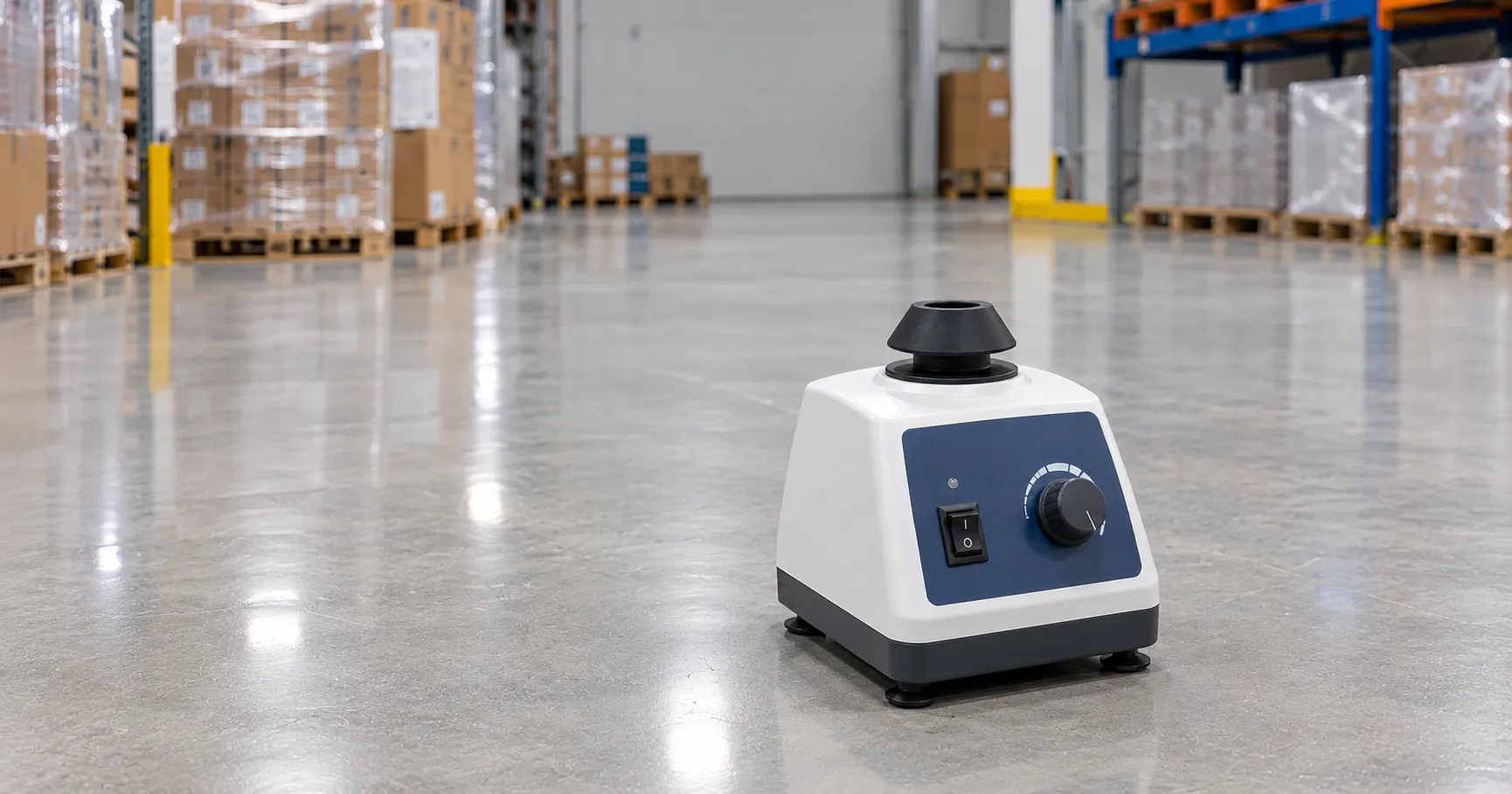
The two are often confused but do different jobs. A vortex mixer uses a tiny 4 to 5 millimetre orbit at very high speed to homogenise one tube in seconds. An orbital shaker uses a much larger orbit at low speed to mix many vessels gently for extended periods. Choose an orbital shaker for cell culture, bacterial growth, staining and washing steps, hybridisation and prolonged incubations; choose a vortex for rapid single-tube homogenisation.
Platform, clamps and accessories
The platform is the key interface. A universal non-slip rubber mat holds mixed labware such as microplates, Petri dishes and beakers by friction, while dedicated flask clamps (from 25 millilitre up to 5 litre) and test-tube or bottle racks lock vessels down for higher speeds. Stacking tiers multiply capacity in the same footprint. Check the maximum load the platform is rated to carry, because a heavy, off-balance load stresses the drive; some models auto-detect imbalance and stop.
Incubated and CO2-compatible shakers
Many workflows need temperature as well as motion. An incubated orbital shaker adds a heated (and sometimes cooled) chamber to hold cultures at 37 degrees Celsius, with control typically to within a fraction of a degree, and larger shaking incubators regulate humidity too. For mammalian cell culture, a compact shaker built for a CO2 incubator must tolerate high humidity and 5 per cent carbon dioxide without corroding or upsetting the chamber's atmosphere; confirm the model is rated for in-incubator use before specifying it.
Duty cycle, drive and control
Because a shaker may run for days, the drive and control matter. A brushless, maintenance-free motor is preferable for continuous duty and quieter running. Look for a controlled acceleration and deceleration ramp to avoid splashing at start and stop, a timer with a hold-to-continuous option, and speed accuracy that holds the set rpm under load. Slow-running models for delicate cultures and higher-speed models for microbial growth cover different ends; a wide, stable speed range with fine control is the most versatile.
Standards, safety and maintenance
Laboratory electrical safety follows IEC 61010-1, with electromagnetic compatibility under the IEC 61326 series, and a compliant unit carries UKCA or CE marking. Where cultures are biological, set the placement and any containment against a risk assessment and HSE guidance on hazardous substances. Maintenance is modest: keep the platform and mat clean and disinfected, check clamp screws and mat adhesion, avoid overloading, and site the shaker on a level, stable surface. For NHS and diagnostic laboratories, reliability and traceable temperature control support the quality expectations set out for services on the NHS.
Applications across microbiology and cell culture
Orbital shakers underpin a wide span of work. In microbiology th, they grow bacterial and yeast cultures in shake flasks, where the swirling surface maximises oxygen transfer for healthy aerobic growth. In cell and tissue culture, they keep suspension cells evenly distributed and support gentle mixing during transfection or treatment. In molecular and immunochemistry, they drive staining, destaining, washing, hybridisation and blot incubation, and in general chemistry they dissolve solids and equilibrate solutions over time. The gentle, sustained motion is what makes them suitable for living cultures that a vortex would damage.
How a shaker differs from other platforms
Orbital motion is one option among several. A rocking or see-saw platform tilts slowly for blots and delicate washes; a reciprocating (linear) shaker moves back and forth and suits some extractions; a 3D or gyratory shaker adds a nutating tilt for very gentle blending. The orbital shaker's smooth circular path is the general-purpose choice for flasks and plates because it combines good mixing and aeration with low shear. Matching the motion type to the sample, and reserving high-speed vortexing for single-tube homogenisation, protects fragile cultures and improves reproducibility.
Placement, utilities and total cost of ownership
Where a shaker runs matters as much as its specification. A level, vibration-tolerant bench or floor space is essential, and heavy or stacked platforms need a stable base. Incubated and CO2-compatible models add power and, for shaking incubators, heat output and floor area to plan for. Budget for clamps, mats and racks, occasional drive servicing, and the electricity of long incubated runs. Prioritise a brushless, maintenance-free motor and a strong warranty for equipment that may run continuously for days, because unplanned failure mid-culture is costly in lost work.
Temperature uniformity in incubated models
For incubated and shaking-incubator models, how evenly the chamber holds temperature is as important as the set point. Ask for the temperature uniformity across the platform and the recovery time after the door opens, because a warm spot skews growth between flasks on the same run. Good units hold the set value to within a fraction of a degree and distribute heat with forced air. If cultures are temperature-sensitive, a model with cooling as well as heating widens the usable range below ambient. Confirm how temperature is logged for traceability, since diagnostic and quality-accredited laboratories need evidence that cultures were held at the specified conditions throughout. An alarm on over- or under-temperature, and a port for an external calibrated probe, help demonstrate that control during audit.
Procurement checklist
-
Match the orbital diameter to the work: larger orbits for flasks and oxygen transfer, smaller for microplates and low volumes.
-
Confirm the speed range and that fine low-end control exists for delicate cultures.
-
Check the platform's maximum load rating and whether imbalance detection stops the unit safely.
-
Select clamps, racks, mats and stacking tiers to fit your flasks, plates and throughput.
-
Decide if you need an incubated shaker or a CO2-incubator-compatible model, and confirm the temperature and humidity ratings.
-
Prefer a brushless motor and controlled acceleration and deceleration ramps for continuous duty.
-
Verify UKCA or CE marking and IEC 61010-1 compliance, with wipe-clean, corrosion-resistant surfaces.
-
Review warranty, service access, spares for clamps and mats, and quoted continuous-duty life.
Conclusion
An orbital shaker mixes culture plates and flasks by gentle, sustained orbital motion, so the orbit size, speed control, load rating and any incubation define whether it suits your cultures. Specify the platform and temperature capability around your vessels and duty cycle, and treat continuous-duty reliability as a buying criterion. To compare shakers and incubators for your lab, contact MediGear, and laboratory buyers can register requirements via MediGear for buyers.
Disclaimer
This article is for informational purposes only. It is published by MediGear (medigear.uk) for general information and procurement guidance, and is not clinical, diagnostic, treatment, technical, engineering, legal or regulatory advice, nor a product endorsement, guarantee or substitute for professional assessment. MediGear does not provide medical consultations. Buyers should consult their clinical, biomedical, estates and regulatory contacts, and the manufacturer's documentation, and independently verify all specifications, certifications, compatibility and suitability before purchase. Specifications, certifications and availability are correct at the time of publication and may change without notice. MediGear is a medical-equipment distributor and does not sell medicines or pharmaceutical products.