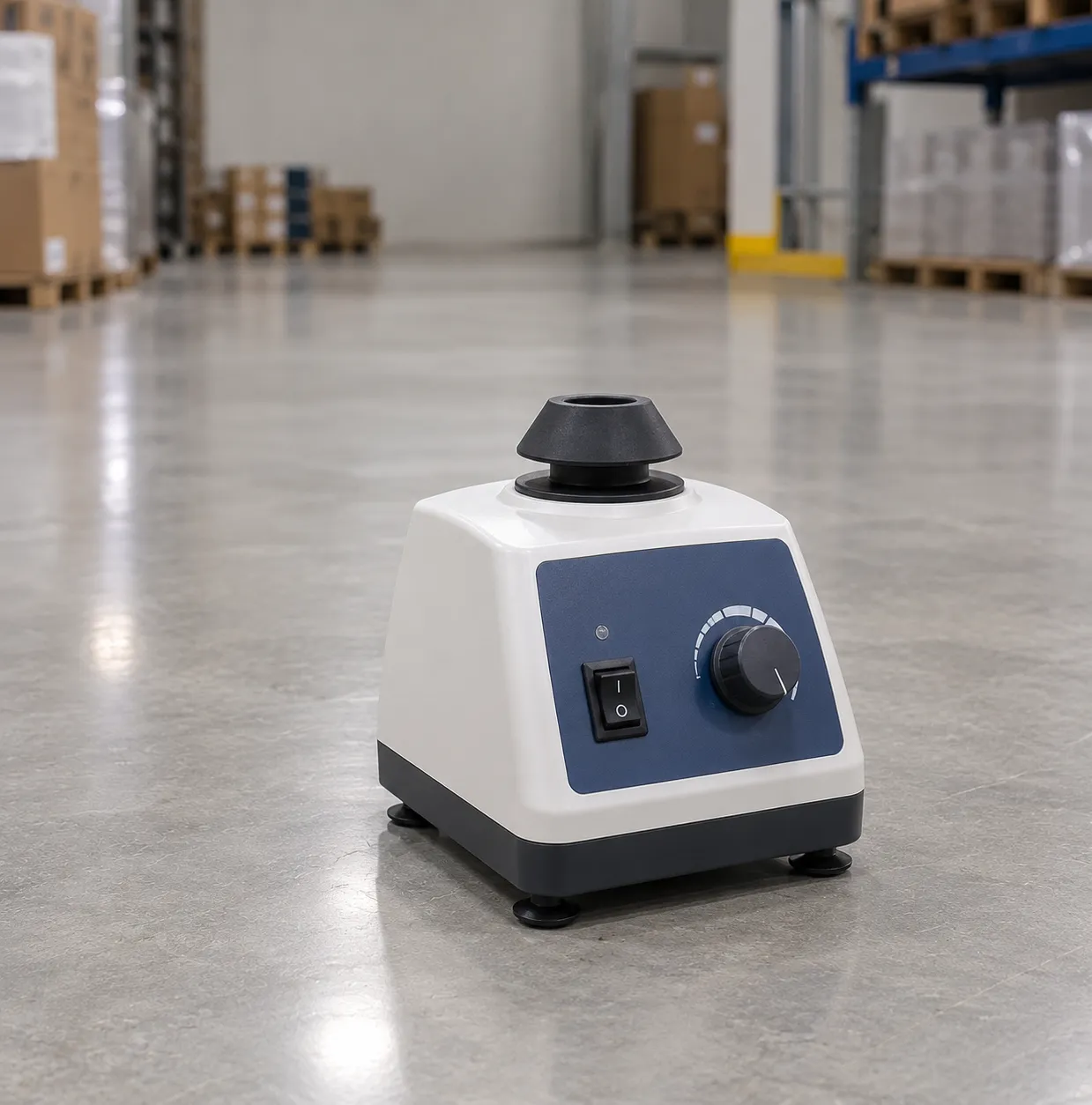
A vortex mixer is a small benchtop device that spins an offset cup or platform in a tight circle, so a tube pressed against it swirls its contents into a vortex and mixes them in seconds. It is the workhorse for rapid homogenisation of single tubes, resuspending pellets, dissolving reagents, and blending small volumes before an assay.
The action is a fixed or adjustable orbital motion at high speed. Because the orbit is tiny and the speed high, the liquid climbs the tube wall and folds back on itself, giving fast, energetic mixing of low-viscosity samples.
How the vortex is created
An eccentric drive rotates the head so its centre traces a small circle, typically an orbital diameter of about 4 to 5 millimetres. Speeds are high, commonly ranging from around 200 up to 2,500 or 3,000 revolutions per minute. The combination of a small orbit and high rpm produces the characteristic tight vortex; a larger orbit at the same speed would splash rather than fold. A rubber cup head grips the tube and damps vibration, and the whole unit sits on suction feet or is held down to stop it walking across the bench.
Touch mode versus continuous mode
Two operating modes cover most needs. In touch (pulse) mode, the head spins only while a tube is pressed onto it, which suits quick, ad-hoc mixing of individual samples. In continuous mode, the head runs constantly at a set speed, freeing both hands and allowing longer, unattended mixing or use with multi-tube attachments. Better instruments offer both, with a mode switch and a speed dial, so one device covers spot mixing and sustained agitation.
Heads and attachments
The standard rubber cup accepts common microcentrifuge and small test tubes. Interchangeable platforms extend the range: foam tube-holder inserts for several microtubes, plate holders for microplates, flask clamps, and trays for beakers or larger vessels. Multi-tube heads let a batch mix at once in continuous mode. When comparing models, check which attachments fit, how quickly they change, and whether the drive is rated for the extra mass of a loaded platform.
Choosing speed, orbit and drive
Match the specification to the sample. Delicate biological material, cells or proteins prone to shear or foaming, needs gentle, controlled speed, so a model with fine low-end control and a smooth ramp is preferable to a fixed-speed unit. Resuspending a firm pellet or dissolving a stubborn solid wants high top-end rpm. A brushless motor runs quieter, cooler,r and longer than a brushed one and copes better with continuous duty. Consider the noise level for a shared lab and the footprint for a crowded bench.
Aerosols, foaming and safe use
Energetic vortexing of biological or hazardous samples can create aerosols. Use sealed, capped tubes, allow a short settle before opening, and carry out work with infectious or toxic material inside a microbiological safety cabinet where the risk assessment requires it; workplace control of hazardous substances is covered by HSE guidance. Foaming can denature proteins and trap air in reactions, so tune speed and time rather than defaulting to maximum. Never vortex samples in unsealed or cracked tubes.
Standards, cleaning and maintenance
Laboratory electrical instruments are built to IEC 61010-1 with electromagnetic compatibility under the IEC 61326 series, and a compliant unit carries UKCA or CE marking. Maintenance is light: keep the cup and platform clean and disinfected, inspect the rubber head for perishing, check the suction feet grip the bench, and confirm the drive is not straining under overloaded platforms. A wipe-clean housing with a sealed control panel resists spills. Ask about warranty length and whether replacement heads and feet are stocked.
Applications across the laboratory
Vortex mixers appear in almost every discipline. They resuspend cell pellets after centrifugation, dissolve powders and lyophilised reagents, mix buffers and standards, prepare samples before extraction, and blend reactions in molecular, microbiology, haematology and chemistry work. In molecular labs, filter-capped tubes and brief, controlled vortexing help mix master mixes without shearing template. The device is inexpensive relative to its usefulness, which is exactly why matching the specification to the samples, rather than buying the cheapest fixed-speed unit, repays itself in fewer failed preparations. Because a vortex touches so many workflows, a single underperforming unit can quietly slow a whole team, so it is worth treating even this humble device as a considered purchase rather than an afterthought at the end of an order.
How a vortex differs from other mixers
A vortex is one of several mixing tools, and choosing the wrong one wastes time. Rockers and see-saw platforms give slow, gentle tilting for blots and cell washes; roller mixers rotate bottles and blood tubes to keep suspensions even without foaming; magnetic stirrers blend larger volumes with a stir bar. The vortex is the tool for fast, energetic homogenisation of a single small tube. Knowing where its tight, high-speed orbit helps, and where a gentler device is safer for delicate samples, keeps a mixed workflow efficient and protects fragile material.
Warranty, life and total cost of ownership
Running costs are low, but longevity varies. A brushless motor and a well-sealed, wipe-clean housing extend life in continuous-duty use, while cheap brushed units running for hours can overheat and wear. The main consumables are the rubber cup and platform inserts, which perish and need replacing, and the suction feet. Check warranty length, whether replacement heads, cups and feet are stocked, and the noise level, which matters in a shared, occupied laboratory. A modest premium for a quieter, longer-lived unit is usually justified where the mixer runs daily, and stocking one or two spare cups keeps a bench working while a worn head is replaced.
Setting up for reproducible mixing
Consistent results come from consistent settings, not from pushing every sample to maximum. Fix a speed and time for each sample type and record them, because a resuspension that needs three seconds at moderate speed will foam and shear at full power. A smooth acceleration ramp reduces splashing and the risk of liquid reaching the tube cap. Stable footing matters too: worn suction feet let the unit walk and change the effective mixing, so check they grip a clean, level bench. For multi-tube platforms, balance the load so the head is not driven off-centre. These small controls turn a simple mixer into a repeatable step in a validated method.
Procurement checklist
-
Confirm the speed range and whether it offers fine low-end control for delicate samples as well as high top-end rpm.
-
Check that both touch (pulse) and continuous modes are available if you need spot mixing and sustained agitation.
-
Match interchangeable attachments (multi-tube inserts, plate holders, flask clamps) to your labware and how fast they swap.
-
Prefer a brushless motor for continuous duty, lower noise, and longer life.
-
Verify the drive rating supports the mass of any loaded platform without stalling.
-
Assess stability: suction feet or hold-down, footprint and noise for a shared bench.
-
Confirm UKCA or CE marking and IEC 61010-1 compliance, plus wipe-clean, sealed controls.
-
Check warranty and availability of replacement cups, heads and feet.
Conclusion
A vortex mixer is a simple device, but the right orbit, speed control and attachments decide whether it homogenises a stubborn pellet or shears a delicate sample. Specify the modes, motor type a, nd heads your workflow needs, and treat aerosol control as part of the purchase, not an afterthought. To compare benchtop mixers for your lab, contact MediGear, and laboratory buyers can register requirements through MediGear for Buyers
Disclaimer
This article is for informational purposes only. It is published by MediGear (medigear.uk) for general information and procurement guidance, and is not clinical, diagnostic, treatment, technical, engineering, legal or regulatory advice, nor a product endorsement, guarantee or substitute for professional assessment. MediGear does not provide medical consultations. Buyers should consult their clinical, biomedical, estates and regulatory contacts, and the manufacturer's documentation, and independently verify all specifications, certifications, compatibility and suitability before purchase. Specifications, certifications and availability are correct at the time of publication and may change without notice. MediGear is a medical-equipment distributor and does not sell medicines or pharmaceutical products.