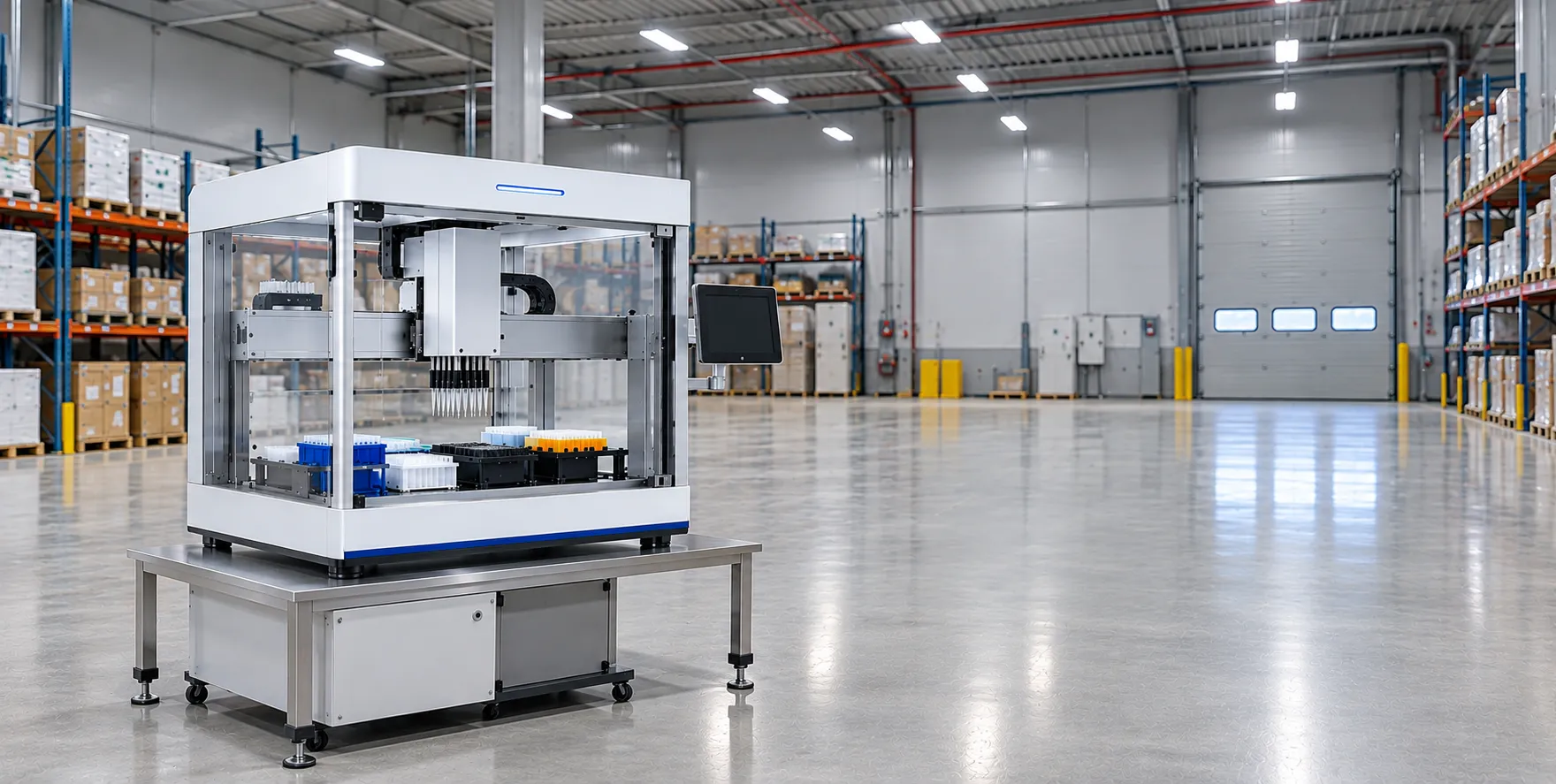
An automated pipetting robot is a benchtop instrument that moves one or more motorised pipetting channels across a fixed deck of labware and dispenses programmed volumes without a person holding a pipette. It replaces manual pipetting for repetitive, high-volume tasks such as plate filling, serial dilutions, reagent addition, and sample reformatting, running unattended for long batches.
The instrument is defined by three things: the deck that holds the labware, the pipetting head that does the work, and the motion system that positions the head. Getting those specifications right for your plate formats and volumes matters far more than headline throughput figures.
The deck and labware positions
The deck is a gridded worktable of fixed nests or positions that hold microplates, tip racks, reagent troughs, tube racks, and waste chutes. Deck capacity is quoted in positions or standard SBS (ANSI/SLAS) footprints; a compact instrument may offer 6 to 15 positions, while larger models exceed 25. More positions mean fewer operator interventions per run, because tips, plates and reagents can all sit on the deck at once. Some decks add active nests such as heated or cooled blocks, magnetic separators, orbital shaker positions and on-deck tip washing.
The pipetting head and channel formats
Heads fall into two families. Channel (pipettor) heads carry 1, 4, 8, 1,2 or 16 independent tips, often on a movable span that can pitch between tube and plate spacing; independent channels allow cherry-picking and hit-picking of individual wells. Full-plate heads carry 96 or 384 tips and transfer an entire plate in one stroke for maximum speed. Volume ranges typically span roughly 0.5 to 100 microliters per channel, with dedicated low-volume heads for sub-microliter work. As with manual pipettes, the head may be air-displacement or positive-displacement; specify positive-displacement channels for viscous or volatile fluids.
Throughput and plate formats
Throughput depends on head type and plate density. A 96-channel head fills a 96-well plate in a single aspirate-dispense cycle, so a run of dozens of plates completes in minutes rather than the hour a manual operator would take. Confirm the plate formats you actually use, 96, 384, or 1536 wells, and the well and reservoir depths, because tip length and Z-travel must reach the bottom of deep-well blocks. Ask for realistic cycle times for your specific protocol, not just the maximum tip-transfer rate.
Tips, liquid classes and contamination control
Robots use disposable tips, either racked or on continuous reload, and many support filter tips for aerosol-sensitive assays. Tip cost is a major running expense, so check tip compatibility, whether third-party tips are supported, and whether tips can be reloaded automatically from a stacker. Liquid-class settings, adjustable aspirate and dispense speeds, delays, air gaps,s and tip-touch, let you tune handling for serum, DNA, detergents, or organic solvents. Liquid-level detection and clot detection reduce failed transfers and cross-contamination.
Software, scheduling and traceability
A method editor lets scientists build protocols from graphical steps, and worklists can be imported from a spreadsheet or a LIMS. Look for barcode reading of plates and tubes for sample tracking, audit trails and electronic records suitable for regulated environments, and simulation or dry-run modes that catch deck-layout errors before reagents are wasted. For diagnostic use, the data-handling features should support the traceability expectations of ISO 15189 medical laboratories.
Standards, safety and calibration
Electrical safety for laboratory instruments follows IEC 61010-1, with electromagnetic compatibility under the IEC 61326 series; a compliant instrument should carry UKCA or CE marking and a declaration of conformity. Volumetric performance is still assessed against ISO 8655, and buyers should ask how the robot's volumes are verified, by gravimetric test, photometric dye assay or both, and how often. Where the workstation forms part of an in-vitro diagnostic process, confirm the regulatory position with guidance from the MHRA. Moving parts mean the instrument needs guarding or an enclosure with interlocks, and a defined space for safe access and maintenance.
Walk-away operation and unattended runs
The value of a robot is measured in walk-away time. Enough deck positions for tips, plates,s and reagents, automatic tip reload from a stacker, and reliable error handling let a run continue while staff do other work. Look for on-board error recovery that pauses cleanly and logs the fault rather than aborting a whole batch, plus remote status alerts. Liquid-level and clot detection prevent a single blocked tip from spoiling downstream plates. The more of a protocol the instrument completes without intervention, the greater the real productivity gain over manual pipetting.
Footprint, utilities and installation
These are benchtop or floor instruments with real space demands. Confirm the physical footprint, the clearance needed to open the enclosure and load the deck, bench weight loading, and the power supply, and check whether an uninterruptible supply is advisable to protect long runs. Some models need extraction or a fume or containment enclosure when volatile solvents or biological material are handled. Plan the installation, alignment and acceptance testing with the supplier, and agree who performs the initial volume verification against ISO 8655.
Applications and total cost of ownership
Typical work includes ELISA and immunoassay set-up, serial dilutions, PCR and qPCR plate preparation, normalisation, reagent addition and reformatting between plate densities. When costing a robot, add tips and filter tips, the service contract, replacement pipetting modules or syringes, software support, training and expected downtime to the capital price. Tip economics often dominate: a high per-tip cost or a locked proprietary tip can outweigh the headline saving. Judge the business case on realistic weekly plate volumes and the staff time genuinely released, not on the theoretical maximum throughput. Factor in the reduction in repetitive-strain injury risk and the improved reproducibility that comes from removing operator-to-operator variation, both of which carry real, if less visible, value.
Precision, carryover and contamination control
Automation only helps if the numbers are trustworthy. Ask for the instrument's accuracy and precision (coefficient of variation) at the volumes you actually dispense, not just at the top of the range, because low-volume error dominates many assays. Carryover between wells is controlled by disposable tips, tip-touch and adjustable dispense height, and by air gaps that stop droplets from tracking back. For contamination-sensitive molecular work, specify filter tips, confirm the deck layout separates clean tips from waste, and consider a model with UV decontamination or an enclosure. Where reagents are precious, a dead-volume figure for troughs and reservoirs is worth checking, since a low dead volume reduces waste across thousands of transfers.
Procurement checklist
-
List your plate formats (96, 384, 1536), well depths and reservoir types, and confirm Z-travel and tip length reach them.
-
Choose the head: independent channels for flexibility and cherry-picking, or a 96/384 full-plate head for raw speed.
-
Count deck positions against your protocol so tips, reagents and plates fit without frequent intervention.
-
Check tip cost, third-party tip support, filter-tip options, and automatic tip reload.
-
Confirm liquid-class tuning, liquid-level and clot detection for your sample types.
-
Assess software: worklist import, LIMS and barcode integration, audit trails, simulation mode.
-
Verify UKCA or CE marking, IEC 61010-1 compliance and the volume-verification method against ISO 8655.
-
Price installation, training, service contracts, spare pipetting modules, and expected uptime.
Conclusion
An automated pipetting robot pays back when the deck, head and software match the plates and protocols you run every week, not when it wins on a spec sheet. Judge candidates on realistic cycle times, tip economics and volume-verification evidence, and plan for service and training from day one. To scope an instrument for your throughput or arrange a demonstration, talk to MediGear, and laboratories sourcing capital equipment can list requirements via MediGear for buyers.
Disclaimer
This article is for informational purposes only. It is published by MediGear (medigear.uk) for general information and procurement guidance, and is not clinical, diagnostic, treatment, technical, engineering, legal or regulatory advice, nor a product endorsement, guarantee or substitute for professional assessment. MediGear does not provide medical consultations. Buyers should consult their clinical, biomedical, estates and regulatory contacts, and the manufacturer's documentation, and independently verify all specifications, certifications, compatibility and suitability before purchase. Specifications, certifications and availability are correct at the time of publication and may change without notice. MediGear is a medical-equipment distributor and does not sell medicines or pharmaceutical products.