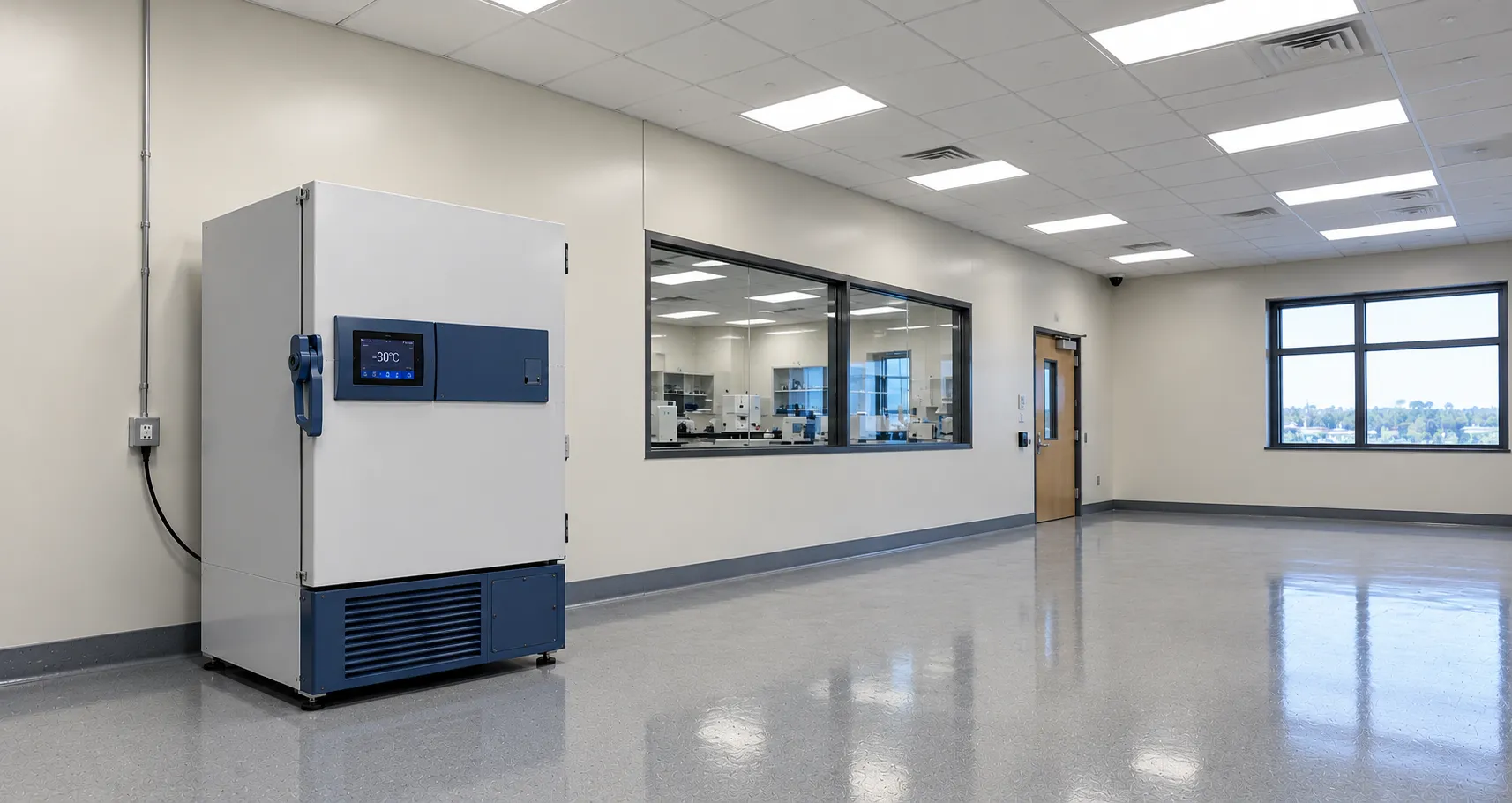
An ultra-low temperature (ULT) freezer is a laboratory cabinet that holds samples at around −80°C, typically adjustable across roughly −40°C to −86°C. It reaches those temperatures using either a two-stage cascade refrigeration circuit or a free-piston Stirling engine, and it keeps them there with thick vacuum-panel insulation and a tightly sealed door. At −80°C th, the molecular activity that drives sample degradation is all but halted, which is why serum, plasma, DNA, RNA, cell lysates a, nd many reagents are archived at this temperature.
This article covers the −80°C mechanical freezer specifically — how it makes the cold, how samples are racked, and what it costs to run. Chilled +2 to +8°C storage and cryogenic preservation below −150°C are covered in sibling articles.
How a Freezer Reaches Minus 80
A single refrigeration circuit cannot practically reach −80°C, so most ULT freezers use a cascade system: a first (high) stage cools a second (low) stage's condenser, and the low stage, running a different refrigerant, then reaches ultra-low temperature. Each stage uses a refrigerant matched to its part of the range, increasingly low-GWP hydrocarbon blends rather than older HFCs. The alternative is a Stirling engine, a free-piston cooler with no conventional compressor or cascade, which modulates its cooling output and so runs efficiently at partial load and recovers quickly. Cascade units are the long-established workhorse; Stirling units can save energy and cope well with frequent door openings. A dual-compressor cascade also offers a degree of resilience, since the high stage can hold a reduced temperature if the low stage falters, buying time to react before samples are at risk.
What Keeps the Cold In
Holding −80°C against a warm room is as much about insulation as refrigeration. Modern ULT freezers combine vacuum insulation panels with foamed insulation to achieve a thin wall and a large usable interior. A multi-gasket door, sometimes with a heated frame to stop it icing shut, seals the cabinet, and inner compartment doors reduce cold loss when only one section is opened. Because opening the outer door lets warm, moist air in, frost management and fast temperature recovery are key performance measures, not afterthoughts.
Sample Organisation: Racks, Boxes and Capacity
Samples are stored in cardboard or polycarbonate boxes, usually in a 9 x 9 or 10 x 10 grid of cryovials, held in stainless-steel or aluminium racks. Capacity is quoted both in litres and in the number of 22-inchboxes a cabinet holds; a large upright can store several hundred boxes, which is tens of thousands of vials. Upright cabinets give dense, easy-to-index storage and a small footprint; chest freezers hold temperature more stably and lose less cold when opened, but use floor space and are harder to organise. A clear rack-and-box inventory map is essential, because time spent with the door open searching for a vial warms every other sample.
Alarms, Monitoring and Backup
A ULT freezer holds irreplaceable material, so monitoring is not optional. Expect a calibrated temperature display, high and low temperature alarms, a door-ajar alarm, battery-backed local alarming an, and a volt-free contact for a central monitoring or building-management system. Many sites add an independent wireless temperature logger and remote alerts. For the highest-value collections, a backup cooling system injects liquid CO₂ or liquid nitrogen (LN2) to hold the cabinet cold if the refrigeration fails, buying time to move samples or effect a repair.
Energy Use, Heat and Siting
ULT freezers are among the most energy-hungry devices in a laboratory, historically drawing roughly 15–25 kWh per day, though newer high-efficiency and Stirling models cut that substantially. Every watt of cooling is also rejected into the room as heat, so a bank of freezers needs adequate air conditioning; without it, cabinets run hot, work harder an, and fail sooner. Site units with clearance around the condenser for airflow and cleaning, away from direct sun and heat sources, and plan the electrical supply for the inrush current at start-up. Running cost and cooling load, not just purchase price, dominate the total cost of ownership.
Setting the Temperature: Minus 70 or Minus 80?
Not every sample needs the coldest setpoint. Running at −70°C rather than −86°C can cut energy use markedly while still protecting many sample types, and some laboratories standardise on −70°C as a deliberate efficiency measure. The right setpoint depends on what is stored and for how long, so it is a decision for the sample owners, but the freezer should be able to hold either reliably and recover quickly after door openings at the chosen setpoint.
Frost, Defrosting and Door Discipline
Frost is the constant enemy of a ULT freezer. Every door opening admits humid room air that freezes onto gaskets, shelves an, and the inner surfaces, gradually stopping doors from sealing and boxes fitting, and forcing the refrigeration to work harder. Inner compartment doors, quick and disciplined access, and keeping the outer door open for the shortest possible time all limit ice build-up. Periodic manual defrosting is still needed: samples are moved to backup storage, the cabinet is warmed, dried and cleaned, then brought back to temperature and re-validated before reloading. A planned defrost schedule prevents the slow performance loss that end-fails hold −80°C.
Warranty, Validation and Standardisation
Because a ULT freezer holds high-value material for years, check the compressor or Stirling-engine warranty, which is the costliest part to replace, and confirm the validation the maker supplies. Temperature mapping of the loaded cabinet on installation identifies the warmest position, usually near the door, so the reference probe and most sensitive samples are placed appropriately. Standardising on one or two models across a site simplifies spares, training, rack compatibility a, nd having a validated spare freezer ready for emergency transfer.
Maintenance and Service Life
Routine care extends life and prevents failures: keep the filter and condenser clean of dust, clear frost from door gaskets, defrost on a planned schedule, and verify alarms and battery backup regularly. A cabinet that ices up or has a dusty condenser loses efficiency and eventually the ability to hold −80°C. Calibrate the reference sensor against a traceable standard, keep a validated spare freezer or spare capacity for emergency sample transfer, and hold a service contract with a fast response, because a warming ULT freezer is a genuine emergency.
Procurement Checklist
Before specifying an ultra-low freezer, confirm the following:
-
Temperature range and stability to −86°C, and whether cascade or Stirling refrigeration suits your load and door-opening frequency.
-
Usable capacity in 22-inchboxes, not just litres, and upright versus chest to match footprint and stability needs.
-
Insulation and door design (vacuum panels, heated frame, inner doors) for fast recovery and low frost build-up.
-
Monitoring: calibrated display, high/low/door alarms, battery backup,p and a volt-free BMS contact.
-
Backup cooling with CO₂ or LN2 for high-value collections, plus a plan for emergency sample transfer.
-
Energy consumption and heat rejection, checked against your room cooling and electrical supply.
-
Service, calibration and spares, with a defined response time and low-GWP refrigerant.
Conclusion
An ultra-low freezer holds samples near −80°C by combining cascade or Stirling refrigeration with heavy vacuum insulation and a tightly sealed, well-monitored cabinet. Choose on usable box capacity, recovery speed, monitoring and energy use, and always plan backup cooling and a fast service route for such valuable contents. To compare cascade and Stirling ULT freezers, monitoring options and backup systems, contact MediGear or set out your requirements through our buyer services.
Disclaimer
This article is for informational purposes only. It is published by MediGear (medigear.uk) for general information and procurement guidance, and is not clinical, diagnostic, treatment, technical, engineering, legal or regulatory advice, nor a product endorsement, guarantee or substitute for professional assessment. MediGear does not provide medical consultations. Buyers should consult their clinical, biomedical, estates and regulatory contacts, and the manufacturer's documentation, and independently verify all specifications, certifications, compatibility and suitability before purchase. Specifications, certifications and availability are correct at the time of publication and may change without notice. MediGear is a medical-equipment distributor and does not sell medicines or pharmaceutical products.