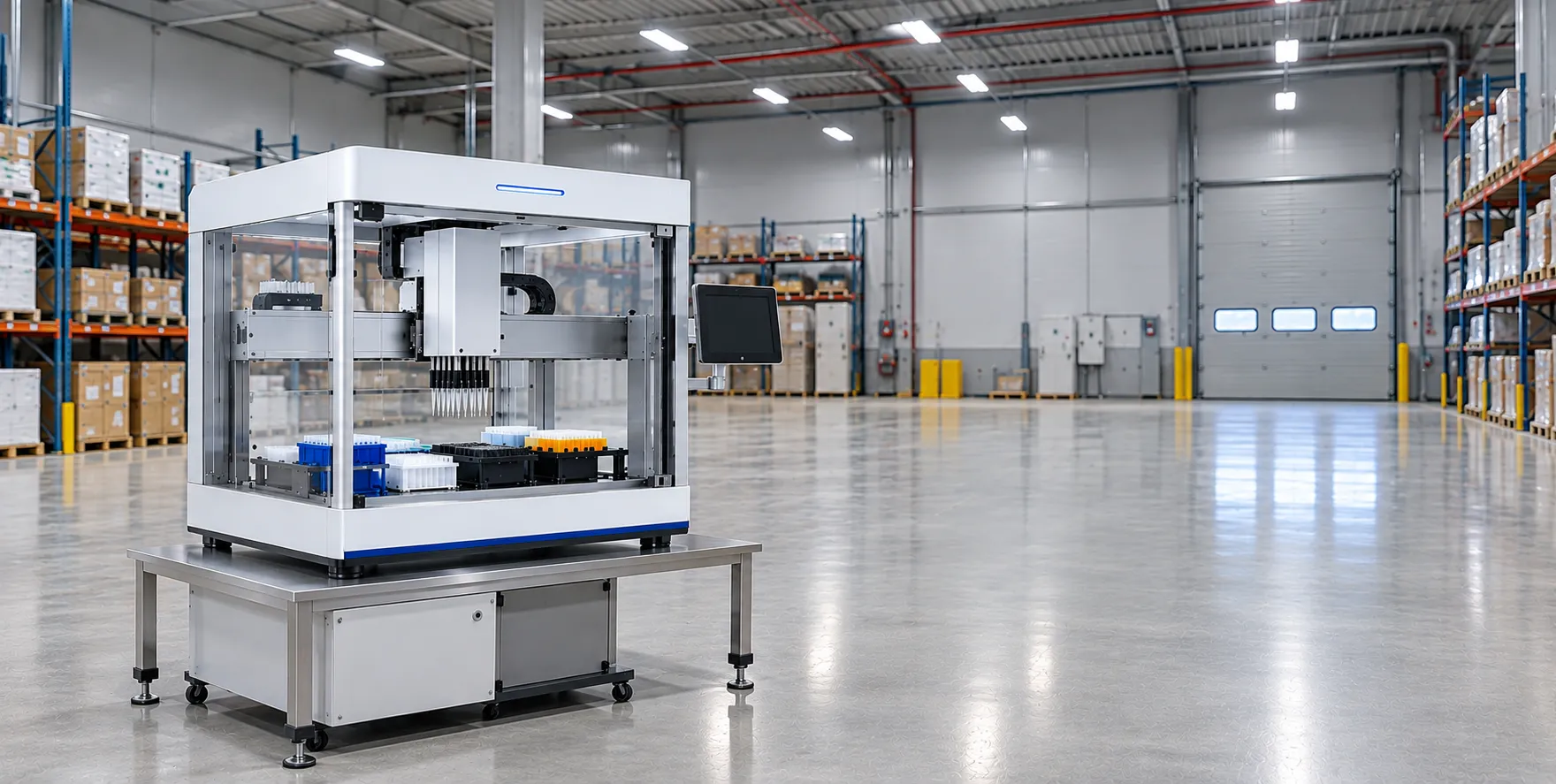
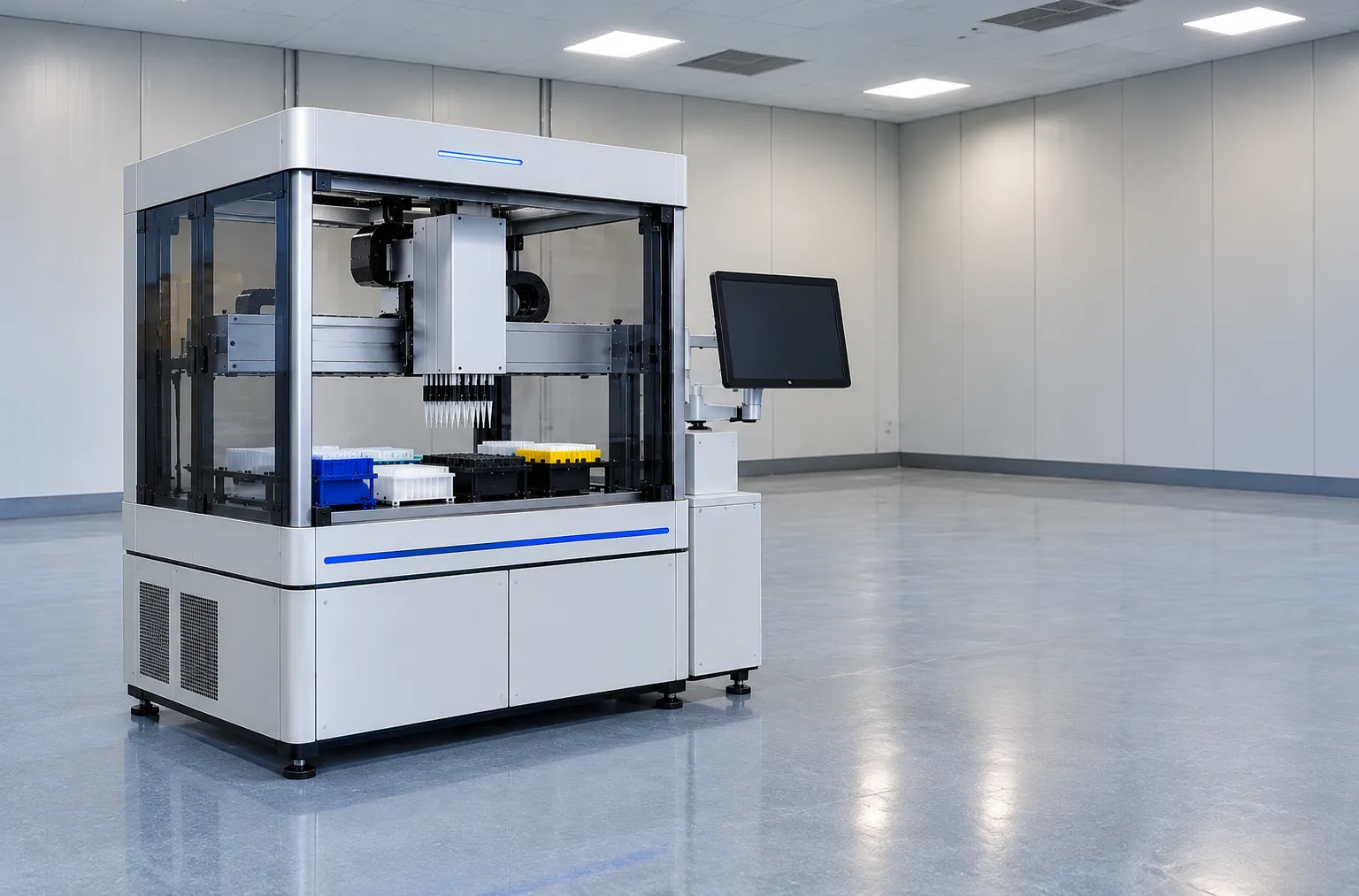
A liquid handling system is an integrated workstation that combines automated pipetting with the surrounding devices, software, nd workflow logic needed to run a complete laboratory process, not just a single dispensing step. Where a pipetting robot moves liquid, a liquid handling system schedules that pipetting alongside heating, cooling, shaking, sealing, incubation, plate reading, nd sample transport so an assay runs end to end with minimal human intervention.
Lab speed improves because the bottleneck shifts from a person to a scheduler. The system chains steps, tracks labware and reagents, and keeps devices busy in parallel, turning a day of manual bench work into a defined, repeatable,e and auditable run.
The system as a whole, not one instrument
It helps to separate three ideas. A pipette is a tool. A pipetting robot is an instrument. A liquid handling system is the platform that ties the robot to everything around it. The distinction matters at procurement: you are buying an architecture, integration, and software as much as hardware, and the questions are about modularity, interoperability,y and how the pieces are scheduled together.
Modularity and integrated devices
Systems are built from modules so a lab can start small and expand. Common on-deck or integrated devices include heater-shakers, thermal cyclers for PCR, magnetic-bead separators, plate sealers and peelers, barcode readers, plate hotels or stackers for storage, centrifuges and absorbance, fluorescence or luminescence plate readers. A robotic arm, either a plate-moving gripper on the deck or a separate articulated arm, transports labware between modules and between the workstation and adjacent instruments, extending capacity without adding operators.
Software, scheduling and orchestration
The software is the heart of the system. A method or protocol editor lets scientists assemble steps graphically, and a scheduler optimises timing so several plates progress through shared resources without collisions, maximising instrument utilisation. Look for a labware database that stores plate, tip and reservoir geometries; liquid-class libraries for different fluids; dynamic scheduling that recovers from delays; and simulation so a run can be validated before reagents are committed. Open interfaces such as the SiLA standard and instrument SDKs make it easier to add third-party devices and avoid single-vendor lock-in.
Workflow integration and data
A system earns its keep by joining the informatics, not only the hardware. Worklists arrive from a LIMS or an electronic lab notebook, barcodes track every plate and tube, and results and audit trails return to the same systems. For medical laboratories, data handling should support the traceability and quality expectations of ISO 15189, and any diagnostic application should be scoped against current MHRA device guidance. Full audit trails, user access control and electronic records are essential where regulated records apply.
Scalability across settings
The same architecture spans very different workloads. A small research or GP-linked pathology lab might run a single deck for nucleic acid extraction and PCR set-up, while a high-volume diagnostic centre couples several workstations to storage carousels and readers for continuous walk-away operation. Genomics library prep, ELISA, cell-based screening, next-generation sequencing set-up and sample banking are typical processes. Because the platform is modular, a facility can add readers, sealers or an arm as demand grows rather than replacing the whole system.
Standards, safety and validation
Electrical safety follows IEC 61010-1 with the IEC 61326 series for electromagnetic compatibility, and the assembled system should carry UKCA or CE marking with a declaration of conformity. Volumetric performance of the pipetting module is assessed against ISO 8655. Buyers in regulated environments should plan for installation, operational and performance qualification (IQ/OQ/PQ), and check the workplace risk assessment for biological aerosols and hazardous reagents against HSE guidance, including any containment enclosure.
Total cost of ownership
Hardware is only part of the spend. Budget for method development and validation time, tips and consumables across every module, service contracts covering the robot and each integrated device, software licences and upgrades, operator training, and the floor space and services (power, uninterruptible supply, and sometimes a fume or containment enclosure) the platform needs. A cheaper deck with an expensive tip or a locked-down software model can cost more over five years than a well-integrated system.
Robotic transport and expanding capacity
Movement of labware is what turns a deck into a system. A plate-moving gripper on the pipetting head handles on-deck moves, while a separate articulated or track-mounted robotic arm passes plates to off-deck instruments such as readers, sealers, centrifuges, and storage carousels. This lets throughput grow by adding instruments around a central transport rather than buying a bigger deck. Confirm the arm's reach, the instruments it can already serve, and whether adding a new device needs vendor integration work or is supported out of the box.
Validation and qualification
Regulated laboratories cannot simply switch a system on. Plan installation, operational and performance qualification (IQ/OQ/PQ), with documented evidence that the platform is installed correctly, functions to specification and performs the intended assay reproducibly. Method validation then confirms each protocol delivers acceptable accuracy and precision, including the pipetting module's conformance to ISO 8655. Agree with the supplier on qualification documentation and support, how revalidation is handled after software updates or hardware changes, and how audit trails satisfy inspection.
Applications and where the speed shows
Systems suit any repetitive, multi-step, plate-based process: next-generation sequencing library preparation, nucleic acid extraction, ELISA, cell-based assays and high-throughput screening, serial dilution and sample banking. The speed gain is largest where many plates pass through shared devices, because the scheduler keeps a reader, sealer and thermal cycler working in parallel while pipetting continues. For lower, variable workloads, a single well-chosen deck may be the better buy; the platform concept pays back when sustained, standardised throughput justifies the integration and validation effort.
Choosing a vendor and avoiding lock-in
Because a system is bought as an architecture, the vendor relationship lasts years. Weigh how open the software is, whether protocols and labware definitions are portable, and how much third-party hardware is genuinely supported through standards such as SiLA rather than only on paper. Ask to see the platform run a protocol close to yours, and speak to reference sites about reliability, support response, and how disruptive software upgrades have been. Confirm the service footprint in the UK, engineer response times, spare-part stocking, and the cost of adding a module later. A slightly less capable platform with open interfaces and strong local support often outperforms a closed, feature-rich one over a five-year life.
Procurement checklist
-
Map your end-to-end workflow first, then confirm which modules (readers, sealers, thermal cyclers, magnets, storage) the system must integrate.
-
Assess the scheduler: parallel plate handling, dynamic recovery, utilisation reporting, nd pre-run simulation.
-
Check open interfaces (SiLA, SDKs) and third-party device support to avoid vendor lock-in.
-
Confirm LIMS or ELN integration, barcode tracking, audit trails and access control for regulated data.
-
Verify UKCA or CE marking, IEC 61010-1 compliance ,and ISO 8655 volume verification of the pipetting module.
-
Plan IQ/OQ/PQ, method development effort and, the containment or enclosure needed for your samples.
-
Price the full stack: consumables, per-module service, software licences, training, spares and uptime guarantees.
-
Confirm the upgrade path so capacity can grow without replacing the platform.
Conclusion
A liquid handling system speeds a lab up by orchestrating pipetting and the devices around it, so choose it as a platform, judging the scheduler, the openness of its interfaces and how cleanly it joins your informatics. Match modules to your real workflow and cost the whole five-year picture, not the deck alone. To design an integrated workstation around your process, contact MediGear, or explore supply and integration options through MediGear partners and register needs via MediGear for buyers.
Disclaimer
This article is for informational purposes only. It is published by MediGear (medigear.uk) for general information and procurement guidance, and is not clinical, diagnostic, treatment, technical, engineering, legal or regulatory advice, nor a product endorsement, guarantee or substitute for professional assessment. MediGear does not provide medical consultations. Buyers should consult their clinical, biomedical, estates and regulatory contacts, and the manufacturer's documentation, and independently verify all specifications, certifications, compatibility and suitability before purchase. Specifications, certifications and availability are correct at the time of publication and may change without notice. MediGear is a medical-equipment distributor and does not sell medicines or pharmaceutical products.