Radiofrequency ablation (RFA) is a minimally invasive technique that uses a high-frequency alternating current to heat and destroy a small, targeted volume of tissue. In pain management, that target is usually a nerve carrying pain signals: heating the nerve interrupts its ability to transmit pain from a joint or the spine, giving relief that can last many months. The same electrothermal principle is also used to ablate tumours and abnormal cardiac tissue, but the equipment a pain clinic buys is configured for controlled, precise nerve lesioning.
For a procurement lead, RFA is bought as an energy system: a radiofrequency generator, insulated probes with active tips, and often a stimulation and temperature-monitoring capability that lets the operator confirm probe position before the lesion is made. Specifying it well means understanding lesion control, probe options, and the electrosurgical safety framework that governs any device passing current through a patient.
How radiofrequency ablation works
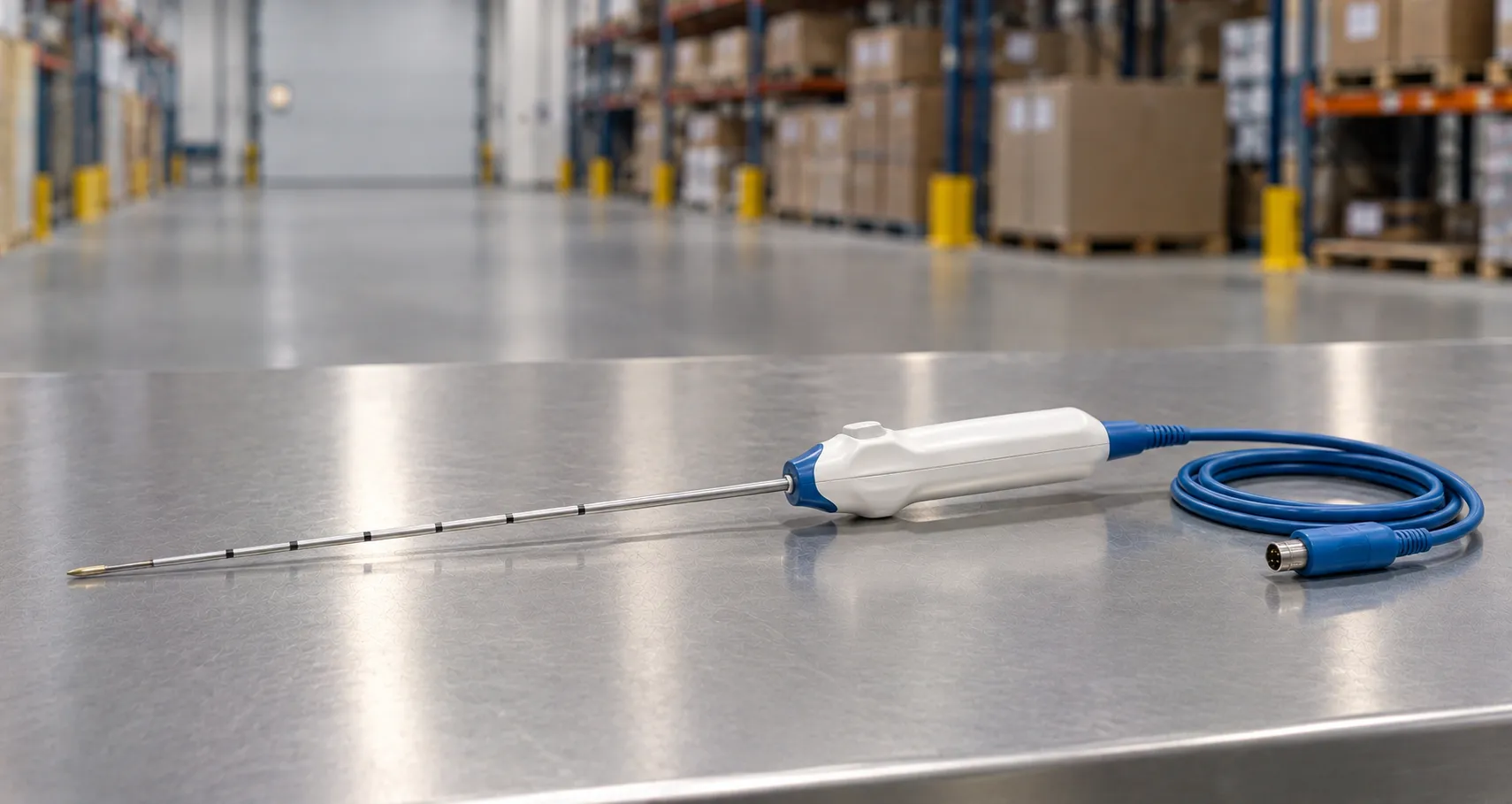
The generator produces alternating current in the radio-frequency range. Current flows from the active tip of an insulated probe placed at the target, through the tissue, and back to a large dispersive electrode (a grounding pad) on the patient's skin. Because the current concentrates at the small active tip and spreads out at the large pad, heating occurs only around the tip. The oscillating current agitates ions in the tissue, generating frictional heat; raising the tip to a controlled temperature for a set time coagulates the nerve within a predictable lesion volume. The generator continuously measures tip temperature and tissue impedance and modulates output to hold the target temperature, which is what makes the lesion size reproducible. In pulsed RFA, current is delivered in bursts so peak tissue temperature stays lower, aiming to modulate nerve function with less destruction; in continuous conventional RFA th, the tip is held hot to create a defined thermal lesion.
Where it is used in pain management
RFA is widely used for chronic facet-joint pain in the cervical, thoracic and lumbar spine by lesioning the medial branch nerves, for sacroiliac joint pain, and increasingly for chronic knee pain via the genicular nerves. It is typically performed under imaging guidance in a day-case setting. The clinical decision to offer RFA rests with the treating team and follows guidance such as that published by NICE; the buyer's job is to supply a system that lets clinicians place probes accurately and control the lesion reliably.
The system: generator, probes and grounding
The generator is the capital item. It sets and holds temperature, times the lesion, measures impedance,nce and usually provides sensory and motor stimulation to help confirm the tip is by the target nerve and clear of nearby motor nerves. Probes and cannulae carry the current to the tissue; the active tip length and gauge determine lesion size and shape. Most probes and the introducer cannulae are single-use to guarantee sterility and a clean, correctly insulated tip. The dispersive pad completes the circuit and must have good skin contact over an adequate area to avoid heating at the return site. Cooled-tip probes circulate water through the tip to enlarge the lesion while keeping the tip surface cooler, which changes the consumable set and cost.
Key specifications a buyer must check
Confirm the generator's temperature range and control accuracy, the available lesion timers, and whether it offers both conventional and pulsed modes plus sensory and motor stimulation. Check the probe range: active tip lengths, needle gauges, and whether standard and cooled-tip options run on the same generator, since these are proprietary and probes from one maker will not connect to another's console. Establish which items are single-use, the connector type, and whether multi-lesion or multi-probe capability is offered for treating several nerves in one sitting. Confirm compatibility with the dispersive pads you intend to stock and the generator's impedance-monitoring and fault-detection behaviour.
Standards, regulation and electrosurgical safety
An RFA generator passes radio-frequency current through the patient, so it is high-frequency surgical equipment and must meet the particular safety standard IEC 60601-2-2, which sits under the general standard IEC 60601-1 and covers return-electrode monitoring, output limits and fault behaviour. The system must carry valid UKCA or CE marking with instructions for use stating the intended purpose and the single-use status of probes and pads. Because the dispersive electrode is central to safety, confirm the generator supports contact-quality monitoring for the pads you use. Ask the supplier for the declaration of conformity and confirm Great Britain registration; the MHRA is the regulator and adverse-incident route, and workplace electrical and safety duties fall under the HSE framework. File the instructions for use, since they define both the safety checks and the reprocessing status of every component.
Single-use and reprocessing considerations
Probes, introducer cannulae and dispersive pads are supplied sterile and single-use; they contact tissue or broken skin and are discarded after one patient, never re-sterilised, because reprocessing risks compromising insulation, tip geometry and sterility. Reusable connecting cables are cleaned to the manufacturer's method between cases and inspected for insulation damage, since a cracked cable is an electrical-safety hazard. Cooled-tip systems add a pump and a sterile tubing set to the consumable stream, and the circulating water reservoir must be managed to the manufacturer's instructions. Sterile-services and biomedical teams should confirm cable inspection intervals and the generator's routine electrical-safety test schedule as part of adoption.
Use across settings and total cost of ownership.
RFA sits in hospital pain-management services, interventional radiology and day-surgery units rather than primary care. The generator is a one-off purchase; the running cost is the per-procedure probe, cannula and pad set, multiplied by annual case volume, with cooled-tip cases costing more per lesion than conventional ones. Model that consumable stream against expected throughput, and budget for generator servicing, calibration checks, stimulation-cable replacement and software updates. Consider whether a single generator can serve several lists or sites to improve utilisation. Where a department already owns diathermy, remember RFA is a distinct platform with its own probes and cannot simply borrow electrosurgical accessories. Our team can compare RFA generators and consumable contracts against your case mix — register as a buyer or use the contact page to discuss options, and manufacturers can list their systems with us.
Procurement checklist
-
Confirm temperature control accuracy, lesion timers and conventional plus pulsed modes.
-
Check sensory and motor stimulation for confirming probe position.
-
Match probe tip lengths, gauges and cooled-tip options to intended procedures.
-
Verify probes, cannulae and pads are the generator's proprietary consumables.
-
Confirm IEC 60601-2-2 compliance and dispersive-pad contact-quality monitoring.
-
Request UKCA or CE documentation and single-use status for each component.
-
Model per-procedure consumable cost against annual case volume.
-
Establish cable inspection intervals, calibration and servicing terms.
Conclusion
Radiofrequency ablation treats chronic pain by heating a targeted nerve with radio-frequency current to interrupt pain signalling, with lesion size held reproducible by tip-temperature and impedance control. As a purchase,e it is a proprietary energy system, so buyers should check the generator's modes and control accuracy, the probe range, the single-use consumable stream, and the IEC 60601-2-2 electrosurgical safety framework. Confirm the UKCA or CE paperwork, dispersive-pad monitoring, and servicing terms before committing. MediGear can help pain services and interventional units compare RFA systems and consumable contracts so the investment matches clinical need and case volume.
Disclaimer
This article is for informational purposes only. It is published by MediGear (medigear.uk) for general information and procurement guidance, and is not clinical, diagnostic, treatment, technical, engineering, legal or regulatory advice, nor a product endorsement, guarantee or substitute for professional assessment. MediGear does not provide medical consultations. Buyers should consult their clinical, biomedical, estates and regulatory contacts, and the manufacturer's documentation, and independently verify all specifications, certifications, compatibility and suitability before purchase. Specifications, certifications and availability are correct at the time of publication and may change without notice. MediGear is a medical-equipment distributor and does not sell medicines or pharmaceutical products.