Cryosurgery is the controlled use of extreme cold to destroy unwanted tissue. A cryogen is delivered to a probe or applicator, the tip is driven to a very low temperature, and the target tissue is frozen so that its cells die. It is used to treat skin lesions, some tumours, cervical and other mucosal lesions, and certain cardiac and prostate conditions. Rather than cutting or heating, cryosurgery kills tissue by freezing, which makes it valuable where a precise, bloodless zone of destruction is wanted with the vasculature largely left as scaffolding.
For a buyer, cryosurgery equipment ranges from a simple handheld device to a full console with pressurised gas and imaging integration. The right specification depends entirely on the setting, the cryogen used, and whether probes are reusable or single-use, so it pays to understand the freezing principle before comparing systems.
How cold destroys tissue
Freezing damages cells in several ways. As the tissue cools, ice crystals form outside the cells first, drawing water out and dehydrating them; with faster, deeper cooling, ice also forms inside the cells and ruptures their membranes and organelles directly. When the tissue thaws, small blood vessels in the frozen zone are damaged, cutting off the blood supply and causing further, delayed cell death. Because of this, cryosurgery is usually delivered as a freeze–thaw cycle, often repeated: a rapid freeze to the lethal temperature, a hold, then a slower thaw, repeated to widen and deepen the zone of destruction. The size of the resulting ice ball, and the fact that the lethal temperature is only reached toward its centre, mean the operator must extend the freeze margin beyond the visible lesion edge to be confident of treating it fully.
Cryogens and how systems differ
Nitrous oxide systems
Many gynaecological and general cryoprobes use nitrous oxide, which cools the probe tip by rapid gas expansion (the Joule–Thomson effect) as it passes through a fine nozzle. These systems reach moderately low temperatures suitable for mucosal and superficial lesions and run from a gas cylinder.
Argon and helium systems
Cryoablation consoles for tumours often use argon to freeze and helium to actively thaw, again exploiting gas expansion, and reach lower temperatures for deeper lesions. They use fine needle-like probes placed under imaging.
Liquid nitrogen systems
Liquid nitrogen, at around minus 196 Celsius, is used in dermatology by spray or probe for skin lesions and is the coldest common cryogen. Spray devices are simple; probe systems circulate or apply the liquid to a metal tip.
Handheld versus console
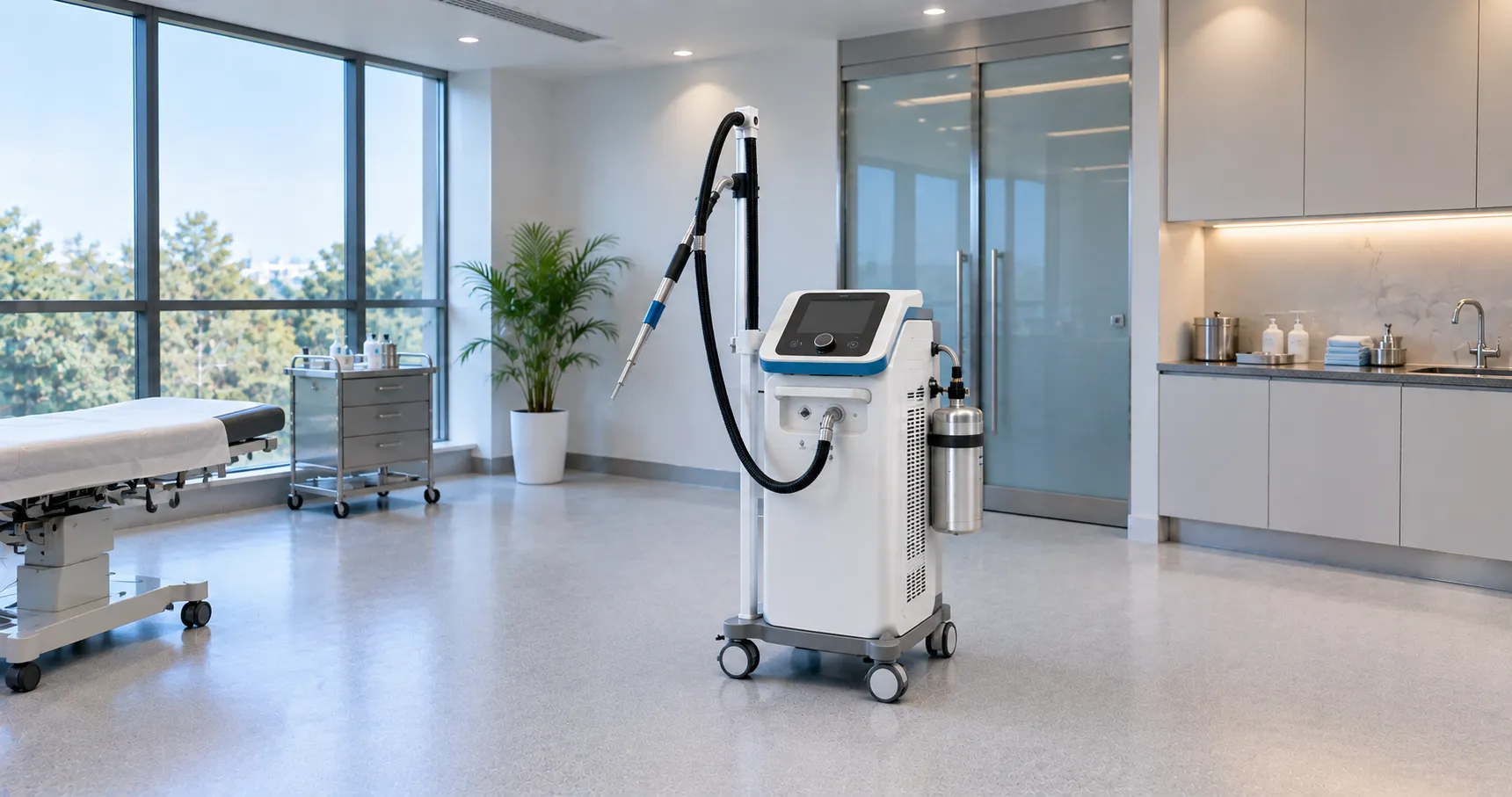
Handheld cryotherapy pens and spray flasks suit dermatology and minor procedures; full consoles with multiple probe channels, temperature monitoring and imaging integration suit tumour cryoablation in theatre or interventional radiology.
Key specifications a buyer must check
Confirm the cryogen the system uses and that your facility can supply and store it safely, since nitrous oxide, argon and liquid nitrogen each carry different storage, ventilation and handling requirements. Check the range of probe or applicator sizes and shapes and the ice-ball dimensions each produces, the minimum tip temperature, and whether the console monitors temperature or freeze zone. Establish which probes are reusable and autoclavable and which are single-use, the number of independent freeze channels for multi-probe ablation, and any thermocouple or imaging compatibility. For dermatology, confirm spray-tip aperture options and trigger control for dose accuracy, since a finer aperture treats a small lesion precisely while a wider one covers a broader field. Also check the freeze and thaw times the console can time and log, because reproducible cycle timing is what makes lesion size consistent between operators.
Standards, regulation and safety
A cryosurgical system is a medical device and must carry valid UKCA or CE marking, with instructions for use stating the intended purpose, the cryogen, and the reusable or single-use status of each probe. Because the hazard here is pressurised gas and cryogenic liquid rather than electrical current, the electrosurgical standard IEC 60601-2-2 does not apply; instead, the relevant controls are gas-cylinder and pressure-system safety, cryogenic-liquid handling, and adequate ventilation, all of which fall under workplace duties overseen by the HSE. Any electrically powered console still meets the general medical electrical safety standard IEC 60601-1. Ask the supplier for the declaration of conformity and confirm Great Britain registration; the MHRA is the regulator and adverse-incident route. Confirm that gas storage, asphyxiation risk from nitrogen, and pressure-relief arrangements are assessed by your estates team before installation.
Decontamination and single-use considerations
Probes that contact tissue must be decontaminated between patients: reusable cryoprobes are cleaned and sterilised to the manufacturer's validated method, usually steam autoclave, and inspected for damage to the tip and insulation, because a fault can affect freezing or leak gas. Single-use needle probes for tumour cryoablation are discarded after one patient and never reprocessed, since their fine channels cannot be reliably cleaned and their geometry is critical. Spray cryotherapy in dermatology uses disposable or cleanable tips depending on the system, and spray flasks must be filled and vented to the manufacturer's instructions to avoid blockage or over-pressure. Sterile-services teams should confirm the validated reprocessing route and inspection regime, and stores must manage cryogen supply, cylinder rotation and single-use probe stock so a list is never delayed for want of gas or a sterile probe.
Use across care settings and total cost of ownership
Cryosurgery spans many settings: dermatology clinics and GP practices using liquid-nitrogen spray or nitrous-oxide pens for skin lesions, colposcopy clinics treating the cervix, and theatre or interventional-radiology suites performing tumour cryoablation with argon consoles. The capital cost ranges from modest for a handheld device to substantial for a multi-channel console, and the running cost is dominated by cryogen supply and by single-use probes in the tumour setting. Model cryogen consumption and probe use against case volume, and budget for cylinder rental or nitrogen delivery, console servicing, temperature-sensor calibration and probe replacement. Match the equipment to the setting: a dermatology clinic does not need a tumour-ablation console, and a cryoablation service cannot work with a spray flask. Our team can match cryosurgery equipment to your caseload and cryogen supply — register as a buyer or use the contact page, and suppliers can list their systems with us.
Procurement checklist
-
Confirm the cryogen and that your facility can store and handle it safely.
-
Check probe and applicator sizes and the ice-ball dimensions each produces.
-
Verify minimum tip temperature and any temperature or freeze-zone monitoring.
-
Establish which probes are reusable and autoclavable versus single-use.
-
Confirm the number of independent freeze channels for multi-probe work.
-
Request UKCA or CE documentation and IEC 60601-1 compliance for powered consoles.
-
Assess gas storage, ventilation and pressure-system safety with estates.
-
Model cryogen and single-use probe cost against annual case volume.
Conclusion
Cryosurgery destroys tissue by freezing it through repeated freeze–thaw cycles, using cold rather than heat or a blade to create a controlled, largely bloodless zone of destruction. The right system depends on the cryogen, the setting and the probe options, so buyers should check ice-ball dimensions, tip temperature, reusable-versus-single-use probes and, above all, the gas and cryogenic-liquid safety arrangements. Confirm the UKCA or CE paperwork and estates sign-off before committing. MediGear can help clinics and theatres match cryosurgery equipment and cryogen supply to their caseload so cold-based treatment is delivered safely and economically.
Disclaimer
This article is for informational purposes only. It is published by MediGear (medigear.uk) for general information and procurement guidance, and is not clinical, diagnostic, treatment, technical, engineering, legal or regulatory advice, nor a product endorsement, guarantee or substitute for professional assessment. MediGear does not provide medical consultations. Buyers should consult their clinical, biomedical, estates and regulatory contacts, and the manufacturer's documentation, and independently verify all specifications, certifications, compatibility and suitability before purchase. Specifications, certifications and availability are correct at the time of publication and may change without notice. MediGear is a medical-equipment distributor and does not sell medicines or pharmaceutical products.