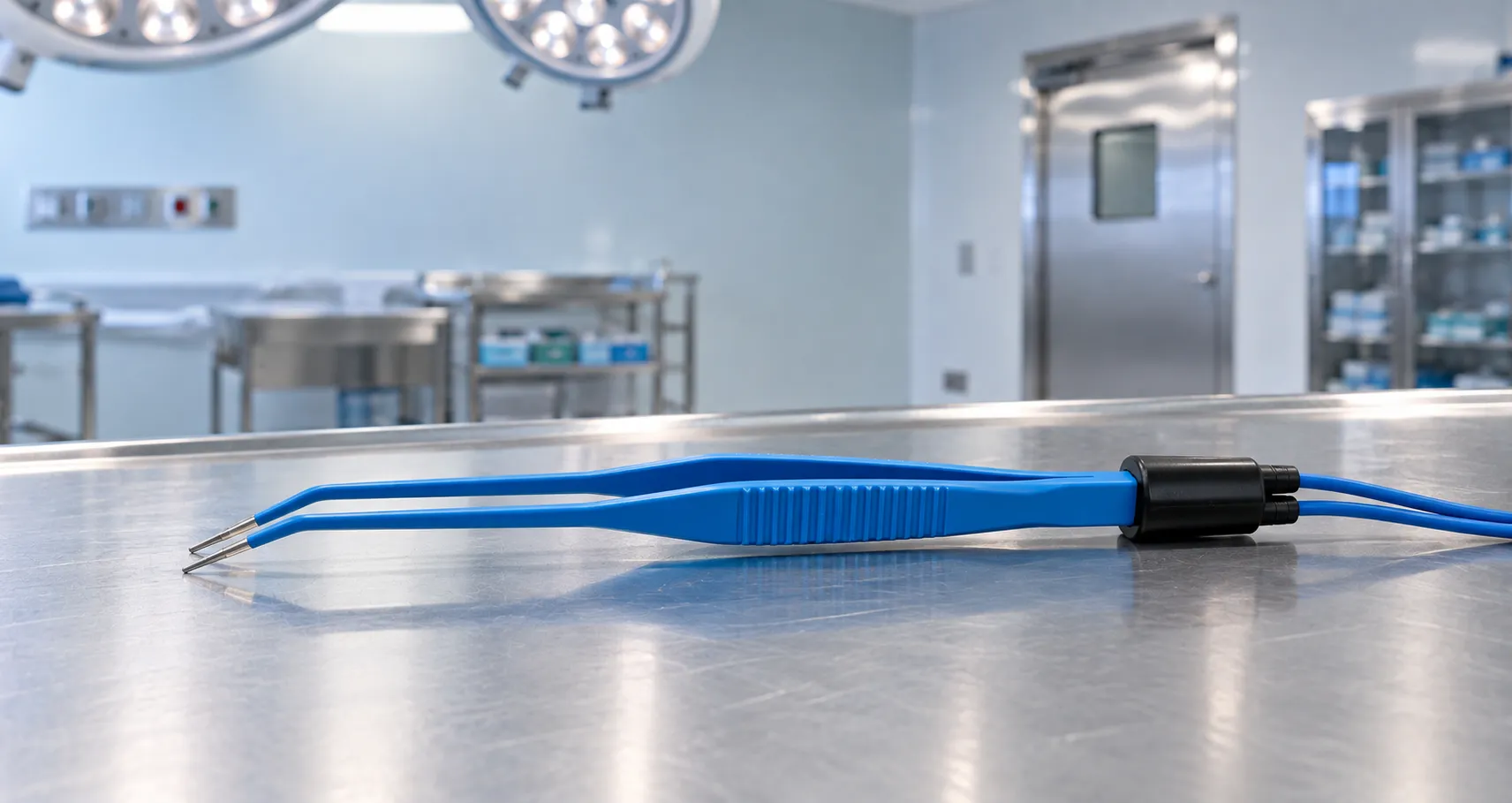
Bipolar forceps are an electrosurgical instrument that coagulates tissue by passing a high-frequency current between the two tips of the forceps. The tissue grasped between the tips completes the circuit, so the current travels only across that small gap rather than through the patient's body. That confinement is the whole point: it delivers precise, localised coagulation with minimal spread to surrounding tissue, which is why bipolar forceps are trusted in neurosurgery, ophthalmic and ENT work, and any procedure near delicate structures.
For a theatre buyer, bipolar forceps are bought as part of an electrosurgical system: the forceps themselves, a cable, and a generator (diathermy unit) set to a bipolar mode. Specifying them well means matching tip design to the surgery, choosing reusable or single-use sensibly, and confirming the electrosurgical safety framework that governs any device passing current through tissue.
How bipolar coagulation works
In a bipolar circuit, one forceps tip is the active electrode and the other is the return. When the generator is activated, current flows from one tip, through the pinch of tissue held between them, to the other tip. The tissue's resistance to that current generates heat, which denatures protein and seals small vessels — coagulation without cutting. Because both electrodes are at the instrument, no current passes through the rest of the patient, and no patient return electrode (grounding pad) is required, unlike monopolar diathermy. This eliminates the risk of stray-current burns at a distant site and greatly reduces the lateral thermal spread, since heating is confined to the few millimetres of tissue between the tips. Generator output in bipolar mode is deliberately lower and more controlled than monopolar cutting, and many units automatically stop delivering energy once the tissue between the tips has fully coagulated and its impedance rises.
Tip designs and how they compare
Standard and fine tips
Tip width sets the precision. Fine and microsurgical tips concentrate energy for delicate work in neurosurgery and ophthalmology; broader tips coagulate a larger area faster in general surgery. Bayonet-shaped forceps angle the shafts so the surgeon's hand does not block the line of sight down a narrow field.
Non-stick tips
Tissue char sticking to the tips interrupts work and can tear a fresh seal on release. Non-stick tips, often silver-alloy or specially coated, reduce adherence and are valued where repeated precise coagulation is needed.
Irrigating and vessel-sealing variants
Some bipolar forceps drip saline to cool the tips and prevent sticking; separate advanced bipolar vessel-sealing instruments run on a dedicated generator feedback algorithm to seal larger vessels, which is a distinct product class from simple coagulating forceps.
Reusable versus single-use
Reusable forceps are durable and economical per use over a long life but must be cleaned, sterilised, and inspected each cycle. Single-use forceps guarantee a clean, undamaged tip every time and remove reprocessing, at a per-case cost.
Key specifications a buyer must check
Confirm tip width and shape (straight or bayonet), shaft length, and whether the design is standard, non-stick, or irrigating, matched to the specialty. Check the connector type and, critically, that the forceps and cable are compatible with your generator's bipolar output, since connectors and pin configurations differ between makers. Establish the generator's bipolar power range and whether it offers auto-stop coagulation, and confirm the forceps are rated for that output. For reusable forceps, confirm they are fully autoclavable, and the tips can be realigned if bent; for single-use, confirm sterility and connector fit. Where vessel sealing of larger vessels is needed, verify whether a dedicated advanced bipolar device and matching generator are required rather than plain forceps.
Standards, regulation and electrosurgical safety
Bipolar forceps pass high-frequency current through tissue, so the system is high-frequency surgical equipment and must meet the particular safety standard IEC 60601-2-2, which sits beneath the general standard IEC 60601-1 and covers output limits, insulation and fault behaviour for electrosurgery. The forceps and cable must carry valid UKCA or CE marking with instructions for use stating the intended purpose, the maximum rated voltage, and the reusable or single-use status. Cable insulation integrity is a genuine safety matter, because a cracked cable can cause a burn or fault, so reusable cables are inspected each cycle. Ask the supplier for the declaration of conformity and confirm Great Britain registration; the MHRA is the regulator and the route for reporting an electrosurgical incident, and workplace electrical-safety duties fall under the HSE framework. File the instructions for use, since they set the rated output and the validated reprocessing method.
Sterilisation and single-use considerations
Reusable bipolar forceps contact tissue and must be decontaminated between patients: cleaned to remove all char and soil, inspected for tip alignment and insulation damage, then sterilised to the manufacturer's validated method, usually steam autoclave. Bent tips lose the correct gap and coagulate poorly, so alignment is part of the inspection. Reusable cables are cleaned and checked for insulation cracks. Single-use forceps are discarded after one patient and never reprocessed, which suits high-throughput or infection-sensitive lists at a predictable per-case cost. Many departments run both: reusable microsurgical forceps for routine neurosurgery and disposables for overflow or isolation cases. Sterile-services teams should confirm the validated reprocessing route and the tip-inspection regime before adoption, and keep enough forceps in circulation to cover the sterilisation turnaround so a list never waits on a single set. A gentle realignment of splayed tips restores the correct gap, but forceps with pitted, worn or cracked insulation should be withdrawn rather than kept in use.
Use across settings and total cost of ownership.ip
Bipolar forceps are concentrated in hospital theatres, especially neurosurgery, ophthalmic, ENT, plastic and general surgery, and analogous instruments serve referral veterinary practice. The generator is shared capital; the ongoing cost is the forceps and cables, reusable or single-use, plus generator servicing and electrical-safety testing. Model reusable-forceps decontamination and periodic replacement against single-use per-case pricing for your volumes, and factor in the tip type, since non-stick and irrigating forceps cost more but can speed surgery and reduce re-coagulation. Standardising connectors and generators across theatres simplifies stock, training and cable holdings. Our team can compare bipolar forceps ranges and generator compatibility against your specialties — register as a buyer or reach us through the contact page, and manufacturers can explore partnership options with us.
Procurement checklist
-
Match tip width, shape, and shaft length to the specialty and field of view.
-
Decide between standard, non-stick, or irrigating tips based on how much repeated coagulation is needed.
-
Verify forceps and cable connectors are compatible with your generator's bipolar output.
-
Confirm the generator's bipolar power range and any auto-stop coagulation feature.
-
Choose reusable or single-use forceps against case volume and infection control.
-
Confirm IEC 60601-2-2 compliance and the maximum rated voltage.
-
Request UKCA or CE documentation and validated reprocessing instructions.
-
Establish cable inspection, tip realignment,nt and electrical-safety test intervals.
Conclusion
Bipolar forceps deliver precise coagulation by confining current to the tissue held between two tips, avoiding a patient return electrode and limiting thermal spread, which is why they are trusted near delicate structures. Buying well means matching tip design to the specialty, confirming connector and generator compatibility, choosing reusable or single-use sensibly, and meeting the IEC 60601-2-2 electrosurgical safety standard. Confirm the UKCA or CE paperwork, rated voltage, and reprocessing route before committing. MediGear can help theatres compare bipolar forceps and generator compatibility so precise coagulation is supplied reliably and at a sensible cost per case.
Disclaimer
This article is for informational purposes only. It is published by MediGear (medigear.uk) for general information and procurement guidance, and is not clinical, diagnostic, treatment, technical, engineering, legal or regulatory advice, nor a product endorsement, guarantee or substitute for professional assessment. MediGear does not provide medical consultations. Buyers should consult their clinical, biomedical, estates and regulatory contacts, and the manufacturer's documentation, and independently verify all specifications, certifications, compatibility and suitability before purchase. Specifications, certifications and availability are correct at the time of publication and may change without notice. MediGear is a medical-equipment distributor and does not sell medicines or pharmaceutical products.