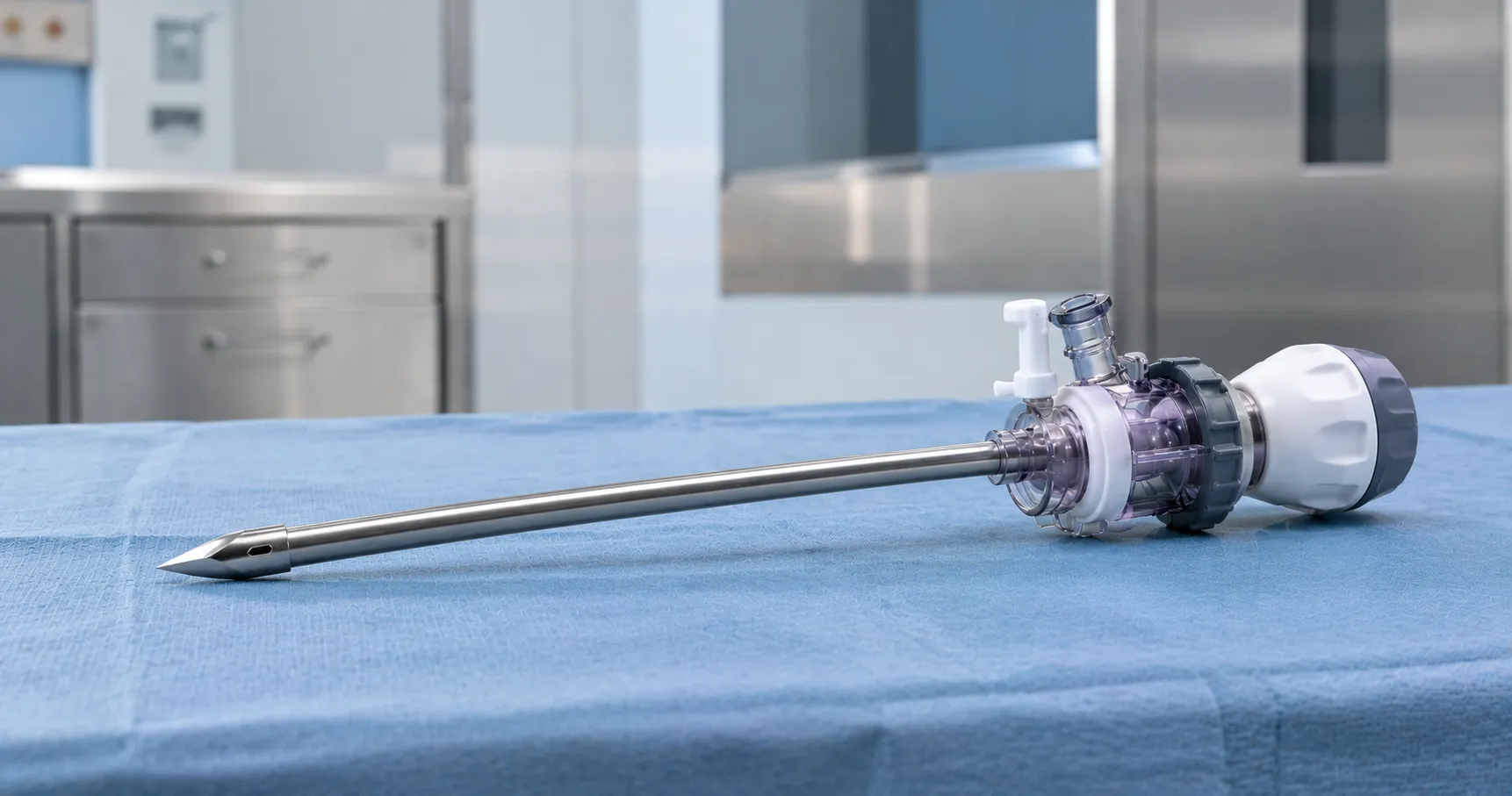
A trocar system is the assembly that makes a working channel through the abdominal wall in keyhole surgery. It pairs a cannula, the tube that stays in place as a port, with a sharp or dilating obturator that pierces or spreads the tissue during entry and is then withdrawn. Once seated, the cannula holds the insufflation seal and lets the surgeon pass a laparoscope or instruments in and out without losing the pneumoperitoneum.
Because a laparoscopic case needs several ports of different sizes, trocars are a high-volume, high-stakes purchase. Entry injury, gas leakage, slippage, and the cost of single-use versus reusable designs all hinge on how they are chosen. This guide sets out the types, the specifications that matter, and how to buy them well.
How a trocar establishes a port
After the pneumoperitoneum is created, the trocar is pushed through the abdominal wall at a chosen site. The obturator does the work of entry: a bladed tip cuts, a bladeless conical or pyramidal tip dilates and separates muscle fibres, and an optical tip lets the surgeon watch each layer part on the laparoscope as it advances. Once the tip enters the cavity, the obturator is removed, and the cannula remains as the access port. A valve or seal in the cannula head keeps gas in while instruments pass through, and a retention feature, whether a thread, balloon, or ribbed sleeve, resists the tendency of the port to slide out during busy instrument exchanges.
The parts of a trocar system
Three elements define any trocar. The cannula sets the working diameter and length and carries the seal and any gas-insufflation stopcock. The obturator determines the entry method and is the part most linked to entry-related injury risk. The seal or valve system keeps the abdomen inflated while allowing instruments of varying diameters to pass; universal seals accept a range of instrument sizes through one port without a reducer, which speeds up surgery and cuts the number of ports and adaptors needed.
Entry types and how they compare
Bladed trocars
Bladed obturators cut cleanly through the wall and need less insertion force, but the cutting tip carries a higher theoretical risk of injury to vessels or bowel on entry. Many bladed designs shield the blade automatically once through the fascia to limit that exposure.
Bladeless (dilating) trocars
Bladeless conical or pyramidal tips separate muscle fibres rather than cutting them, which tends to leave a smaller fascial defect that is easier to close and may lower the risk of port-site herniation. They require more insertion force and a firmer, more controlled push.
Optical-entry trocars
Optical trocars have a clear tip that admits the laparoscope, so the surgeon sees each tissue layer separately during insertion. This visual entry is valued in patients with a high body-mass index or suspected adhesions, where blind entry is riskier.
Radially expanding and Hasson (open) options.
Radially expanding systems place a needle and sheath, then dilate the sheath up to port size for a snug, low-leak fit. The Hasson technique uses a blunt cannula placed through a small open incision under direct vision, favoured where adhesions make needle entry unwise.
Key specifications a buyer must check
Start with diameter: 5 mm and 10 to 12 mm are the workhorses, with 15 mm and larger for staplers and specimen work, and 3 mm for fine paediatric and cosmetic cases. Check the available cannula lengths, because bariatric and paediatric patients need short and long options, and confirm whether the seal is a universal design that accepts several instrument sizes without a reducer. Look at the retention feature and how well it resists slippage, the smoothness of instrument passage through the valve, and whether the cannula has a dedicated insufflation stopcock. For optical systems, confirm compatibility with your laparoscope diameter and angle. Match the obturator type to your surgeons' preference and case mix, and check that single-use kits arrive sterile with clear expiry dating. Compatibility with your existing instruments and staplers is essential before standardising.
Single-use versus reusable systems
Reusable metal trocars have a long service life and a low cost per use once decontamination is accounted for, but each set must be cleaned, inspected for a sharp, undamaged tip and functioning valve, then sterilised between patients, and seals wear and need replacing. Single-use trocars arrive sterile, guarantee a consistently sharp tip and an intact seal for every case, and remove reprocessing entirely, at a per-case price. Hybrid systems pair a reusable cannula with a disposable seal or obturator to balance the two. The right mix depends on theatre throughput, decontamination capacity and infection-control policy; many units keep reusable ports for routine work and disposables for high-volume or higher-risk lists.
Standards, regulation and safety
Trocars are sterile, often single-use invasive medical devices and must carry valid UKCA or CE marking with a declaration of conformity and instructions for use stating single-use status where applicable. Sterile packaging should show the sterilisation method, batch number, and expiry, and single-use devices must never be reprocessed unless the manufacturer explicitly validates it. Reusable instruments should reference the ISO 17664 information-for-reprocessing framework in their documentation. Because sharp entry devices carry an inherent injury and sharps risk, safe-use and disposal duties under the HSE framework apply in theatre. Report any device fault or entry-related incident to the MHRA, the UK medical-device regulator, and check current procurement guidance on GOV.UK. Keep the instructions for use, since they define correct entry technique and, for reusable ports, the validated cleaning route.
Consumables, spares and total cost of ownership
For single-use trocars,s the per-case device is the main cost, so model annual port usage per procedure type against unit price and remember that a case commonly uses three to five ports of mixed sizes. For reusable systems, the running costs are decontamination, staff time, sterilisation capacity,y and periodic replacement of worn seals, obturators, and tips, plus enough sets in circulation to cover turnaround. Universal seals reduce spend on separate reducers and adaptors. Standardising on one compatible family across sizes simplifies training, stock control and instrument fit. We can help you balance reusable and single-use ports across your theatre list — register as a buyer or get in touch to compare trocar systems.
Use across surgical settings.
Trocars are used across laparoscopic general surgery, gynaecology, urology, colorectal and bariatric work, and in robotic surgery, where dedicated robotic ports interface with the arms. A district general hospital typically standardises on a mixed set of 5 mm and 11 mm ports with optical-entry options for difficult cases, while a bariatric centre leans on longer cannulas and bladeless entry to reduce fascial defects. Day-surgery units favour ready-sterile single-use kits for quick turnover. Paediatric theatres need the smallest diameters and shortest lengths, and veterinary laparoscopy uses the same platform scaled to the animal. Matching diameter, length and entry type to the setting avoids both leaking, ill-fitting ports and the expense of premium features a routine list never needs.
Procurement checklist
-
Choose the diameters your procedures need: 3, 5, 10 to 12 and 15 mm as appropriate.
-
Confirm short and long cannula lengths for paediatric through bariatric patients.
-
Prefer universal seals that accept several instrument sizes without a reducer.
-
Match obturator type, bladed, bladeless or optical, to surgeon preference and case mix.
-
Check the retention feature resists slippage during instrument exchanges.
-
Verify compatibility with your laparoscope, instruments and staplers before standardising.
-
Decide single-use, reusable or hybrid against throughput and decontamination capacity.
-
Confirm UKCA or CE marking, sterile packaging, batch and expiry, and single-use status.
Conclusion
A trocar system is the doorway to every laparoscopic operation, and the choice of diameter, length, entry type, and seal shapes affects safety, speed, ed, and cost on every list. The decision turns on your case mix, your surgeons' entry preferences, the value of universal seals, and an honest comparison of single-use against reusable across throughput. Confirm the sizes, the compatibility, and the sterile documentation, then cost the options against real port usage. MediGear can supply trocar systems and matched instruments so your ports seat securely, seal reliably,y and suit your budget.
Disclaimer
This article is for informational purposes only. It is published by MediGear (medigear.uk) for general information and procurement guidance, and is not clinical, diagnostic, treatment, technical, engineering, legal or regulatory advice, nor a product endorsement, guarantee or substitute for professional assessment. MediGear does not provide medical consultations. Buyers should consult their clinical, biomedical, estates and regulatory contacts, and the manufacturer's documentation, and independently verify all specifications, certifications, compatibility and suitability before purchase. Specifications, certifications and availability are correct at the time of publication and may change without notice. MediGear is a medical-equipment distributor and does not sell medicines or pharmaceutical products.