Triage temperature measurement must be quick, repeatable, and hygienic. Those three demands pull in different directions: the fastest devices are often the most sensitive to technique and environment, while the most consistent methods take longer and involve more handling.
The ten thermometer types below cover triage, ward observation and specialist measurement. Each entry explains the design and what to confirm before purchase.
Site, technique and environment
Different measurement sites produce different readings, and they are not interchangeable. A department should decide which site it uses for triage, record it consistently, and train staff in the technique that site requires.
Environment matters more than most buyers expect. Draughts, direct sunlight, recent movement between hot and cold areas and a patient's covering can all affect surface measurement in particular. A device used near an entrance door will behave differently from the same device used in a side room.
The ten thermometer types
1. Non-contact infrared forehead thermometers
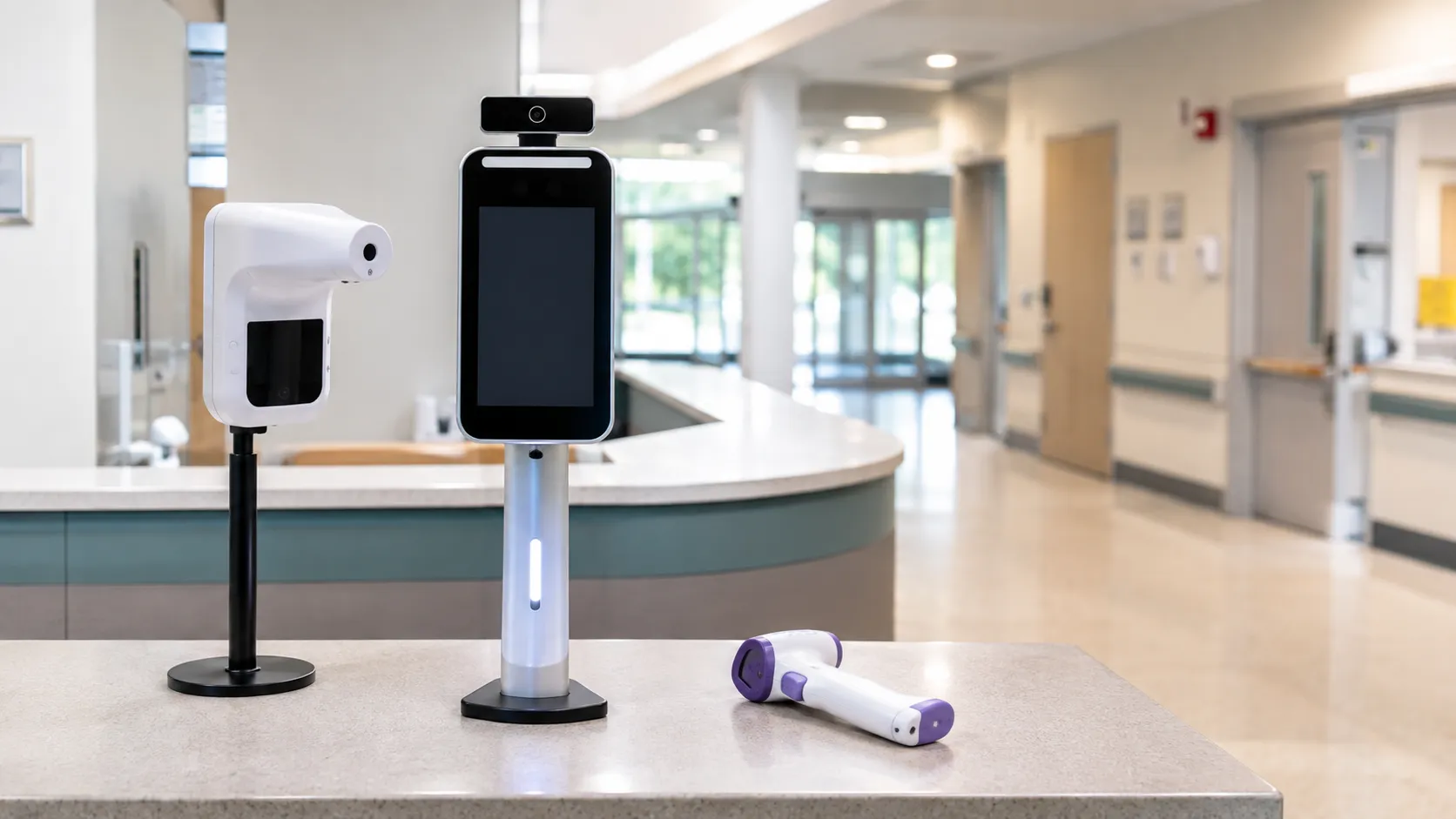
Fast, hygienic, and well-suited to high-volume triage. They need consistent distance and a settled patient, and they are the most affected by environmental conditions.
2. Tympanic thermometers
Measure infrared emission from the ear canal, with single-use probe covers. Technique affects results, so training is worthwhile.
3. Temporal artery thermometers
Scanned across the forehead in contact with the skin. Quick to use, with cleaning between patients required.
4. Digital contact thermometers
Probe devices used at oral or axillary sites with disposable sheaths. Slower, but familiar and consistent when technique is followed.
5. Predictive probe thermometers
Estimate the final reading before full equilibrium by shortening the measurement time on wards while retaining contact measurement.
6. Rectal probe thermometers
Used in defined clinical circumstances, particularly for infants, following local policy on site selection and consent.
7. Single-use chemical thermometers
Disposable strips or dot matrix devices assigned to one patient. Useful for isolation nursing where device sharing is undesirable.
8. Continuous skin sensor systems
Wearable sensors giving ongoing temperature trends rather than single readings, used where continuous observation is required.
9. Zero-heat-flux core temperature systems
Sensors designed to estimate core temperature non-invasively, used mainly in theatre and critical care rather than triage.
10. Thermal imaging screening systems
Camera-based systems that flag elevated surface temperature at entrances. They are screening prompts only, and any flagged reading requires confirmation with a clinical thermometer.
Throughput and hygiene in a busy department
Triage volume shapes the practical choice as much as accuracy does. A device requiring a probe cover per patient adds a handling step and a consumable that can run out mid-shift, while a non-contact device removes both but demands more attention to positioning. Whichever route a department takes, the number of devices should reflect the number of triage points rather than the number of staff, so that measurement never becomes the queue.
Practical points to confirm
-
Probe covers. Confirm cover type, supply and whether the device functions without one.
-
Cleaning. Verify that approved cleaning agents are compatible with the products the department already uses.
-
Calibration. Ask how accuracy is verified, at what interval, and whether a check device is available.
-
Display and audibility. Check readability and alert volume in a busy triage area.
-
Battery type. Confirm battery format and expected life across a large fleet.
-
Data capture. Establish whether readings are transcribed manually or transferred to observation charting.
Training, fleet control and servicing
Training should focus on the technique for the chosen site, environmental factors that affect readings, the correct use of covers, and what to do when a reading appears inconsistent with the patient's appearance. A short practical session prevents most measurement disputes.
Because thermometers are small and portable, fleet control is a genuine issue. Asset tagging, defined storage points, and a replacement plan prevent devices from drifting between departments.
For servicing, I agree on accuracy verification intervals, cleaning validation, battery replacement, and spare parts availability. Ensure the organisation receives published medical device safety alerts so field safety notices reach clinical teams.
Probe cover supply is the constraint most likely to bite mid-shift, so confirm it before rollout. Departments standardising a triage method can discuss provision with the Medigear.uk team.
Final thoughts
Choose one triage method and support it properly. A fast non-contact or tympanic device best serves most departments at the front door, contact thermometers for ward observation, and single-use options for isolation. Confirm covers, cleaning compatibility and calibration arrangements before rollout.
This article provides general procurement guidance for healthcare organisations. It is not clinical advice and does not replace manufacturer instructions or local observation policy.