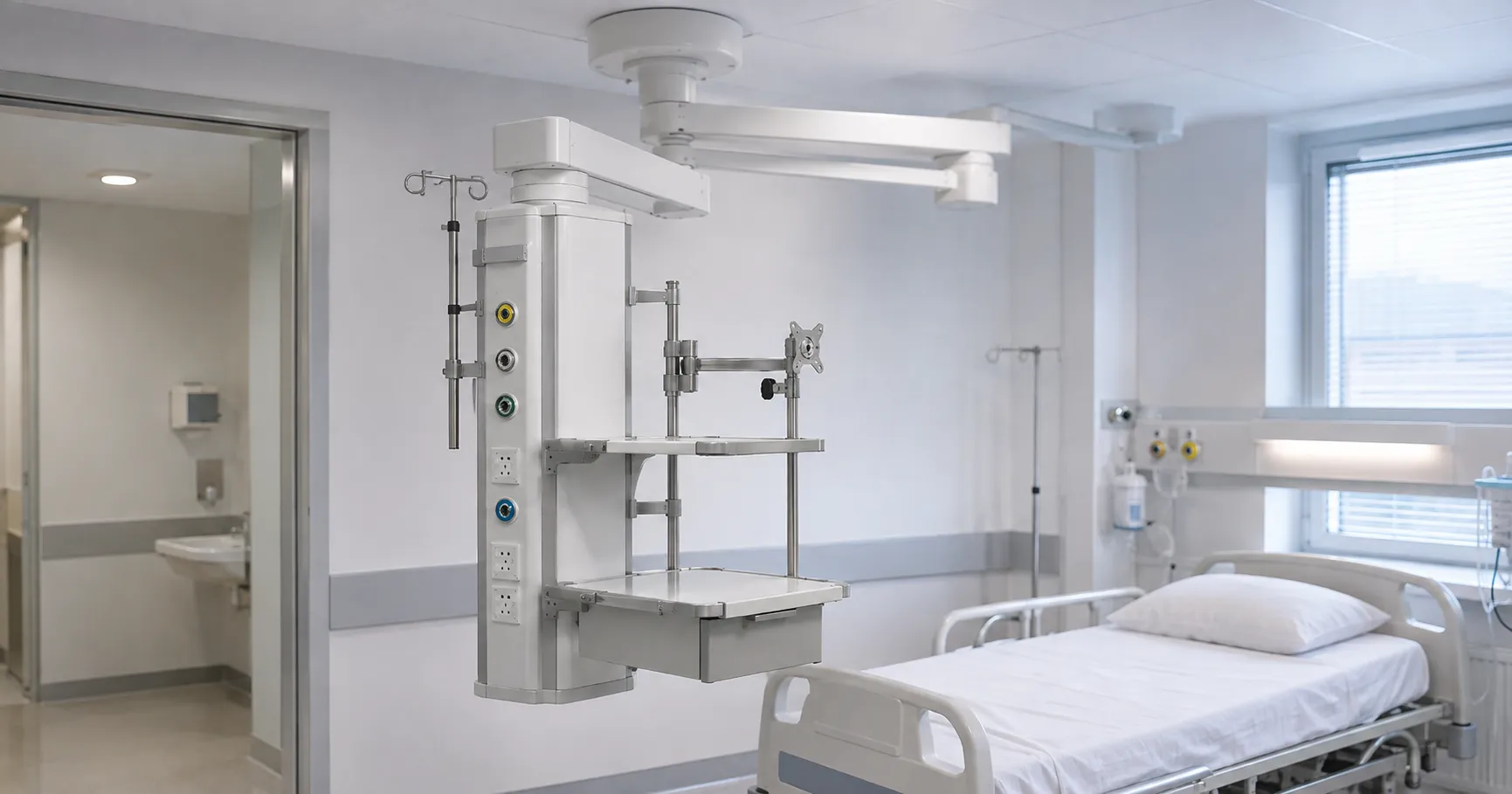
A ceiling pendant brings gases, power, and data to the bedside and keeps them off the floor, which makes a critical care bedspace workable during a busy shift. The right pendant is the one that puts every service within reach of the team without the trailing leads and floor-standing cylinders that turn an emergency into an obstacle course.
The ten ceiling pendant types below cover intensive care, high dependency and theatre-adjacent use. Each entry explains its role and what to confirm before the installation is designed.
Services, reach and the way a team works.
A pendant is specified around the services a bedspace needs: medical gas outlets, electrical sockets on separate circuits, and data and nurse-call connections. Getting the count and mix right matters more than any single feature, because a bedspace short of outlets forces workarounds that undermine the whole point of the pendant.
Reach and movement decide how the pendant serves the team. A rigid arm fixes the service head in one place while single- or double-articulated det sta allow bringing services to the patient from either side of the bed. The choice follows how the unit positions beds and moves around them.
The ten pendant types
1. Rigid single-arm pendants
A fixed vertical column carrying the service head, suited to bedspaces where the head stays in one position. Simple and stable, with no articulation to maintain.
2. Single articulated arm pendants
One movable arm allows the service head to be repositioned along, giving flexibility when the tasam approaches from varying angles.
3. Double articulated arm pendants
Two arms in series giving a wide reach and the ability to fold the head away from the bed, useful in bedspaces where access changes through the day.
4. Combined gas and electrical pendants
Carry medical gas outlets and electrical services on one head, keeping the two grouped for the bedside team. Circuit separation and gas outlet identification are the points to confirm.
5. Separate gas and power dual pendants
Split services across two pendants, often keeping gases on one and power and data on another to reduce clutter on a single head.
6. Pendants with integrated shelving and drawers
Add work surfaces, drawers, and rails to the service head, providing space for monitoring and consumables without a separate trolley.
7. Pendants with monitor mounting
Include arms or plates for mounting patient monitors and other devices, lifting them to eye level and off the work surface.
8. High-capacity theatre-style pendants
Heavier-duty heads for bedspaces carrying substantial equipment loads, with the arm strength and service count that implies.
9. Pendants with height-adjustable heads
Allow the service head height to be set for the team and the equipment, improving access and posture at the bedside.
10. Compact pendants for high dependency areas
Smaller heads for areas needing pendant services, without the full service of an intensive care bedspace.
Load capacity, installation and the ceiling above
A pendant is as much a structural installation as a service point, so the ceiling and the fabric above it are part of the decision. Confirm the load the arm and head must carry, including monitors, pumps and shelving, and verify the ceiling structure supports it with the margin the manufacturer requires. Bringing services to the pendant, coordinating with the gas pipeline, electrical distribution and data cabling, is a project that involves estates and specialist installers, so it belongs in the planning from the start rather than as an afterthought. Movement clearance matters too, since an articulated arm needs room to swing without striking adjacent equipment, walls or another bedspace.
What to confirm before ordering
-
Service count. Confirm the gas outlets, socket count and data connections each bedspace needs.
-
Arm type. Establish rigid, single- or double-articulated arms based on how beds are positioned.
-
Load capacity. Confirm the head and arm carry the intended equipment with margin.
-
Ceiling structure. Verify the ceiling supports the installation with ease.
-
Movement clearance. Check the arm swings freely without striking adjacent fixtures.
-
Cleaning. Confirm that the surfaces suit the unit's infection-prevention routine, training, and servicing.
Pendant surfaces are cleaned frequently in a critical care setting, so confirm the finishes and shrouds allow effective cleaning without trapping soil in joints or around the arm pivots. Smooth, wipeable surfaces support the routine the infection prevention team sets.
Training should cover safe use of the arm movement, correct identification of gas outlets, loading within the stated capacity and how to report a fault. Staff moving between units benefit from familiarity with the specific pendant design.
For servicing, agree planned maintenance covering gas outlet integrity, electrical safety testing, arm mechanism inspection and brake function, since a pendant that drifts is a hazard. Ensure the unit receives MHRA alerts and recalls so field safety notices reach the critical care and estates teams.
Load capacity and service count should be settled with estates before the installation is designed. Units planning a bedspace layout can review options with verified equipment suppliers.
Final thoughts
Specify the pendant around the services, the movement and the load a bedspace genuinely needs, and treat the ceiling structure and installation as part of the decision. Most intensive care bedspaces are best served by articulated heads with the right service count, cleanable finishes and planned maintenance of the arm and outlets agreed before installation.
This article provides general procurement guidance for healthcare organisations. It is not clinical or engineering advice, and it does not replace manufacturer instructions, medical gas standards or expert advice on installation.