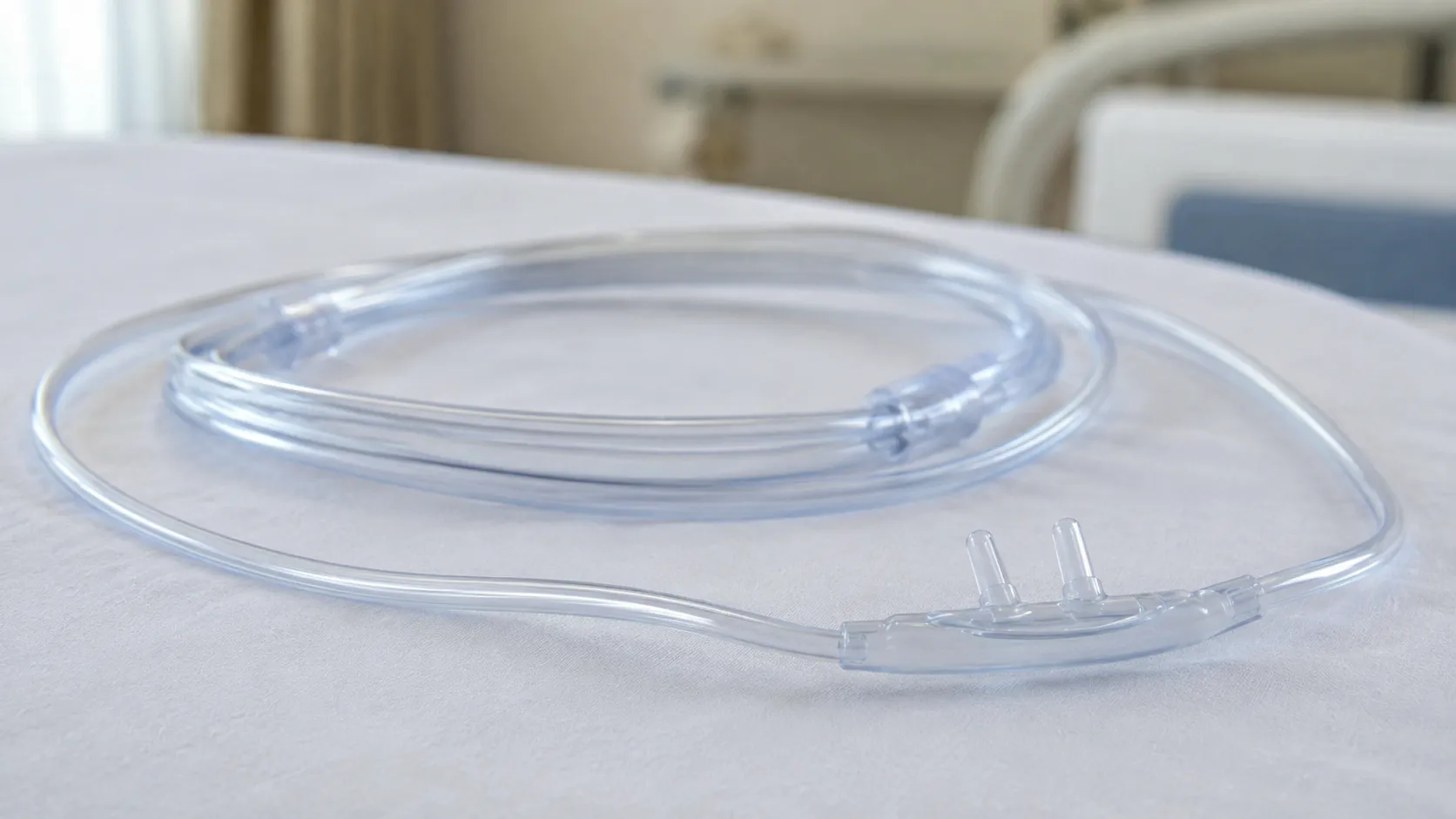
A nasal cannula is a lightweight two-prong tube that sits in the nostrils and delivers supplemental oxygen at low flows, typically 1 to 6 litres per minute, from a flowmeter. It is a variable-performance device: the oxygen it adds mixes with room air the patient draws in, so the effective inspired oxygen depends on the flow set and how the patient breathes, rather than being a fixed, guaranteed concentration.
This guide is for procurement and clinical-engineering teams specifying oxygen-therapy consumables. It explains how low-flow delivery works, the rough concentrations different flows produce, when humidification is needed, the sizes and materials to stock, and the specifications and standards to confirm. High-flow nasal cannula therapy is a separate, heated-humidified technique covered in its own article; this piece stays with conventional low-flow delivery.
How Low-Flow Delivery Works
Oxygen flows continuously through the prongs into the nose, filling the nasopharynx, which acts as a small reservoir. When the patient inhales, that oxygen is drawn in along with room air; the faster or deeper the breath, the more it is diluted, and the lower the effective inspired fraction. This is why a nasal cannula is variable-performance: the same flow gives a slightly different concentration to a fast, deep breather than to a slow, shallow one. It is well suited to patients who need a modest oxygen top-up and are breathing adequately on their own, not to those needing a precise, high or guaranteed concentration.
Flow Rates and Approximate Oxygen Concentration
Low-flow nasal oxygen runs from about 1 to 6 litres per minute. A common rule of thumb estimates that each additional litre per minute raises inspired oxygen by roughly 4 percentage points, so around 24 per cent at 1 litre rising toward the mid-40s per cent at 6 litres. These figures are approximations only, because the true concentration shifts with the patient's breathing, and they should never be treated as delivered values. Flows above about 4 litres per minute add little further concentration while increasingly drying and irritating the nasal lining, which is the practical ceiling that pushes clinicians toward a mask or high-flow system when more oxygen is required.
Humidification and Comfort
Dry oxygen at higher low-flow rates can dry the nasal mucosa and cause discomfort, nosebleeds or crusting, so humidification is commonly added above roughly 4 litres per minute, using a bubble humidifier on the flowmeter. Comfort is not a trivial concern in procurement terms: a nasal cannula's great advantage over a mask is that patients tolerate it for long periods, can eat, drink and talk, and are more likely to keep it on. Soft prongs, a smooth over-ear tube, and an adjustable slide under the chin all support that tolerance and, therefore, the therapy's real-world effectiveness.
Sizes, Materials and Prong Design
Cannulae are moulded from soft PVC or vinyl and should be latex-free. They come in adult, paediatric and infant or neonatal sizes, with neonatal prongs much smaller and shorter to fit tiny nares without occluding them. Curved prongs are designed to follow the natural direction of the nasal passages for comfort and delivery. Tubing is supplied in standard lengths and in longer ambulatory lengths for patients who move around, and it should be crush- and kink-resistant, because a pinched tube silently cuts delivered oxygen. Some cannulae include an integrated carbon-dioxide sampling line for capnography where end-tidal monitoring is wanted alongside oxygen delivery.
Connectors, Setup and Common Pitfalls
The supply end of a cannula terminates in a connector, often a barbed or funnel fitting, that pushes onto a flowmeter probe or bubble humidifier outlet, and this junction is where most quiet failures start. A connector that does not seat leaks firmly, so the patient receives less than the set flow, and a long ambulatory tube that snags under a wheel or bed frame does the same. Buyers should check that the cannula connector matches the flowmeters used across the estate, because a mismatch forces staff to hunt for adaptors or, worse, to improvise. Where oxygen is titrated to a target saturation, an ill-fitting connector or kinked tube undermines the whole exercise, so the humble fitting deserves as much attention as the prongs.
Ambulatory and Domiciliary Use
Nasal cannulae are the backbone of long-term and home oxygen, where a patient may wear one for many hours a day for months. That changes the priorities: extended tubing lengths let a patient move about the home, comfort features decide whether the therapy is actually tolerated, and skin-friendly over-ear tubing reduces pressure sores behind the ears during prolonged wear. Reliable, repeatable supply of the same product matters here more than anywhere, because a patient and their community team come to depend on a consistent fit. Fire-safety guidance is especially relevant in the home, where oxygen enrichment near naked flames or smoking is a documented hazard.
Key Specifications a Buyer Must Check
Match the size range to your patient groups, including neonatal where relevant, and confirm the prong design and softness suit long-wear comfort. Check the supply connector fits your flowmeters and any bubble humidifiers, and that tubing lengths cover both bedside and ambulatory use. Confirm the product is latex-free and single-use, that crush-resistant tubing is specified, and whether a capnography sampling version is needed for monitored settings. Verify supply continuity so the same cannula and matching consumables stay available across wards and community teams, keeping stock interchangeable.
Standards, Regulation and Safety
Nasal cannulae are medical devices and should carry valid UKCA or CE marking from a manufacturer registered with the MHRA. Because oxygen strongly supports combustion, storage, signage and no-smoking precautions around oxygen therapy follow fire-safety and workplace guidance from the HSE, which matters especially for domiciliary oxygen in patients' homes. Oxygen prescribing and target oxygen-saturation ranges follow national NHS and clinical guidance rather than the product itself. Request the instructions for use and confirm the flow range the product is rated for.
Decontamination and Total Cost
Nasal cannulae are single-use and are not reprocessed, so the cost model is unit price times throughput plus disposal, with no cleaning cycle. The wider picture includes bubble humidifiers and their sterile water or consumables where used, and the flowmeters and connectors that must be compatible across the estate. Because cannulae are high-volume items, small unit-price differences and reliable supply continuity move the total spend more than any single feature. Standardising on one or two cannula types with common connectors reduces training and stockholding and avoids adaptor delays at the bedside.
Use Across Care Settings
Low-flow nasal cannulae are used on general and acute wards, in recovery, during transport, in GP and community care, and extensively in domiciliary oxygen therapy, where long-term comfort is decisive. They suit stable patients needing a modest, sustained oxygen top-up. When a patient needs a precise fixed concentration, choose a Venturi mask; in emergencies, a reservoir mask; and for high flows with full heated humidification, a dedicated high-flow nasal system. Matching the device to the requirement, and stocking a coherent oxygen-therapy range, keeps delivery both safe and cost-effective.
Procurement Checklist
-
Confirm the cannula is UKCA- or CE-marked and sourced from an MHRA-registered manufacturer.
-
Stock adult, paediatric and neonatal sizes with appropriately sized prongs.
-
Check the connector fits your flowmeters and bubble humidifiers.
-
Verify standard and ambulatory tubing lengths and crush-resistant tubing.
-
Confirm latex-free, single-use material and comfort features for long wear.
-
Decide whether a capnography sampling version is needed for monitored care—consideration of consumables, disposal, and reliable high-volume supply.
Conclusion
A nasal cannula delivers comfortable, low-flow oxygen from 1 to 6 litres per minute, trading the precision of a fixed-performance mask for the tolerance that makes long-term therapy work. Specify it: Look for sizes, soft-wear prongs, humidification compatibility above roughly 4 litres per minute, and dependable high-volume supply. To compare compliant nasal cannulae, humidifiers, and connectors, or to arrange a facility quote, contact MediGear or open a buyer account.
Disclaimer
This article is for informational purposes only. MediGear (medigear.uk) publishes it for general information and procurement guidance; it is not clinical, diagnostic, treatment, technical, engineering, legal, or regulatory advice, nor a product endorsement, guarantee, or substitute for professional assessment. MediGear does not provide medical consultations. Buyers should consult their clinical, biomedical, estates and regulatory contacts, and the manufacturer's documentation, and independently verify all specifications, certifications, compatibility and suitability before purchase. Specifications, certifications and availability are correct at the time of publication and may change without notice. MediGear is a medical-equipment distributor and does not sell medicines or pharmaceutical products.