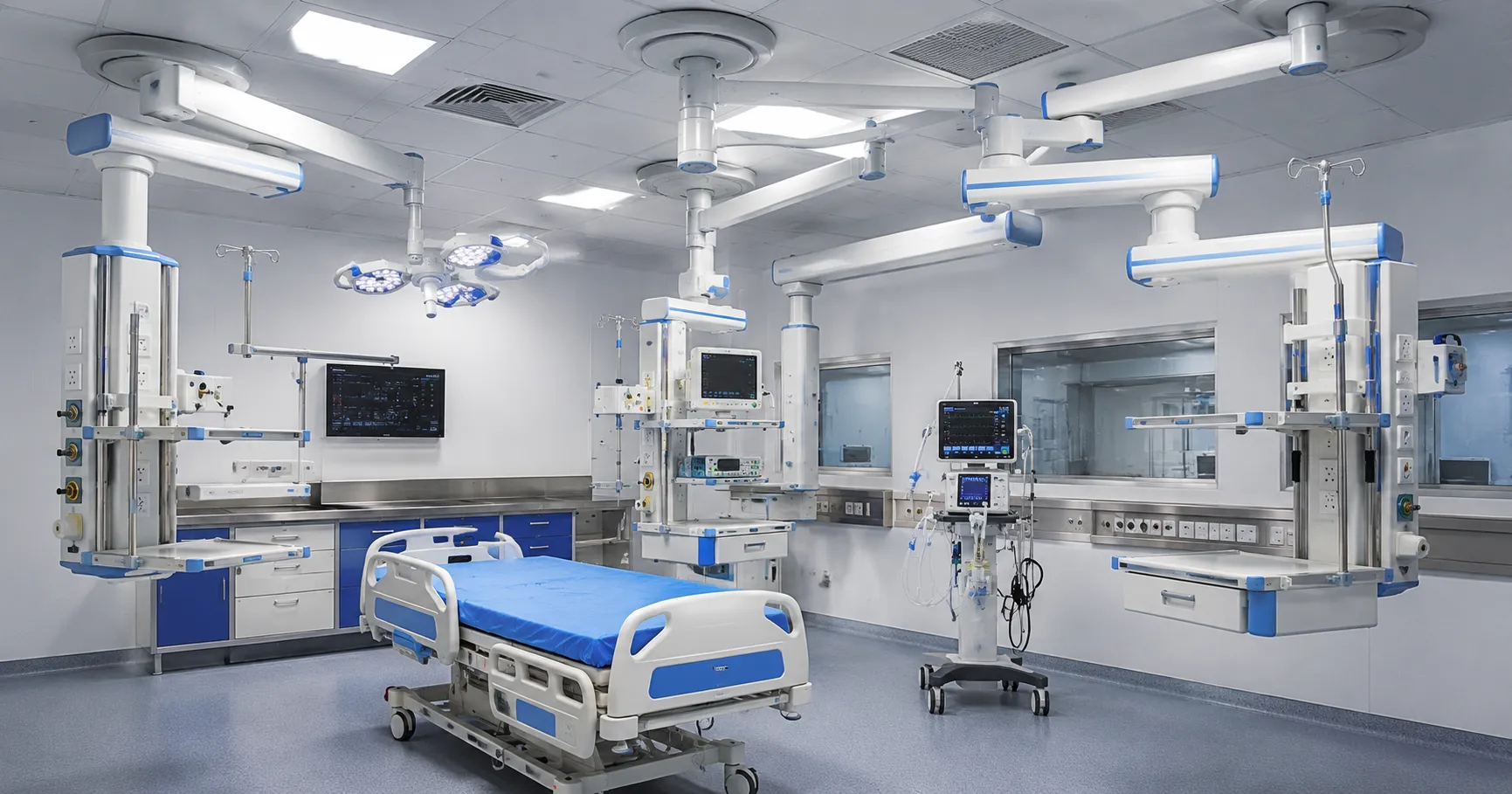
Ceiling-mounted pendants are advanced hospital infrastructure systems designed to organise medical gas, electrical supply, and life support equipment above ICU and operating room patient care areas.
They improve workflow efficiency, reduce floor congestion, and enhance patient safety by keeping critical medical devices within immediate reach of healthcare professionals.
For hospital buyers' services teams, selecting the right system is essential for improving ICU efficiency, surgical performance, and long-term infrastructure reliability.
This article explains working principles, clinical applications, and technical considerations for ceiling-mounted pendant systems.
Clinical Role And Workflow Impact
Centralised Utility Systems — Ceiling-mounted pendants integrate medical gas, electrical, and monitoring systems into a single overhead structure for ICU efficiency.
Improved Workflow Efficiency — Equipment remains easily accessible to healthcare staff during emergency procedures.
Reduced Infection Risk — Removing floor-based equipment improves cleaning efficiency and infection control in clinical environments.
Faster Emergency Response — Life-support systems can be accessed instantly in critical care situations.
ICU And Operating Room Applications
ICU Infrastructure Systems — Supports ventilators, monitors, and infusion pumps for continuous patient care delivery.
Operating Theatre Systems — Provides structured support for anaesthesia, surgical, and monitoring equipment in sterile environments.
Hospitals sourcing through Verified Global Medical Equipment business suppliers receive certified systems with installation and compliance support.
Emergency Department Systems — Enable rapid access to oxygen, suction, and monitoring equipment during trauma care situations.
Technical Structure And Design Factors
Load-bearing design — Engineered to support multiple medical devices safely without structural instability.
Rotational Flexibility — Multi-arm systems allow precise positioning of equipment for different surgical procedures.
Integrated Gas Systems — Oxygen, vacuum, and air supply are built into pendant structures for safe distribution.
Modular Configuration — Allow customisation based on ICU and operating theatre requirements.
Procurement Strategy And Hospital Planning
Ceiling-mounted pendants are long-term investments in hospital infrastructure that directly impact ICU efficiency, surgical workflow, and patient safety outcomes in modern healthcare environments.
Total cost evaluation approach — Hospitals must consider installation, maintenance, upgrades, and erl thane lifecycle services rather than only the initial purchase cost.
Vendor reliability and technical support — Trusted suppliers provide installation guidance, commissioning support, and long-term maintenance services for critical hospital environments.
Hospitals working with medical equipment businesses advertise that reach international procurement teams benefit from standardised deployment, payment, and technical support, as well as improved system reliability.
Compliance and certification requirements — Systems must meet medical gas safety standards, electrical safety norms, and structural load certifications before clinical deployment.
Future expansion capability — Modular pendant systems allow hospitals to expand ICU and operating room infrastructure without full system replacement.
Healthcare institutions often ensure consistency by establishing long-term medical equipment supply business partners across multiple departments.
Maintenance And Operational Reliability
Regular maintenance ensures ceiling-mounted pendants remain safe, stable, and fully functional throughout their operational lifecycle in high-demand clinical environments.
Mechanical system inspection — Rotating arm joints and structural supports must be checked periodically for wear and alignment stability.
Gas and electrical safety checks — Oxygen, vacuum, air, and electrical systems require routine testing to ensure uninterrupted clinical performance.
Cleaning and infection-control maintenance — Pendant systems must withstand frequent disinfection to maintain hygiene standards, i.e., ICU and surgical environments.
Poor maintenance planning can significantly increase downtime and operational risks in critical care hospitals.
Global Demand And Healthcare Infrastructure Growth
Demand for ceiling-mounted pendants continues to increase as hospitals modernise ICU and surgical infrastructure systems worldwide.
Expansion of critical care facilities — Growing ICU capacity and surgical demand are driving the adoption of advanced pendant systems in new hospital projects.
Shift toward modular hospital design — Healthcare infrastructure is increasingly adopting flexible systems that support evolving medical technologies and workflows.
International procurement trends — Buyers prioritise certification, installation support, spare parts availability, and long-term service reliability.
One key insight is that installation quality often has a greater impact on performance than equipment specifications alone.
Final Thoughts
Ceiling-mounted pendants are essential components of modern hospital infrastructure, improving ICU efficiency, reducing floor clutter, and centralising critical medical utilities above patient care areas.
Selecting the right system requires careful evaluation of load capacity, modular flexibility, compliance standards, and maintenance support to ensure long-term reliability in healthcare environments.
Disclaimer
Medigear.uk is a global medical equipment supplier, exporter, and distributor providing information about healthcare products, hospital infrastructure systems, and medical devices for general informational and educational purposes only. The content published on Medigear.uk is not intended to replace professional medical advice, diagnosis, or clinical judgment. Healthcare professionals, biomedical engineers, and procurement specialists are responsible for evaluating and selecting medical equipment based on clinical requirements, safety standards, and regulatory compliance applicable in their region. Medigear.uk does not provide medical treatment, prescriptions, or clinical decision-making services, and all reliance on the information provided is strictly at the user's own discretion.