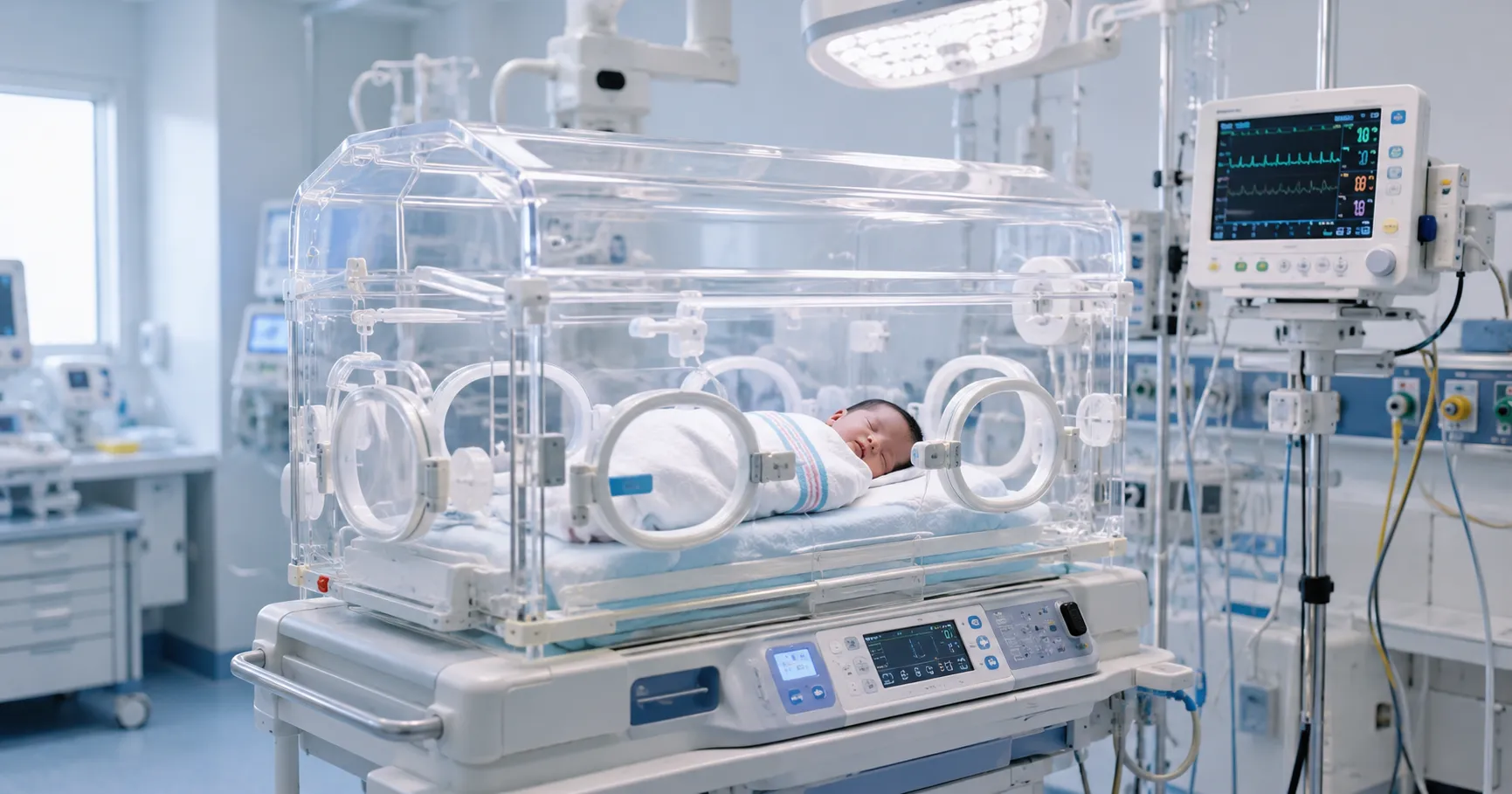
Infant incubators are essential neonatal care systems designed to support premature or medically fragile newborns in hospital intensive care environments by providing controlled temperature, humidity, and oxygen regulation.
In a global healthcare procurement environment, hospital and clinic buyers' services teams responsible for sourcing clinical equipment must evaluate incubator reliability, safety performance, and long-term operational stability before deployment in neonatal intensive care units.
Modern neonatal systems are no longer simple warming devices but rather advanced life-support environments that integrate monitoring sensors and controlled atmospheric conditions to support critical newborn care.
This article explains the clinical functions, technical requirements, procurement considerations, and operational challenges associated with infant incubators in global healthcare systems.
Clinical Role In Neonatal Care Environments
Thermal Stability Regulation — Infant incubators maintain a stable body temperature for newborns who cannot regulate their own body temperature naturally. This prevents hypothermia and supports metabolic stability in early life stages.
Oxygen Environment Control — Controlled oxygen delivery ensures that newborns with respiratory distress receive safe, monitored oxygen support. This reduces the risks of oxygen toxicity or deficiency.
Humidity Management System — Maintaining proper humidity levels prevents dehydration and supports skin development in premature infants. Facilities often adjust humidity levels based on gestational age.
Infection Protection Barrier — The enclosed structure reduces exposure to external pathogens. Experienced clinical staff often emphasise infection control as a major survival factor in NICU environments.
Global Deployment Settings In Neonatal Units
Infant incubators are deployed across diverse healthcare environments, including tertiary hospitals, district hospitals, and specialised neonatal care centres worldwide.
In neonatal intensive care units, ts they are used for continuous monitoring of premature and high-risk newborns requiring life-support stabilisation on systems.
In a maternity hospital, the provider provides post-delivery care for infants requiring observation and thermal regulation.
Emergency paediatric care units provide immediate stabilisation for newborns requiring urgent intervention before transfer to the NICU.
Facilities sourcing through verified global medical equipment business suppliers benefit from equipment calibration certification and compliance documentation aligned with regional healthcare safety standards.
Technical Characteristics And Specification Considerations
Temperature Control Accuracy Systems — Precise thermal regulation ensures newborns remain within safe physiological temperature ranges. Small variations can significantly impact neonatal stability in clinical environments.
Integrated Monitoring Sensors — Advanced incubators include sensors that track heart rate, oxygen saturation, and temperature in real time. This allows early detection of physiological instability.
Airflow Filtration Technology — HEPA filtration systems maintain sterile airflow within the incubator chamber—this reduces the risk of infections in immunocompromised newborns.
Alarm And Safety Systems — Built-in alarms notify staff of temperature, oxygen, or system fluctuations. In practice,ce procurement teams often prioritise alarm responsiveness over advanced interface features.
Operational Insight — Experienced clinical supply managers typically evaluate how specification accuracy translates into real-world neonatal stability rather than focusing solely on technical numbers.
Procurement Evaluation Guidance
Infant incubator procurement requires careful evaluation of lifecycle costs, reliability, and clinical compatibility across hospital environments.
Total Cost Of Ownership Consideration — Procurement teams must evaluate maintenance, calibration, replacement parts, and training costs over time, rather than just the initial purchase price.
Vendor Evaluation Standards — Manufacturers should be assessed based on compliance certification service network and availability of spare components across international markets.
Business advertisements by distributors and manufacturers to global healthcare buyers have increasingly shifted toward providing performance validation data to meet hospital procurement expectations.
Training and System Integration — Staff training ensures proper usage and reduces operational risk in neonatal units. Equipment compatibility with existing ICU systems is also a key evaluation factor.
Healthcare networks managing procurement across multiple facilities often find that establishing long-term medical equipment supply business partners improves consistency and reduces operational downtime.
Maintenance And Equipment Service Life
Regular maintenance is essential for ensuring incubators operate safely and consistently in neonatal intensive care environments.
Calibration and Sensor Maintenance — Temperature and oxygen sensors require routine calibration to maintain accuracy in clinical use. Even minor deviations can affect neonatal safety outcomes.
Air Filtration Maintenance Cycles — Filters must be inspected and replaced periodically to maintain sterile airflow. This is especially important in high-volume NICU units.
Electrical and Alarm System Testing — Regular testing ensures alarm systems respond correctly to environmental fluctuations. Hospitals in resource-limited regions often face higher lifecycle costs due to limited access to services.
Global Demand And International Sourcing
Demand for infant incubators continues to increase globally due to rising neonatal care standards and expanding ICU infrastructure across healthcare systems.
Procurement teams across regions prioritise certified systems with proven reliability in both high-income and developing healthcare environments.
International sourcing decisions often involve trade-offs between new and refurbished systems based on budget availability and clinical urgency.
Export documentation lead times and after-sales service capability significantly influence procurement decisions in cross-border healthcare equipment trade.
Final Thoughts
Infant incubators are essential neonatal care systems that provide controlled temperature, humidity, and oxygen support to ensure newborn safety and stability in critical care environments.
Their role in improving neonatal survival rates makes them a vital part of modern NICU infrastructure.
Selecting the right incubator system requires careful evaluation of safety features, clinical performance, and long-term service support.
Disclaimer
Medigear.uk is a global medical equipment supplier, exporter, and distributor providing information about medical devices, healthcare infrastructure, and hospital equipment for educational and informational purposes only. The content published on Medigear.uk is not intended to replace professional medical advice, diagnosis, or clinical judgment. Healthcare professionals, biomedical engineers, and procurement teams are responsible for selecting and using medical equipment in accordance with clinical requirements, regulatory standards, and institutional policies. Medigear.uk does not provide medical treatment, clinical recommendations, or diagnostic services, and any reliance on the information provided is strictly at the user’s own discretion.