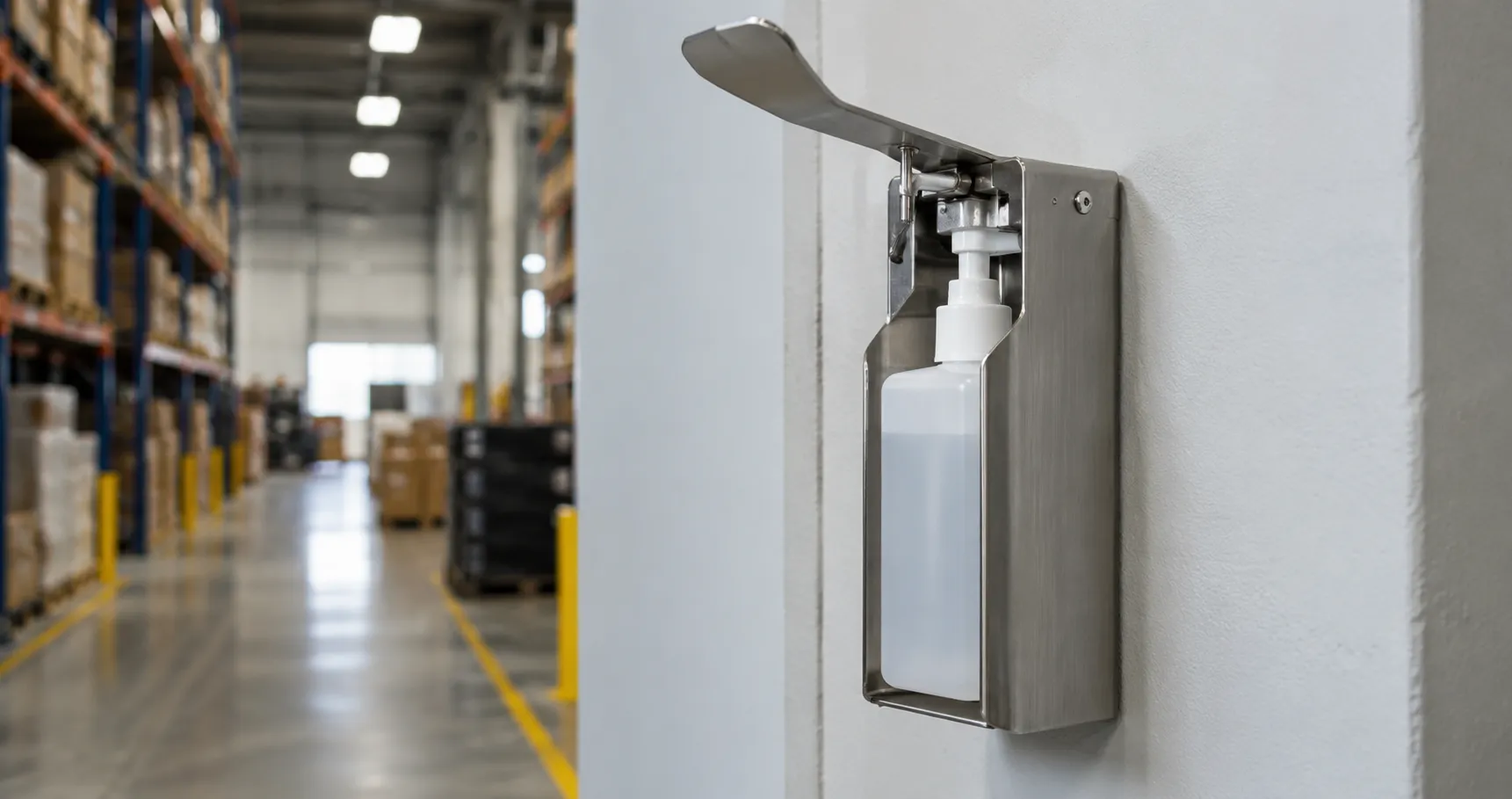
An elbow-operated dispenser is a wall-mounted soap or handrub dispenser fitted with a long lever arm that you press with your elbow or forearm instead of your hand. The point is to break a contamination route: on an ordinary push-button dispenser, every user presses the same small pad with fingers that have just handled a patient, a trolley or a door, and the next person's clean hands meet that surface. Moving the contact to the elbow keeps hands off the one part everyone touches, so the dispenser stops being a shared touch point.
For an infection-control or estates buyer, the elbow lever is a low-cost, battery-free way to make dispensing near hands-free at a clinical wash station. It sits between the ordinary push button and a full sensor unit, and it is the lever mechanism, not the bottle inside, that defines it.
How the long lever cuts hand contact
The mechanism is simple leverage. A long arm extends out and up from the pump; pressing it downward with the forearm or the point of the elbow drives the same pump that a finger would otherwise push, delivering a measured dose. Because the arm is long, a small, comfortable elbow movement produces enough travel to dispense, and the user's hands stay open and clear beneath the nozzle to catch the product. Nothing the hand has touched is touched again, which is the whole design intent at a hand-wash point where the next step is a clinical procedure.
The cross-contamination problem it solves
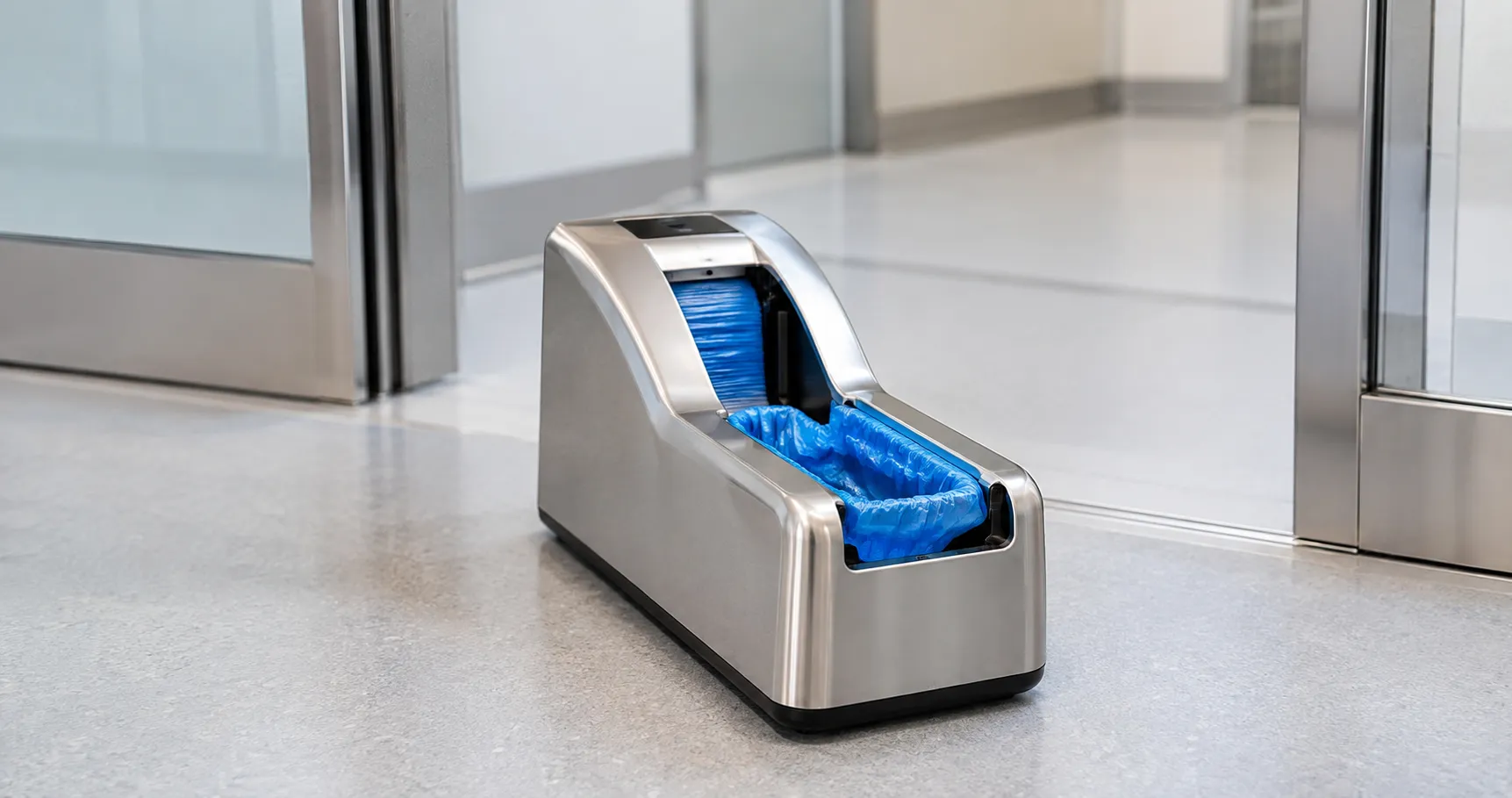
Hand-hygiene dispensers are, paradoxically, high-touch objects. A conventional button is contacted by dozens of pairs of hands a day, many of them not yet washed, making the pad a classic fomite that can pass organisms from one user to the next. The elbow lever removes that hand-to-hand relay by design: the actuator is met only by a sleeve or forearm, and hands complete their hygiene without recontaminating the dispenser they just used. It is the same reasoning that drives hands-free taps, applied to the product side of the basin. The same logic applies to automatic shoe cover dispensers, which fit an overshoe without a hand ever gripping a dirty sole. The Health and Safety Executive treats hand hygiene and the surfaces that support it as workplace infection controls.
Elbow lever versus sensor and push-button dispensers
Three dispenser actuations are common, and each has a place. A push-button dispenser is the cheapest but is a shared touchpoint. A sensor dispenser is fully no-touch but needs power or batteries and adds electronics that can fail or run flat. Some sensor units double as automated dispensers that track sanitiser use for hand-hygiene auditing. An elbow-operated dispenser is the middle path: no electronics, nothing to charge, robust and cheap, while still keeping hands off the actuator. The trade-off is that it needs a deliberate arm movement and enough space around the unit for an elbow, so it suits dedicated clinical wash stations and scrub areas more than a cramped public washroom.
Lever length, leverage and mounting height
Getting the ergonomics right decides whether staff actually use the elbow rather than reverting to a finger. The lever must be long enough to provide easy leverage and stand clear of the wall so a forearm fits behind it, and the unit must be mounted at a height where pressing with the elbow feels natural rather than awkward. Too high and users push with a fingertip; too low and it is uncomfortable. The nozzle should project far enough that the dose lands on open hands held below, clear of the lever. These small details are what make the hands-free intent hold up in daily use.
What it dispenses and bottle compatibility
Elbow dispensers deliver the same range of products as other clinical dispensers: liquid soap, antiseptic detergents such as chlorhexidine or povidone-iodine, and alcohol-based handrubs. The unit is specified around the bottle or cartridge it accepts, commonly 500 ml and 1000 ml formats, and around the dose the pump delivers. As with any dispenser, the product must match the unit for viscosity, and alcohol handrub versions must meet flammable-content siting requirements. Sealed-cartridge elbow units combine the touch-free lever with a closed refill, pairing two infection-control advantages in one fitting.
Cleaning the dispenser itself
Even a near-hands-free dispenser is a clinical surface and gets cleaned on the ward's schedule. A smooth ABS or stainless casing and a wipeable lever let staff disinfect it without catching on fiddly detail, and a level window shows when the refill is due so a unit is never left empty at a critical wash. Because the actuator is a lever rather than electronics, there is little to go wrong beyond the pump and the return spring, which keeps upkeep minimal. National infection-prevention guidance from the National Institute for Health and Care Excellence (NICE) frames why these touch points are cleaned and managed as part of standard precautions.
Where elbow dispensers belong
The elbow lever comes into its own at dedicated clinical wash points: hand-wash basins on wards, clinical rooms, dental surgeries, laboratories and the wash stations feeding theatre and treatment areas. Anywhere staff wash frequently, and the next action is clinical, cutting the dispenser touch point matters. In lower-risk public washrooms, a simple button or sensor may work better, and at surgical scrub troughs the sink's own hands-free taps pair naturally with elbow or sensor dispensers, sitting alongside surgical glove dispensers for clean glove access. Choosing per location, rather than fitting one type everywhere, is the sensible approach.
Fitting elbow dispensers into a hand-hygiene layout
An elbow dispenser rarely works alone; it is one element of a wash station designed around keeping hands clean. Paired with a hands-free tap and sited so the user can wash, dose and dry without touching a shared surface, it closes the loop that a touched button would otherwise leave open. Spacing matters too, because the lever needs clear air around it for a forearm, so units are not crammed against a wall return or a paper-towel holder. Where several dispensers sit together, for soap, antiseptic and handrub, consistent lever height and orientation help staff use them without thinking. Treating the elbow dispenser as part of the basin's layout, rather than a fitting bolted on afterwards, is what makes the touch-free benefit real in the flow of a busy clinical wash.
Specifying an elbow-operated dispenser
-
Confirm the lever is long enough for easy elbow leverage and stands clear of the wall for a forearm.
-
Check the mounting height makes elbow use natural, so staff do not revert to a fingertip.
-
Ensure the nozzle projects clear of the lever so the dose lands on open hands below.
-
Match the unit to your bottle or cartridge size, typically 500 ml or 1000 ml, and the product viscosity.
-
Prefer a sealed-cartridge version when you want touch-free actuation and a closed refill.
-
Specify a smooth, wipeable ABS or stainless casing with a visible level indicator.
-
For alcohol handrub, confirm the unit suits flammable-content siting requirements.
Running costs
An elbow dispenser is inexpensive to own and run. With no batteries or sensors, the only moving parts are the lever, pump, and return spring, so maintenance is minimal and requires no power. The recurring cost is the product and, for cartridge versions, the sealed refill that brings a fresh pump each time. Standardising on a small number of elbow and cartridge types across a site simplifies stockholding and keeps the right refill matched to the right unit, which is where hidden costs otherwise creep in.
The final word
An elbow-operated dispenser is a simple, durable way to remove a hidden fomite at the clinical basin, keeping just-washed or about-to-wash hands off the surface every colleague touches, without the electronics of a sensor unit. Specify the lever length, height, and nozzle carefully; pair it with the right product and, ideally, a sealed cartridge; and fit it where hand hygiene is frequent and the stakes are high. To specify elbow dispensers and matched consumables, contact the MediGear buyers' team for the right configuration.
Disclaimer
This article is for informational purposes only. MediGear (medigear.uk) publishes it for general information and procurement guidance; it is not clinical, diagnostic, treatment, technical, engineering, legal, or regulatory advice, nor a product endorsement, guarantee, or substitute for professional assessment. MediGear does not provide medical consultations. Buyers should consult their clinical, biomedical, estates, and regulatory contacts and the manufacturer's documentation, and independently verify all specifications, certifications, compatibility, and suitability before purchase. Specifications, certifications and availability are correct at the time of publication and may change without notice. MediGear is a medical-equipment distributor and does not sell medicines or pharmaceutical products.