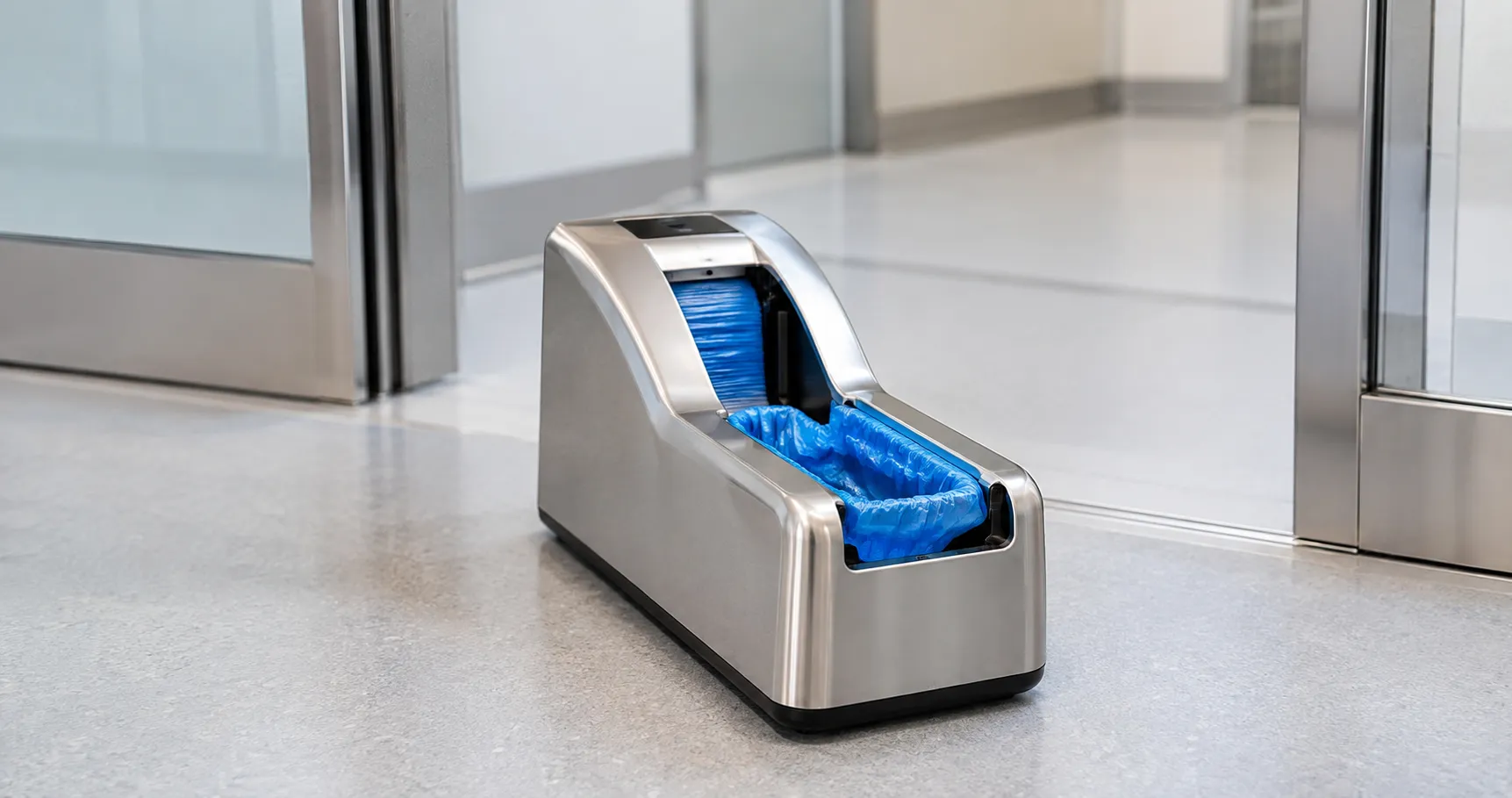
A shoe cover dispenser is a floor-standing machine that automatically wraps a disposable overshoe around a shoe: the user places a foot into the applicator, presses down, and a film cover stretches over the sole and upper without anyone bending, balancing, or touching the cover by hand. That last point is the whole reason it exists. Pulling plastic overshoes on by hand means gripping the dirty sole, contaminating the fingers, and then touching door handles, rails and equipment — the machine breaks that transfer route.
This article is for buyers choosing dispensers for a cleanroom entrance, laboratory, imaging suite, care-home threshold, or any controlled area where visitors and staff keep their own shoes. It explains the two main dispenser types, the overshoe films they use, the cross-contamination logic, and the practical specifications to weigh before ordering.
Automatic applicators versus simple dispensers
There are two dispenser types, and they are not interchangeable. An automatic overshoe applicator is a mechanism loaded with a cassette or roll of specially folded covers; stepping in and pressing down triggers the machine to open a cover and stretch it onto the shoe hands-free. It suits high-traffic thresholds and any area where hand hygiene is required. A manual overshoe dispenser is simpler — a box, wall unit or stand that presents a stack or roll of loose overshoes for the user to pull on themselves. It is cheaper and needs no maintenance, but it reintroduces the very hand-to-sole contact the exercise is meant to avoid. Hence, it suits lower-risk areas or places where hand hygiene follows immediately.
The cross-contamination route it interrupts
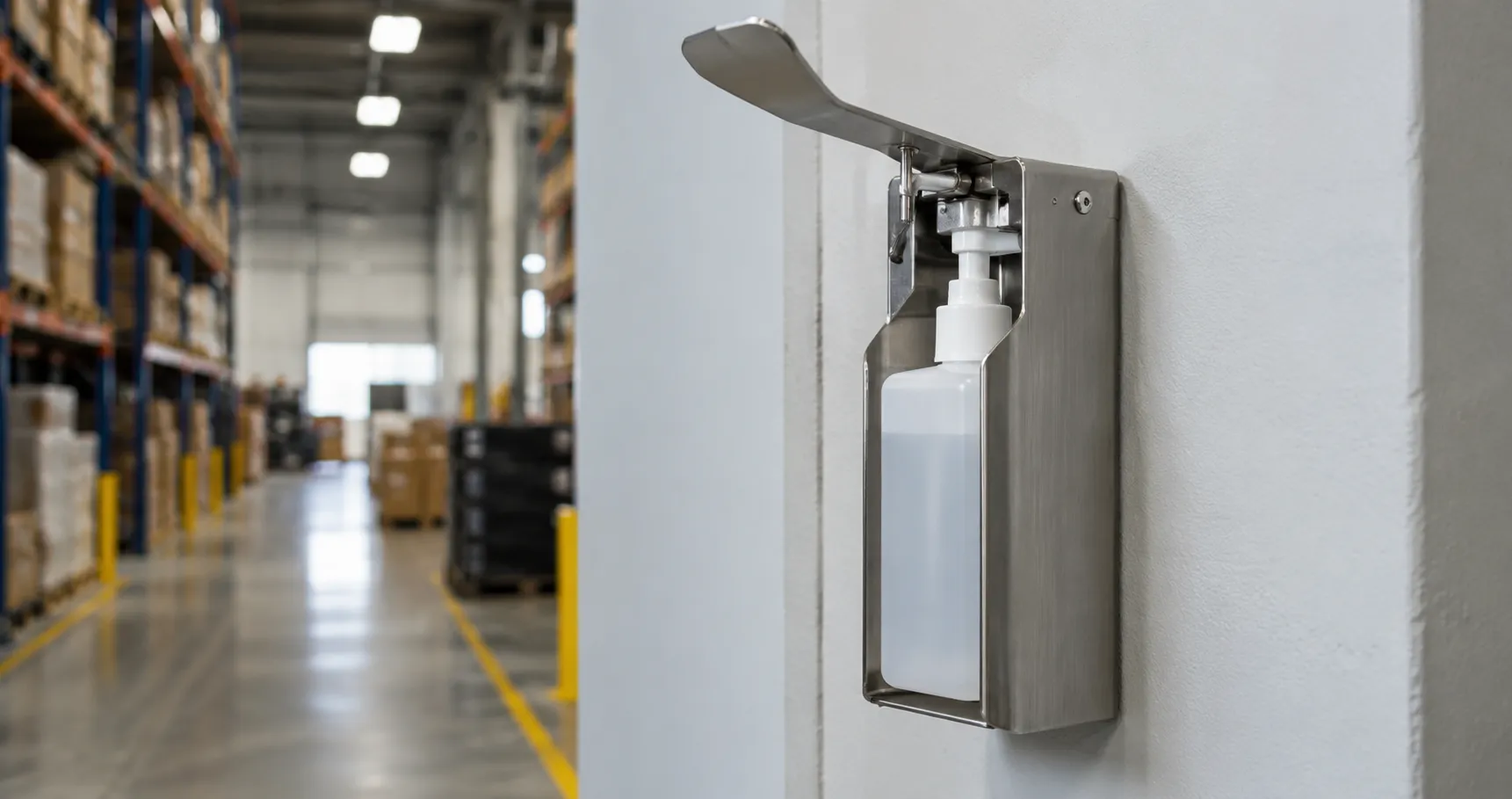
Footwear carries a surprising load of microorganisms and floor soil into a facility, and the moment you put on a shoe is when your hands get contaminated. In a manual process, a person balances on one leg, grabs the shoe, and drags a thin film over it—hands now hold whatever was on the sole, and the next thing they touch spreads it. An automatic applicator removes hand contact entirely, so the barrier goes on without creating a new hazard. The dispenser is not a substitute for hand hygiene or for a proper changing protocol; it is one controlled step, and its value depends on siting it at the threshold before the clean zone begins rather than somewhere staff have already walked through. Pair it with the hand-hygiene soap dispensers at that threshold — ideally elbow-operated units that keep hands off the actuator — so hands are decontaminated as well as shoes.
Overshoe films, capacity and machine footprint
The consumable is the overshoe itself. Common materials are polyethene, including more durable CPE film, with heavier non-woven or laminated covers where more grip or tear resistance is needed. For automatic applicators, the covers must match the exact cassette or fold the machine is designed for; cross-brand covers usually will not feed. Check anti-slip texturing on the sole face, because a smooth plastic film on a hard floor is itself a slip risk. Capacity per load varies widely; some entrance bands benefit from a high-count cassette so it doesn't need reloading throughout; the footprint matters at a narrow threshold, as does whether the unit is free-standing on a weighted base or wall-anchored, and how stable it is when someone presses down with body weight.
Regulation, slip risk and hygiene claims
An overshoe applicator is powered or mechanical work equipment rather than a medical device, so it does not carry medical-device marking; the machine should still meet general product-safety and, where powered, machinery-safety requirements with UKCA or CE marking. The biggest risk is falls- slip-resistant, textured soles and keep floors dry. Treat any supplier claim that overshoes deliver an infection-control benefit with care and check it against your own protocols and NHS infection-prevention practice; overshoes primarily control floor soil and visible contamination, and evidence for wider benefit is context-dependent.
Where dispensers make sense, and where they do not
Overshoe dispensers earn their keep at thresholds where people keep their own shoes and floor cleanliness matters: cleanroom and laboratory entrances, imaging and endoscopy suites, care-home and domiciliary doorways, pharmaceutical and food-production anterooms, and veterinary practices. They are common at the entrance to areas where a full change of footwear is impractical but tracked soil is unwelcome. They add little where a setting already mandates dedicated theatre shoes and a proper changing protocol. There, overshoes over street shoes are a weaker control than a genuine footwear change, and a boot washer or dedicated theatre clogs do more. Be honest about your situation: buying an applicator for a zone that really needs a changing room is spending on the wrong control.
Keeping the dispenser and its area clean
The dispenser sits in a transition zone that sees constant traffic, so it and the floor around it need a cleaning routine. Specify a wipeable housing that can be disinfected on the ward-cleaning round, and check that the loading mechanism can be cleared and cleaned without dismantling. Used overshoes are another consideration: site a lined waste bin at the exit so covers are removed and binned as people leave the clean zone, not carried back out. A threshold that also offers hand sanitiser, ideally an automated dispenser that tracks sanitiser use, reinforces the doffing step as people leave. Discarded film on a smooth floor is both a slip and a housekeeping problem, so the doffing point deserves as much thought as the donning point. A tidy, well-serviced dispenser reinforces the behaviour you are trying to embed; a jammed or grubby one gets bypassed.
Choosing a shoe cover dispenser: the checklist
-
Applicator or manual — automatic hands-free machine for high-traffic or clean-zone thresholds; manual dispenser only where hand hygiene follows.
-
Cover compatibility — confirm the machine takes a UK-stock cassette and that refills are no longer discontinued.
-
Film type and grip — PE for light use, CPE or laminated for durability, with anti-slip sole texture as standard.
-
Capacity per load — enough covers for a full day at that entrance without midday reloading.
-
Stability — weighted base or wall anchor that stays put under a full press; footprint that fits the threshold.
-
Cleanability — wipeable housing that can be disinfected on the ward-cleaning round.
-
Conformity — UKCA/CE where powered, plus a Declaration of Conformity from the supplier.
Consumables and lifetime cost
With these units, the machine is minor, and the covers are the real budget line. Work out daily footfall, multiply by the cover cost, and that annual figure dwarfs the applicator itself, so a machine locked to expensive proprietary refills can be a false economy. Confirm the price per thousand covers, the pack formatorage space needed, and refill lead time. B that heavier CPE or laminated covers cost more per unit but tear less, so a cheaper film that splits on the first step becomes a false economy once you count wasted covers. Automatic applicators add a small maintenance element — the feed mechanism and any spring or motor — so ask about spares and typical service life. A robust applicator paired with fairly priced, well-stocked covers is the combination.
A sensible way to choose
Match the dispenser to the risk at the door. A clean-zone or high-traffic threshold justifies a hands-free applicator so nobody contaminates their fingers on a sole; a low-risk entrance may need nothing more than a manual stand with hand hygiene alongside. Whichever you pick, tie it to cover availability, slip-safe soles and easy cleaning, and site it before the clean area starts. MediGear's buyers can help you compare applicators and cover contracts, or you can contact us to discuss the right threshold setup.
Disclaimer
This article is for informational purposes only. MediGear (medigear.uk) publishes it for general information and procurement guidance; it is not clinical, diagnostic, treatment, technical, engineering, legal, or regulatory advice, nor a product endorsement, guarantee, or substitute for professional assessment. MediGear does not provide medical consultations. Buyers should consult their clinical, biomedical, estate, and regulatory contacts and the manufacturer's documentation, and independently verify all specifications, certifications, compatibility, and suitability before purchase. Specifications, certifications and availability are correct at the time of publication and may change without notice. MediGear is a medical-equipment distributor and does not sell medicines or pharmaceutical products.