Difficult airway equipment is only useful if it is present, charged and familiar. A department with an excellent video laryngoscope locked in a cupboard, used twice a year, is less prepared than one with simpler equipment that every clinician has handled recently.
The ten laryngoscope types below cover routine and difficult airway work. Each entry explains its role and what to confirm before purchase.
Availability and familiarity come first
Airway equipment should be stored where airway emergencies occur, with a defined contents list and a documented check. Decide early which devices sit on the difficult airway trolley, who checks them, and how often clinicians practise with them.
Decontamination is the other early decision. Reusable blades need a validated reprocessing route, while single-use devices shift the requirement to stock control. Mixed approaches work, but only with clear rules on which is used where.
The ten laryngoscope types
1. Reusable curved blade laryngoscopes
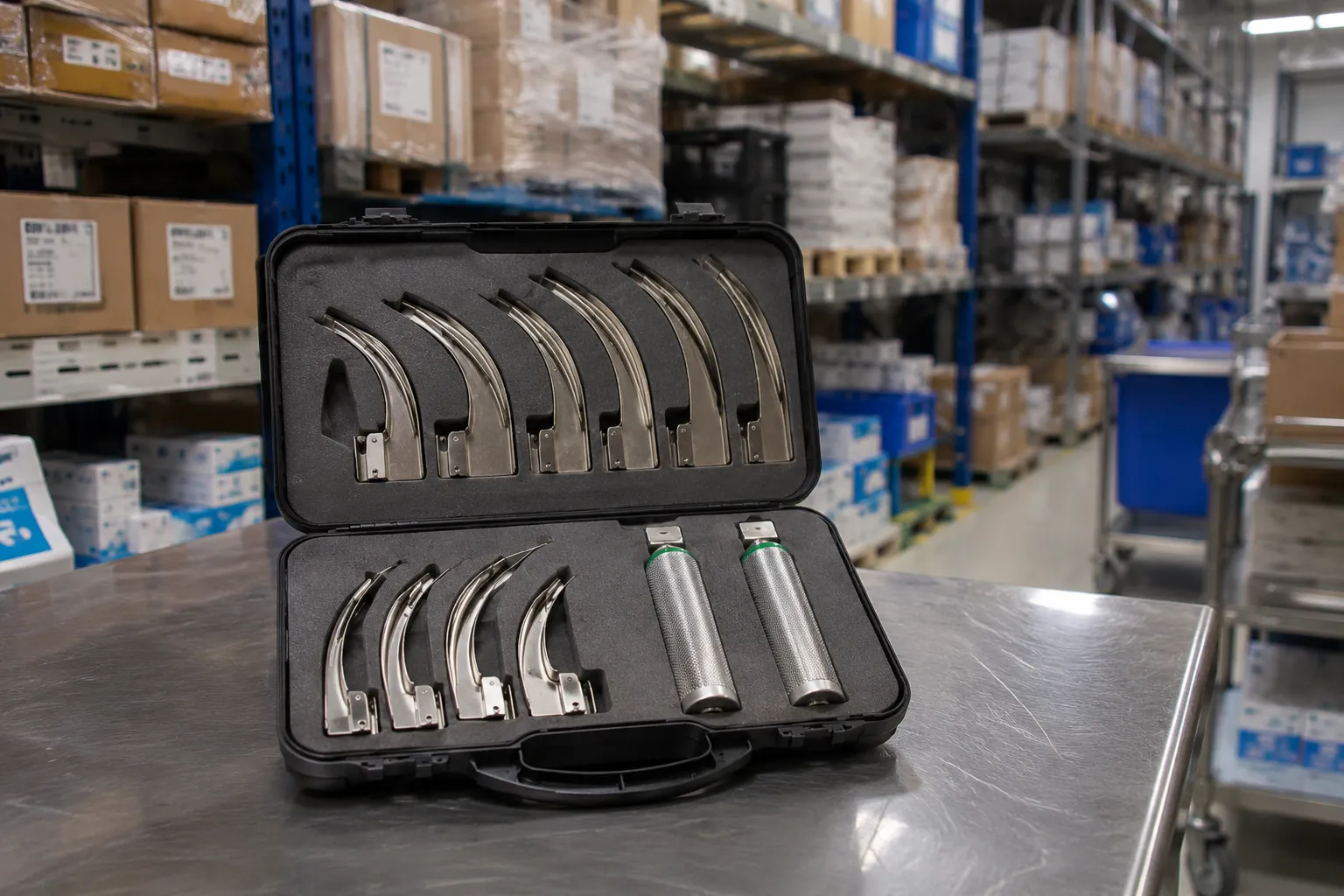
The familiar curved blade design used for routine direct laryngoscopy, available in several sizes for different patients.
2. Reusable straight blade laryngoscopes
Straight blades are favoured in some paediatric and neonatal practice, offering a different approach to epiglottis handling.
3. Fibre-optic illumination handles and blades
Light is carried through a fibre bundle from a handle-mounted source, providing more consistent illumination than bulb-on-blade designs.
4. Single-use metal blades
Rigid single-use blades that remove reprocessing while retaining the feel of a metal blade. Stock rotation and size availability need to be managed
Lighter disposable blades used with a compatible handle. Confirm the fitting standard and check performance with the handles the department holds.
6. Video laryngoscopes with standard-geometry blades
Provide a camera view that retains the blade shape, allowing both direct and indirect views during the thin attempt.
7. Video laryngoscopes with hyperangulated blades
Steeper blade curvature for views that direct laryngoscopy cannot achieve. They usually require a stylet and a specific technique, so training is essential.
8. Channelled video laryngoscopes
Incorporate a guide channel that directs the tube towards the larynx, which some clinicians prefer for particular airway situations.
9. Portable video devices with integrated screens
All-in-one units with the display on the handle, suited to transfers, resuscitation trolleys and areas without a monitor stand.
10. Flexible intubation endoscopes
Steerable scopes used for awake or difficult intubation under appropriate conditions. They require dedicated training and a reprocessing route matching flexible endoscope requirements.
Single-use and reusable in practice
Most departments end up running both. Single-use blades suit resuscitation trolleys and areas where reprocessing turnaround would leave a gap, while reusable instruments remain common in theatre where decontamination is already established. The important part is the rule: staff should know without thinking which device belongs on which trolley, and stock levels for single-use sizes should be checked as part of the same routine that checks batteries.
What to confirm before ordering
-
Blade sizes. Confirm the full size range, including paediatric and neonatal where relevant.
-
Handle compatibility. Check the fitting standard between blades and handles across the fleet.
-
Illumination. Compare light output and consistency, particularly on single-use blades.
-
Screen and recording. Establish screen size, glare performance and whether images can be saved.
-
Battery. Confirm battery type, charge status indication and replacement arrangements.
-
Decontamination. Verify the reprocessing method for every reusable component with your decontamination team.
Training, checks and servicing
Video laryngoscopy is a distinct skill, not simply direct laryngoscopy with a screen—Hyperang—hyperangulated particular practice the tube-within-a-tube delivery sessions into departmental training rather than relying on the device being intuitive.
Difficult airway trolleys require a check covering the device, battery charge, blade sizes, and single-use stock levels. Keep the list short and the check frequent.
For servicing, agree functional checks, battery replacement, camera and screen repair arrangements, electrical safety testing and spare parts. Ensure the department receives published device safety alerts. Hence, so field safety notices reach airway leads promptly.
Blade sizes, handle fittings and single-use stock all need to be confirmed; the trolley is standardised. Availability across reusable and single-use ranges can be checked with verified suppliers.
Final thoughts
Equip for the airways you actually meet and train for the devices you buy. Most departments need reliable direct laryngoscopy in a full-size laryngoscope for the whole team, and flexible capability where the service justifies it. Settle decontamination, trolley checks and training before the equipment arrives.
This article provides general procurement guidance for healthcare organisations. It is not clinical or airway management advice, and it does not replace manufacturer instructions, training or local guidelines.