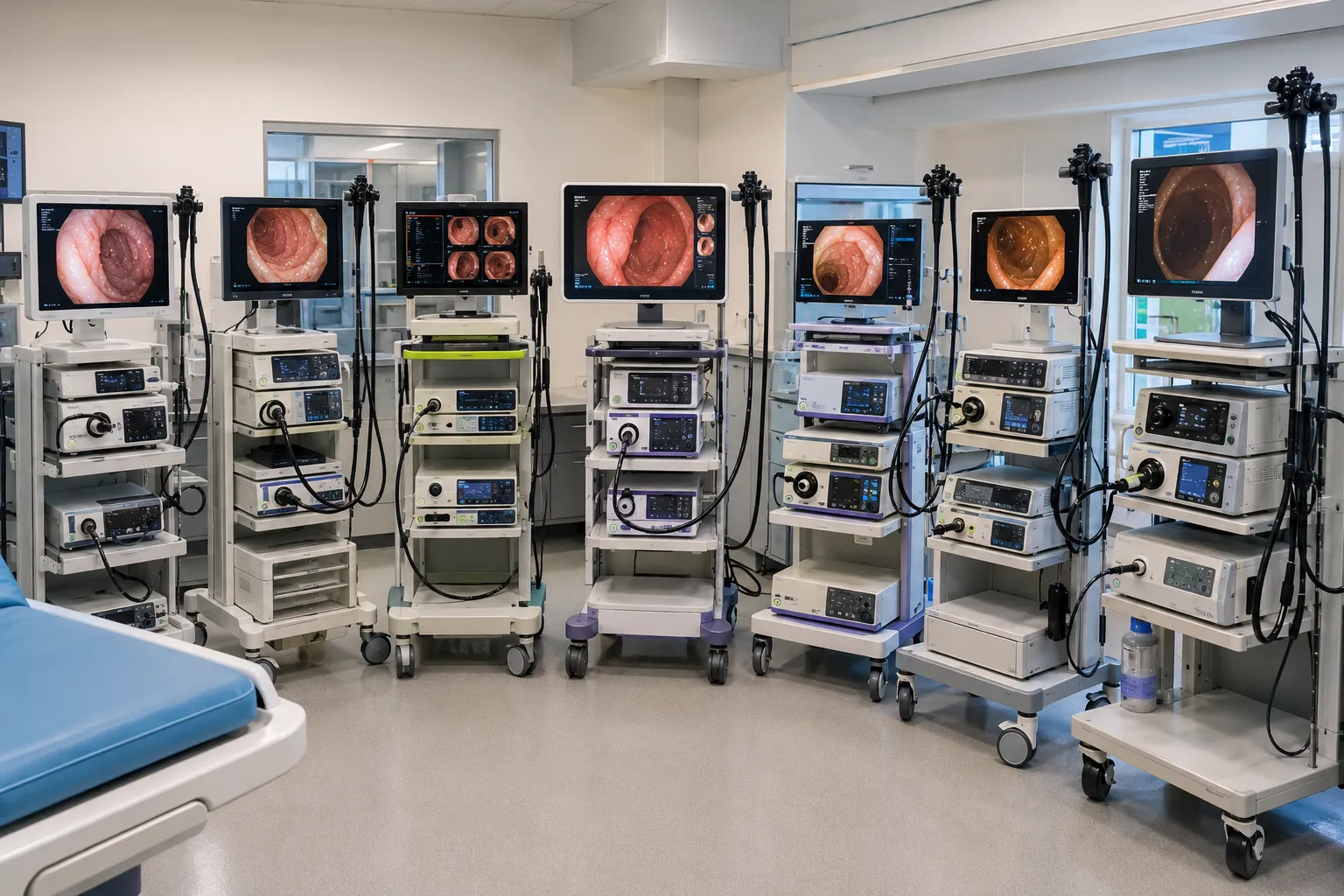
An endoscopy service is a chain, and the scope is only one link. Reprocessing in its entirety- drying and storage, traceability, and technical support determines whether a list runs or stalls. Clinics that specify the tower carefully and leave decontamination until later usually discover the problem on the first busy day.
These ten system elements cover the equipment a gastroenterology clinic assembles. Each entry sets out its role and what to confirm before purchase.
Plan the whole pathway.
Work out the list profile first: procedure types, session length, number of rooms and turnaround expectations. From that, calculate how many scopes are needed to keep lists running while others are in reprocessing, drying or repair. Scope numbers are usually driven by the decontamination cycle rather than the clinical schedule.
Then confirm where reprocessing happens, who staffs it and how instruments move between clean and dirty areas. That layout question shapes almost every other decision.
The ten endoscopy system components
1. Video gastroscopes
Upper gastrointestinal scopes, chosen by working length, insertion tube diameter and channel size. Slim options support alternative access routes where clinically appropriate.
2. Video colonoscopes
Longer scopes with variable stiffness options on many models, supporting easier progression. Channel size matters for suction and therapeutic accessories.
3. Sigmoidoscopes
Shorter instruments for limited lower gastrointestinal examination, useful in screening and outpatient settings.
4. Duodenoscopes
Side-viewing scopes with an elevator mechanism for pancreaticobiliary work. The elevator makes recomplicatesssing more deontamination arrangements must be confirmed in detail.
5. Enteroscopes
Extended-length instruments for deeper small bowel access, often used with an overtube system. These are specialist purchases with specific training needs.
6. Endoscopic ultrasound scopes
Combine endoscopy with ultrasound imaging. They require compatible ultrasound processing equipment, so system compatibility must be verified before ordering.
7. Capsule endoscopy systems
A swallowed capsule with a recorder and review software. Consumable supply and reading time are the practical constraints rather than hardware.
8. Video processors and light sources
The core of the tower, determining image quality and which scope generations are supported. Confirm backward compatibility with any scopes you already hold.
9. Trolleys, monitors and insufflation equipment
The supporting stack, including the monitor, insufflation and irrigation equipment. Cable management and trolley layout affect room workflow more than expected.
10. Reprocessing and storage equipment
Endoscope washer-disinfectors and drying or storage cabinets. Capacity here sets the ceiling on list throughput, so it belongs in the same conversation as the scopes.
Room layout and workflow
Procedure room design shapes daily throughput as much as the equipment does. The tower needs a position that gives the endoscopist a comfortable sightline without stretching cables across walkways, and the nurse assisting needs clear access to accessories and suction. Where scopes leave the room for reprocessing, the route should avoid crossing clean traffic, which is far easier to arrange before installation than afterwards.
Compatibility, traceability and consumables
-
Processor compatibility. Confirm exactly which scope models the processor supports, including older instruments.
-
Washer compatibility. Verify that the washer-disinfector has validated connections for every scope model you hold.
-
Traceability. Establish how each scope, patient and reprocessing cycle is recorded and how records are retrieved.
-
Accessory range. Check channel sizes against bioprobes, forceps, and other accessories in use.
-
Storage. Confirm cabinet capacity and the permitted storage period under local policy.
Training, repair and service cover
Endoscope damage is common, and repairs are a routine part of service operations. Agree in advance how repairs are handled, what turnaround applies, whether loan scopes are provided,d and how damage is assessed. Ask for a clear description of what a repair covers.
Training should include decontamination staff, not just clinicians and nurses. Leak testing, manual pre-cleaning, brushing, and correct loading are the steps where errors can increase infection risk and damage the scope or planned maintenance. Agree intervals for processors, light sources, and washer-disinfectors, along with electrical safety testing, washer validation, and parts availability. Ensure the department receives published device safety alerts so field safety notices reach the service promptly.
Final thoughts
Specify the pathway, not the tower. Scope numbers should reflect the reprocessing cycle, the;washer must match every scope model, tra;eability needs to be workable in practice, and;repair arrangements deserve as much attention as the initial specification. Get those four right and the list runs to time.
This article provides general procurement guidance for healthcare organisations and clinics. It is not clinical advice and does not replace manufacturer instructions or local decontamination policy.