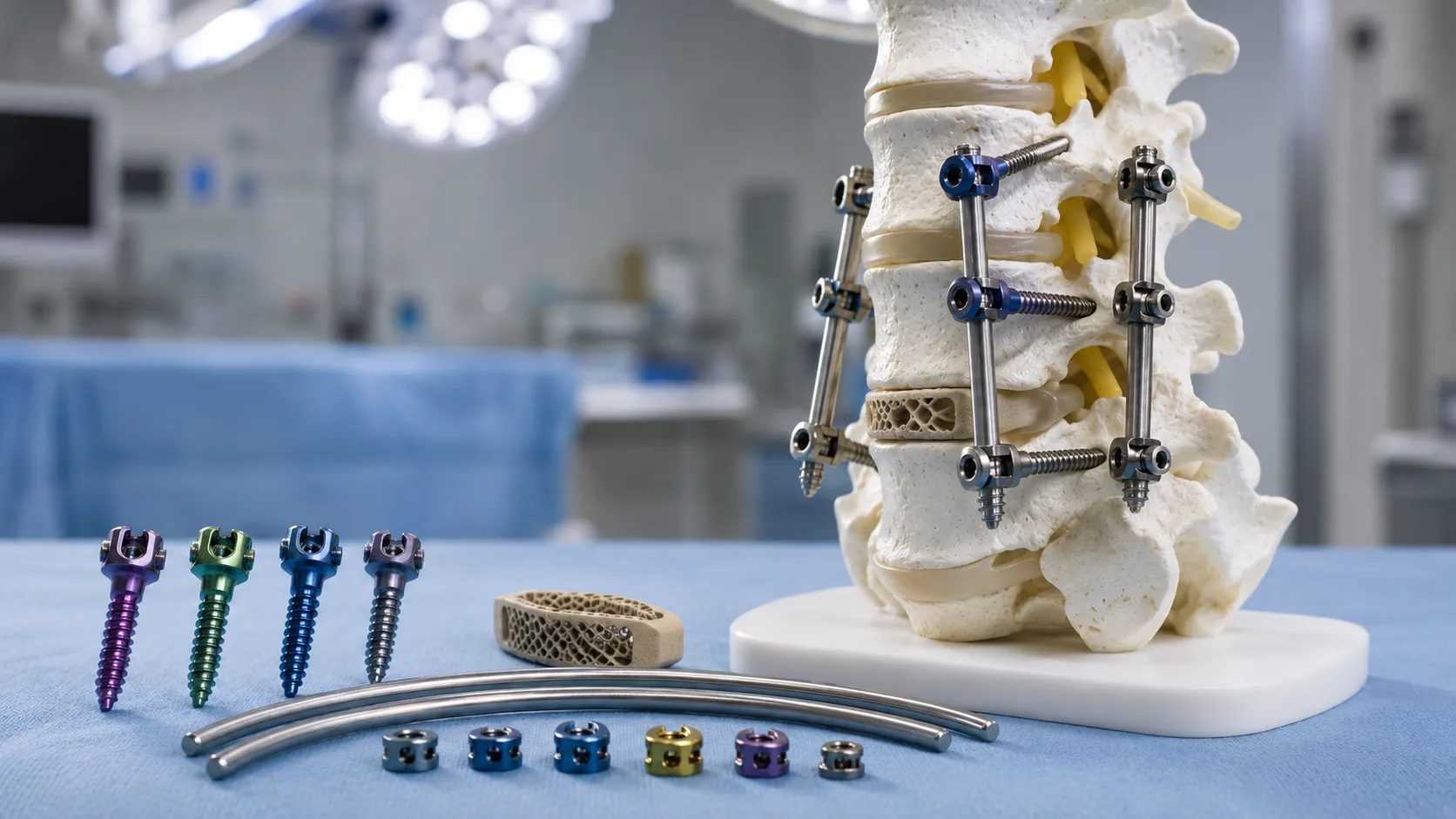
Spinal fusion is a surgical procedure that permanently joins two or more vertebrae into a single solid segment, removing painful movement between them and stabilising the spine. It is used for degenerative disc disease, spondylolisthesis, deformity such as scoliosis, fracture and instability. The fusion is held while bone grows across the segment by a construct of implants, typically screws and rods to lock the vertebrae together and a cage or spacer to replace the disc and carry bone graft.
For a procurement lead or theatre manager, spinal fusion is one of the most implant-intensive and highest-value areas of surgery, spanning pedicle screw systems, interbody cages, graft materials, and the instrument trays that are used. This guide explains the procedure and the implant families involved, and what a buyer should weigh when specifying a spinal system.
Why vertebrae are fused
When movement at a spinal segment is the source of pain or instability, or when deformity or fracture leaves the spine unable to bear load safely, fusing the segment stops the motion. It shares the load through a stable construct. The implants do not themselves cure anything; they hold the alignment steady while the body lays down new bone that bridges the vertebrae into one unit. Solid bony fusion is the goal, and the metalwork is the internal scaffold that makes it possible. This clinical rationale sits behind every implant a buyer stocks.
How a fusion is constructed
The surgeon reaches the spine from the back (posterior), the front (anterior) or the side (lateral), depending on the level and pathology. The disc is often removed, and an interbody cage packed with graft is placed in the disc space to restore height and hold the graft when fusion is desired. Grafts are placed into the vertebrae, most commonly through the pedicles, and connected by rods to lock the segment. Graft material is laid along the bone surfaces. Over months, bone grows through and around the cage and along the graft bed to complete the fusion. The construct must hold rigidly throughout that period.
Pedicle screws and rods
The pedicle screw and rod system is the workhorse of posterior fusion. Screws are driven through the pedicle into the vertebral body, and rods are seated into the screw heads and locked, tying the vertebrae into a rigid frame. Systems differ in screw design (fixed or polyaxial heads that angle to ease rod capture), diameters and lengths to fit different vertebrae, rod material and diameter, and the locking mechanism. Buyers should confirm that the system offers the size range the surgeons need, that screws, rods and connectors are matched within a single validated system, and that the instrument trays for placement are complete and compatible.
Interbody cages and spacers
An interbody cage sits in the cleared disc space to restore disc height, carry graft and support fusion between the vertebral bodies. Cages are named by approach: PLIF and TLIF (posterior and transforaminal, from the back), ALIF (anterior, from the front) and LLIF (lateral). They are made from different materials, commonly titanium alloy, PEEK (a radiolucent polymer that shows graft on iupg), or titanium-coated PEEK, each with trade-offs in stiffness, imaging, and bone integration. Sizing, footprint and lordotic angle are chosen to fit the disc space and restore alignment. Buyers should stock the cage types and size ranges for the approaches their surgeons use, and confirm the inserters match.
Bone graft and graft substitutes
Fusion needs bone to grow, so graft material is central. Options include the patient's own bone (autograft), donor bone (allograft), and synthetic graft substitutes and bone-graft extenders that provide a scaffold for new bone. Biologic products that actively promote bone formation are also used in selected cases. Each has cost, availability, and regulatory implications: allografts are tightly governed and regulated; synthetic substitutes vary widely in composition and price. Buyers should agree with the surgical team on which graft materials to hold and confirm the storage, traceability and regulatory requirements for any human-derived or biologic product. Autograft avoids donor and cost issues but adds a harvest site and its own morbidity, while allograft and synthetics remove the harvest but raise cost, availability and cold-chain considerations. Holding a small, agreed range rather than every option keeps stock, expiry and governance manageable.
Materials, standards and regulation
Spinal implants are long-term implanted devices and must carry valid UKCA or CE marking with a declaration of conformity; they are made from established biomaterials such as titanium alloy, cobalt-chromium and PEEK to defined ISO material standards. MRI-compatibility status must be documented. Full lot and batch traceability is mandatory, and implants must never be reprocessed. The MHRA regulates spinal implants in the UK and issues field safety notices, while clinical guidance on fusion procedures is published by bodies such as NICE, with broader guidance on OV.UK. Human-derived grafts carry additional tissue-establishment governance.
Instrumentation, consumables and total cost of ownership
Spinal systems come with large, expensive instrument trays, and much of the cost of ownership lies in loan-kit logistics, tray decontamination and the implant spend itself, which is high per case. Many trusts use consignment or loan sets, so buyers must manage supply agreements, traceability, and the decontamination turnaround that keeps the next ready list. Standardising on a small number of validated systems reduces training, tray variety and stock complexity. Reliable implant availability across the full size range is essential, because a missing size or an incompatible connector can compromise a construct mid-operation. We can help you structure spinal implant supply and loan-set logistics — register as a buyer or work with us as a supplier.
Use across care settings.
Spinal fusion is performed in spinal and neurosurgical centres and orthopaedic units with a spinal service, not in general theatres. A tertiary spinal centre handling deformity and revision work needs the widest range of screw sizes, cage types and connectors and deep instrument-tray capacity, while a unit doing routine degenerative single-level fusion needs a core system in common sizes with reliable loan-set supply. Trauma units stabilising fractures need immediate access to a fixation system. Matching system breadth and tray availability to caseload keeps lists running without over-committing to stock a unit rarely uses.
Procurement checklist
-
Confirm the pedicle screw and rod system offers the full size range and matched connectors.
-
Stock the interbody cage types and sizes for the approaches your surgeon
-
that the Check that the material (titanium, or PEEK, coated PEEK) suits imaging and integration needs.
-
Agree which gragragrafts to hold and confirm storage, traceability a, andegand regulatoryts (KCAKCA or mKCA org,) )dcumen) td MRI status, ad full lottraceabilityy ofofor evefor every
-
Ensure instrument trays and inserters are complete and matched to the implant system.
-
Manage loan and consignment logistics and decontamination turnaround for list readiness.
Conclusion
Spinal fusion joins vertebrae into one solid segment. It relies on a construct of implants: pedicle screws and rods to lock the spine, an interbody cage to restore height and carry the graft, and the graft material to grow the bridge that completes the fusion. For a buyer, the decisions that matter are choosing validated, well-supported systems with the full size range, managing high-value implant and loan-set logistics, and keeping traceability and regulatory documentation watertight. MediGear can help structure spinal implant supply so your surgeons have the right construct, in the right size, ready for every list.
Disclaimer
This article is for informational purposes only. It is published by MediGear (medigear.uk) for general information and procurement guidance, and is no. It is not diagnostic, treatment, technical, engineering, legal, or regulatory advice, nor a product endorsement, guarantee, or substitute for professional assessment. MediGear does not provide medical consultations. Buyers should consult their clinical, biomedical, estates and regulatory contacts, and the manufacturer's documentation, and independently verify all specifications, certifications, compatibility and suitability before purchase. Specifications, certifications and availability are correct at the time of publication and may change without notice. MediGear is a medical-equipment distributor and does not sell medicines or pharmaceutical products.