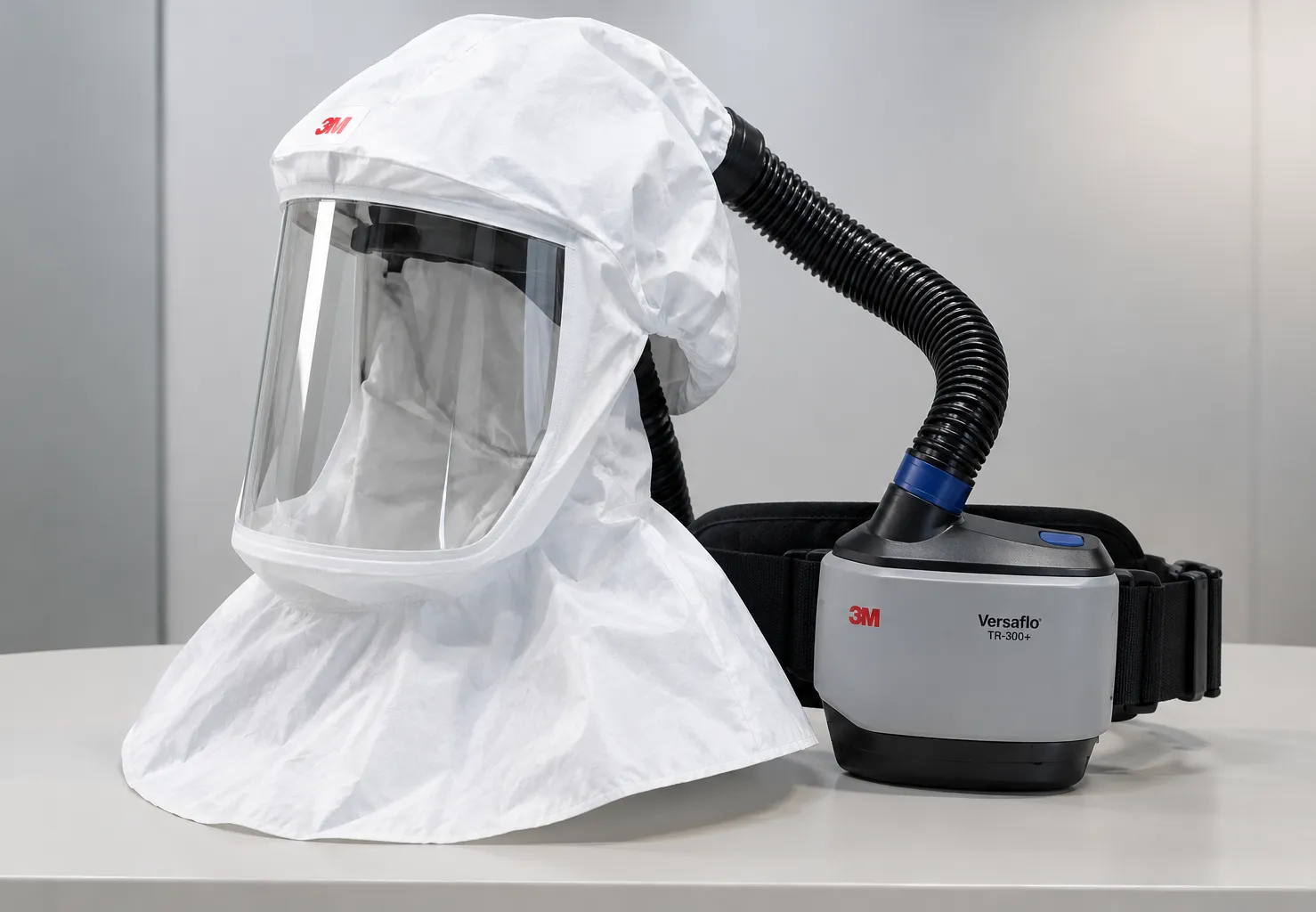
A powered air-purifying respirator (PAPR) protects the wearer against airborne particles by using a battery-driven blower to draw contaminated air through a high-efficiency filter and deliver clean air into a hood, helmet, or facepiece. Because the blower supplies more air than the wearer breathes, the headtop sits under slight positive pressure, so any leakage flows outward rather than drawing contaminated air in. This makes a loose-fitting PAPR a strong choice for protracted or high-exposure work, including aerosol-generating procedures, where a disposable respirator would be uncomfortable and depend entirely on a face seal.
For infection-control and procurement teams, a PAPR is a reusable system rather than a consumable. Blower, battery, breathing tube, filter, and headtop each carry their own specification and cleaning regime, and the assigned protection factor depends on the class of device. As the highest tier of respiratory personal protective equipment, it is specified against the same risk assessment as any other PPE. This guide explains how it works and what to pin down before ordering.
How a PAPR delivers clean air under positive pressure
The heart of the system is a motorised blower, usually worn on a belt, that pulls ambient air through a particulate filter of P3 (high-efficiency) grade and pushes it up a breathing tube to the headtop. The continuous flow — typically a manufacturer-defined minimum of around 120 litres per minute or more — keeps the space inside the hood at a pressure marginally above the surroundings. That positive pressure is the defining safety feature: because air escapes outward through any gaps, a poorly fitting or momentarily disturbed seal does not immediately let contaminated air reach the wearer, unlike a negative-pressure disposable respirator that relies on a tight seal on every breath. It is also a step beyond a simple surgical mask, which is a fluid barrier rather than a sealed, filtered respirator.
Hoods, helmets and loose-fitting facepieces
PAPR headtops come in loose- and tight-fitting forms. Loose-fitting hoods and helmets drape over the head and shoulders with a flexible face seal or shroud, admitting anyone regardless of facial shape or hair. Tight-fitting versions use a half or full facepiece that seals to the skin. The two are governed by different standards: loose-fitting powered hoods and helmets are certified to BS EN 12941 in classes TH1, TH2 and TH3, while powered respirators with a tight-fitting mask fall under BS EN 12942 in classes TM1, TM2 and TM3. In healthcare, the loose-fitting hood dominates because it removes the fit-testing burden and suits staff who cannot achieve a tight seal.
Assigned protection factor and the TH classes
The level of protection is expressed as an assigned protection factor (APF) — the factor by which the device reduces the wearer's exposure. In the UK, a loose-fitting powered hood classified TH3 to EN 12941 carries an APF of 40, while a TH2 device carries an APF of 20; a tight-fitting TM3 device also carries 40. By comparison, a disposable FFP3 filtering facepiece is assigned an APF of 20. These assigned protection factors are set out in the Health and Safety Executive guidance on respiratory protective equipment (HSG53), which any specification should follow. The higher the class, the lower the permitted inward leakage. When you specify a PAPR, confirm the exact class and the APF it delivers, because two hoods that look similar can offer very different protection depending on their certified class, and a device sold simply as powered may sit at the lower TH1 end of the range.
Why a PAPR needs no fit test
A loose-fitting PAPR does not require face-fit testing because it does not depend on a skin-tight seal. Its positive-pressure headtop protects by airflow, not by sealing, so protection does not collapse if the wearer has a beard, stubble, an unusual face shape,e or wears spectacles — all of which can defeat a disposable respirator. This is a major operational advantage: it removes the recurring cost and scheduling of fit testing, and it lets staff who repeatedly fail fit tests on tight-fitting respirators work safely. Wearers still need training on assembling, flow-checking, ng and cleaning the device, but the individual seal check that governs disposable respirators does not apply.
PAPRs during aerosol-generating procedures
PAPRs are valued for aerosol-generating procedures and other high-exposure work where staff spend long periods close to an infectious source. A hood is more comfortable over a long shift than a tight disposable respirator; it does not fog goggles because the flowing air clears the visor, and the higher APF of a TH3 device gives a larger safety margin. The system also integrates eye and face protection into one headtop, removing the compatibility problems that arise when a separate mask, goggles and visor must be worn together. These practical benefits, rather than filtration alone, are why many theatre, ENT and infectious-disease teams keep PAPRs available.
Specifying a PAPR
A PAPR is a system purchase, so the specification must cover every component and its lifecycle. Work through these points before ordering:
-
Confirm the device class and assigned protection factor — TH2/TH3 to EN 12941 or TM class to EN 12942 — against the exposure you need to control.
-
Check the filter grade and type, whether combined gas or vapour filters are required, and filter service life.
-
Verify battery run time on a full shift, charging time, spare-battery provision and any low-flow alarm.
-
Confirm the manufacturer's minimum design flow rate and how the wearer checks flow before use.
-
Choose headtop styles that suit your staff and integrate the eye and face protection they need.
-
Review cleaning, disinfection and decontamination guidance for reuse between wearers.
-
Assess spares availability — shrouds, visors, breathing tubes, seals — and the whole-life service cost.
Batteries, filters and running costs
Unlike a disposable respirator, a PAPR is bought once and run for years, so the recurring cost sits in consumables and upkeep. Filters are replaced on a defined schedule or when breathing resistance or exposure dictates; hoods, shrouds and visors are periodically renewed; and rechargeable batteries degrade and eventually need replacing. A flow indicator or calibrated flow meter should confirm the blower still meets its minimum design flow, since a failing battery or clogged filter reduces flow and therefore protection. Factor in cleaning materials, storage, charging infrastructure and a maintenance regime. Over a device's life these add up, but for staff who use respiratory protection frequently the cost per use can undercut a stream of disposables.
Cleaning and reuse between wearers
Because a PAPR is reusable and often shared, decontamination between wearers is central to safe use. The blower, tube, and headtop are cleaned and disinfected according to the manufacturer's instructions; filters are handled and stored to avoid contamination, and any single-use shroud is discarded. A clear, trained protocol prevents the device itself from becoming a transmission route, and a documented cleaning record supports infection-control audit. When comparing models, weigh how easily each dismantles for cleaning and whether wearable parts that contact the face are replaceable, because an awkward system to decontaminate will not be cleaned reliably in a busy department.
Choosing well: powered respirators.
A powered air purifying respirator delivers filtered air under positive pressure, giving comfortable, high-factor protection without the fit-testing dependency of a tight-fitting disposable — a real advantage for aerosol-generating procedures and long high-exposure lists. Specify around the device class and APF, filter and battery performance, and a practical cleaning regime, and cost the consumables over the device's life. MediGear supplies UK healthcare facilities with respiratory protection and infection-control equipment; register your requirements as a buyer or contact our team to match a PAPR to your clinical exposures.
Disclaimer
This article is for informational purposes only. It is published by MediGear (medigear.uk) for general information and procurement guidance, and is not clinical, diagnostic, treatment, technical, engineering, legal or regulatory advice, nor a product endorsement, guarantee or substitute for professional assessment. MediGear does not provide medical consultations. Buyers should consult their clinical, biomedical, estates and regulatory contacts, and the manufacturer's documentation, and independently verify all specifications, certifications, compatibility and suitability before purchase. Specifications, certifications and availability are correct at the time of publication and may change without notice. MediGear is a medical-equipment distributor and does not sell medicines or pharmaceutical products.